A heavy-duty repair shop can look busy and still be leaking money. The bay is full. Technicians are moving. Phones are ringing. Yet a used part never reaches an invoice, a technician's hour lives only in memory, and a fleet manager waits for an estimate buried beneath a clipboard. The truck gets fixed; the business around the truck does not. Fullbay built its company in that gap.
The Phoenix software maker is a system of record for independent commercial repair shops and in-house fleet maintenance teams. A repair request enters once. From there, Fullbay can assign a technician, track labor, manage parts, send an estimate for digital approval, keep the customer updated, collect payment and move the numbers to accounting. Owners get a live view of work in progress instead of an archaeological dig through paper.
This is vertical SaaS in work boots. The vocabulary is specialized - cores, units, DVIR defects, labor guides and preventive-maintenance intervals - because the customer is specialized. Fullbay serves shops repairing Class 8 trucks, trailers, agricultural and construction equipment, fire apparatus, ambulances, RVs and other equipment that earns money only when it is moving.
Scale figures are reported by Fullbay. They describe platform activity, not company revenue.
The odd idea that made perfect sense
Co-founder Jacob Findlay came from healthcare and accounting, not from a lifetime behind a diesel bench. His framing was disarmingly simple: trucks needed something like an electronic medical record. A vehicle has a history, recurring symptoms, prior procedures and scheduled care. Lose the record and the next diagnosis begins half-blind.
Findlay and David Hoover founded Fullbay in 2014. The first beta customer arrived in 2015. Inventory followed in 2016, along with a Canadian customer. That sequence matters. Fullbay did not begin by promising to reinvent transportation. It began by following one repair from complaint to payment and finding all the places information could fall out.
One record, six handoffs
The product's defensibility is not any one box in that diagram. Competitors can invoice, send a text or track a part. Fullbay's claim is continuity: each action updates the same operational record while integrations pull in QuickBooks accounting, MOTOR and Mitchell 1 repair data, Verizon Connect telematics, Whip Around inspections and other shop tools.
“My mom can stop doing that by hand.”Dylan Palardy, Top Dog Repair & Towing, on the accounting handoff
What failed first was not the truck
A recent Fullbay customer story gives the buying decision some grease under its fingernails. Top Dog Repair & Towing in rural Colorado had already moved to another shop-management platform. The software promised mobile access and a QuickBooks integration. The integration never properly arrived. Technicians still walked to a computer, while the back office kept doing work by hand.
That was the first failure: a promised handoff between systems. What changed owner Dylan Palardy's mind was not a dazzling feature. It was accumulated waiting. His team ran long road calls across Colorado, sometimes staying overnight near job sites. Mobile access was operational infrastructure. Duplicate accounting entry was a tax on every completed job. He returned to Fullbay because those two non-negotiables worked.
Equipment Experts in Washington tells the broader version. Its mobile technicians produced information in the field, but managers could not reliably see who was doing what or how long work took. After a year with Fullbay, the company reported a 20 to 25 percent increase in technician efficiency. That is a customer-reported result, not a universal forecast, but its mechanism is credible: fewer missing steps, less repeated entry and a shared view of each job.
Where visibility compounds
Indexed illustration of Equipment Experts' reported 20-25% technician-efficiency gain after one year. It is not an audited benchmark.
The price is published. The cost needs a calculator.
Fullbay sells subscriptions by shop and user. As of September 2026, Basic starts at $188 a month, Pro at $258 and Elite at $318. Each includes one full-user license. Additional users run from $89 to $119 per month, depending on tier. Plans use annual agreements with monthly billing; larger operations receive enterprise pricing. Integrations can require their own subscriptions, and text messages beyond plan allowances cost five cents each.
The base number is therefore an appetizer. A ten-user Elite setup has a very different bill from a one-person mobile shop. Buyers should price the actual roster, locations, message volume, migration and required data providers. Then compare that fully loaded figure with hours recovered, missed parts captured, time-to-invoice and administrative payroll avoided. If the seller will not model those inputs with the buyer, the demo is unfinished.
Twenty million records become a prediction engine
For its first decade, Fullbay mostly helped shops document what had happened. In March 2026, it acquired Toronto-based Pitstop to work on what happens next. Pitstop analyzes telematics, fault codes and maintenance patterns to identify failures before a breakdown. Fullbay says Pitstop has identified potential failures with greater than 94 percent accuracy in large-fleet use. Combining that engine with Fullbay's repair history could automatically create prioritized service requests, forecast parts demand and give fleets unit-health reports.
The ambition is a sensible extension of the original medical-record metaphor. A chart is useful after treatment. It becomes more valuable when history reveals risk early enough to intervene. The hard part will be data quality. Incomplete notes, inconsistent part names and fleets without connected telematics weaken the signal. Prediction also has an awkward economic test: customers must trust an alert enough to schedule maintenance before a visible failure.
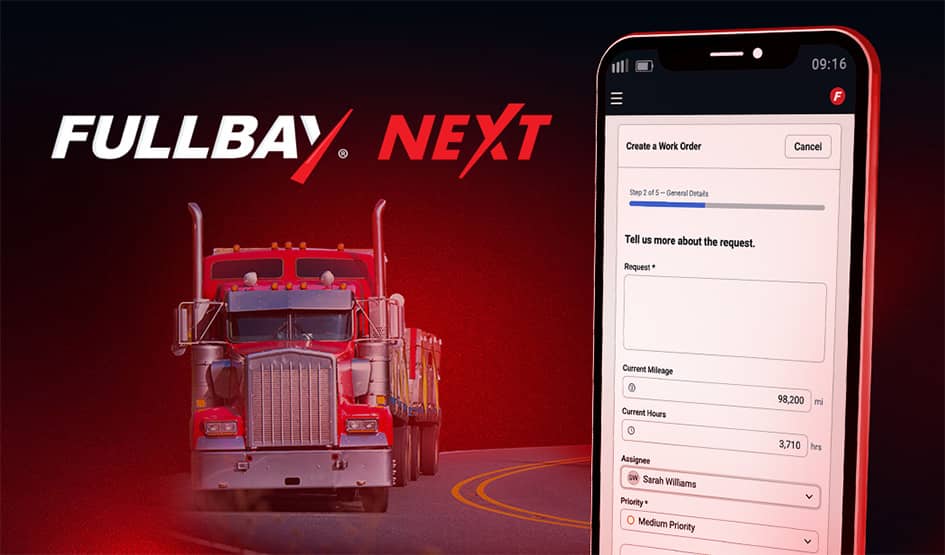
August brought the larger reset. Fullbay Next is a new mobile-first, multilingual platform, not a cosmetic reskin. It starts with solo operators, small shops and mobile repair businesses, with larger operations due in later phases. A technician gets a stripped-down Wrench mode, work moves across a Kanban board, and a Quick Work Order can be drafted in seconds. Voice notes become cleaned-up documentation; photos attach to jobs and can be reviewed by AI.
There is also Spike, an assistant inside the product, and Claudia, a 24-hour phone receptionist configured with a shop's hours, services, pricing and frequently asked questions. Claudia collects callers' details and emails a summary. Fullbay says one early pilot generated more than $1,200 a week in repair orders. Useful, if narrow: the assistant catches demand when a small team has both hands under a truck. It does not diagnose the truck or replace the service manager's judgment.
A specialist in a crowded garage
Fullbay competes with shop platforms such as Shopmonkey, Tekmetric, AutoLeap and Shop-Ware; repair-information vendors such as Mitchell 1 and ALLDATA; and fleet platforms including Samsara, Motive and MaintainX. Its advantage is depth in heavy-duty work. Fleet approvals, long mobile jobs, unit histories, core returns, preventive maintenance, parts markup and technician utilization sit near the center rather than on the edge.
That same choice creates the boundary. A mixed light- and heavy-duty operation may prefer broader vehicle coverage. A tiny shop with simple jobs may not recover enough value to justify per-user pricing and an annual term. A team unwilling to standardize how technicians record time, parts and notes will merely move its disorder onto a brighter screen. Predictive maintenance is especially weak without clean service histories and connected vehicle data.
Conditions that help
- Complex, multi-step repairs
- Mobile technicians or several bays
- Parts and labor leakage worth recovering
- Fleet customers needing approvals and history
Conditions that fight it
- Simple, low-volume work
- Mixed shops needing light-duty breadth
- Weak process discipline or dirty records
- Teams avoiding annual and per-seat costs
The playbook hiding in the bay
Fullbay's most copyable lesson is not “add AI.” It is the order of operations. Start with a narrow industry where coordination errors are expensive. Map the entire revenue event, not one attractive feature. Integrate the systems customers refuse to abandon. Use customer support and an industry conference to keep the feedback loop close. Only then turn accumulated workflow data into automation and prediction.
- Choose an expensive mess. Handwritten work orders and invisible labor are annoying because they cost money.
- Own the complete handoff. The value runs from request to paid invoice, not from dashboard to dashboard.
- Keep the installed tools. Accounting, labor guides and telematics become integrations, not enemies.
- Earn structured history. A decade of useful records can support products a new entrant cannot quickly copy.
- Automate the clerical edge. Clean a note, capture a call, flag a failure. Leave judgment with the technician.
Fullbay's next test is execution across two time horizons. It must keep today's shops invoicing while migrating a decade-old product into Fullbay Next. At the same time, it must prove that predictions built from aggregate history improve the fate of an individual truck. That is less cinematic than autonomous vehicles. It may be more immediately useful. A truck that never gets stranded does not make news. It makes its delivery.