Late in a truck driver’s shift, a parking space becomes more than painted asphalt. It becomes the border between a clean finish and a frantic search, between productive miles and a clock running down. Chris Oliver has spent much of his career in transportation technology studying moments like this: ordinary on paper, expensive in practice, and largely invisible to anyone whose vehicle fits beneath a downtown garage.
Oliver is chief marketing officer at Phoenix-based Trucker Path, but the title understates the shape of his job. He leads new-line-of-business initiatives. He created the company’s in-app Marketplace. He has helped present dispatching, fuel savings, roadside support, routing information and freight tools to a community the company counts at more than one million professional drivers. The work sits where marketing, product strategy and operations overlap, a junction with no tidy lane markings.
His recurring idea is almost stubbornly plain: start with drivers. Ask what wastes their time, what complicates their work and what would make a hard day slightly easier. Then give those answers a product form. In an industry fond of dashboards, Oliver’s useful instrument may be the open ear.
A marketer with road dust on the brief
Oliver’s route to Trucker Path runs through several generations of freight technology. His public biography names PrePass, Zonar and Cargomatic among the brands where he led sales, marketing, growth or development efforts. They form a concise history of the industry’s digital turn: automated highway services, connected fleet systems, on-demand freight matching and, eventually, a mobile platform carried in the cab.
At Zonar, where he spent years building marketing and sales capabilities, the context was the heavily regulated, fiercely practical world of fleet operations. A former colleague, Andrew Johnson, remembers Oliver developing the brand through coordinated advertising and media while expanding a modest sales department into inside, outside, regional and national teams. The telling detail is structural. Growth had to acquire an organization, not merely applause.
In 2019, Oliver joined Cargomatic as CMO during a reconstruction of its executive team following a $35 million Series B financing. The local-freight marketplace was trying to bring startup speed to drayage, local less-than-truckload and white-glove delivery. Oliver described the executive group in terms of urgency, industry fluency and kindness. Even in a release about corporate architecture, he made room for manners. Logistics can be abrasive enough without executives contributing extra friction.
A career built along the freight-tech stack
Selected public milestones, from fleet systems to a driver-centered marketplace.
The second trip to Trucker Path
Oliver’s current Trucker Path chapter is also a return. Before being named CMO in 2021, he had served the company as chief business officer and led development of its strategic plan. Returning with experience from Cargomatic gave him an unusually broad view: the driver looking for a safe stop, the owner-operator pricing a load, the broker searching for capacity and the fleet office trying to see the same trip from a desk.
The company’s “driver-first” phrase can sound like ordinary corporate varnish until Oliver begins supplying the small nouns. Parking. Fuel. Check calls. Dock entrances. Paperwork. Weigh stations. The inconveniences are specific because the user is. A consumer map can suggest a road; a truck-routing product must know height, weight and turn restrictions, then understand that arrival is only useful if a forty-foot vehicle can find the proper gate.
“Trucker Path has always developed solutions by starting with drivers and identifying their needs first.”Chris Oliver, 2021
That philosophy became visible at the Mid-America Trucking Show in Louisville in March 2022. Standing before the press in a blue quarter-zip and company lanyard, Oliver announced Trucker Path Dispatch. The service paired technology with a personal dispatcher who could learn a driver’s preferred lanes, commodities and working habits, source loads, negotiate rates, handle status calls and move documents. The fee was five percent per booked load, without a long contract or subscription.
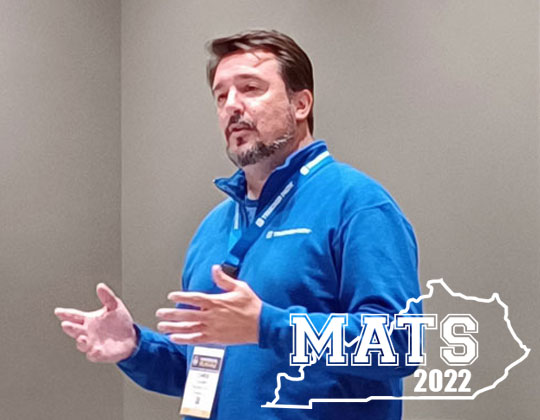
The model was part concierge, part control tower. Oliver described dispatchers as a human conduit to the company’s technologies. That choice matters. A product can make an operator feel automated out of the picture; a familiar voice can make the same system feel like assistance. Technology performs the rapid search while a person remembers that a driver prefers a particular lane, needs to get home or knows a worthwhile restaurant off the route.
Minutes are an operating currency
Oliver’s clearest arguments often reduce large industry problems to time. He has observed that saving a driver even 15 minutes can signal that a carrier understands the job. He has also estimated that searching for parking consumes eight to ten percent of a driver’s potential daily productivity. Once the clock is visible, a feature request becomes an economic case.
Parking is especially revealing. Drivers operate under hours-of-service limits, while available spaces thin out late in the day. A detour to a full lot wastes fuel and legal drive time, then sends the driver toward another uncertain dot on the map. Trucker Path’s community reports availability in real time. Each update helps the next driver, who can return the favor farther down the road. Oliver has called the relationship between platform and driver base “symbiotic,” a biological word for a very mechanical world.
The signals have multiplied. In 2025, Trucker Path added nationwide DOT 511 feeds covering road conditions, closures, crashes and construction. At the WEX OTR Summit that autumn, Oliver pointed to predictive parking analytics as an immediate use of artificial intelligence. The useful future is less science fiction than good timing: a better estimate of where a space will exist when the truck actually arrives.
By 2026, his AI conversations had extended into the travel center. Serving on the NATSO Foundation Technology Steering Council, Oliver joined a panel about practical automation in truck-stop operations. His sharpest image concerned cameras that could interpret what they saw, noticing an overflowing bin or a spill and prompting a response. Cleanliness is hardly a glamorous AI demo. It is, however, something a tired customer notices immediately.
Can the idea save a driver time, remove an operating chore, lower a cost or make a stop more predictable? If the answer is vague, return to the customer.
The marketplace is the message
Oliver’s remit widened as Trucker Path gathered services around its core app. The Marketplace he created has carried fuel savings, roadside help and business services. Trucker Path Deals, announced in May 2025, placed trucker-oriented products and offers in an online market. Each addition followed the same logic: drivers were already using the app to navigate the working day, so adjacent help should require fewer new accounts, searches and detours.
This is marketing expressed as distribution. A useful service enters through a product people already open, then earns attention by reducing expense or hassle. The brand grows because the utility grows. Oliver’s education helps explain his comfort with the arithmetic. At the University of Toledo, he combined marketing, finance and international management in one B.B.A. The creative brief arrived with a spreadsheet tucked inside.
He applies the same financial plain speaking to owner-operators. In a 2022 discussion about managing a freight downturn, Oliver began with costs: truck payments and fuel, certainly, but also insurance, maintenance and the many items that hide around them. He argued for durable relationships with shippers and brokers, the sort built by becoming the person trusted to get the job done. His stated ambition was larger than booking the next load. He wanted to help drivers become better businesspeople.
“How do you know if you’re making any money if you don’t understand what your costs are?”Chris Oliver, 2022
The advice doubles as a portrait of its author. Oliver operates comfortably between the emotional and measurable parts of business. Former colleagues describe him as smart without being diminishing, able to make people at different levels feel heard. His own professional summary adds a parenthetical flourish: energetic leader, mediocre golfer. Trucker Path’s biography supplies two more off-duty coordinates, food and family. The golf joke is efficient personal branding, though perhaps he would object to calling it that.
A clear road is made of details
The most interesting thing about Oliver’s body of work is its refusal to separate brand from behavior. If Trucker Path says it starts with drivers, its product must remember where they can fuel, whether the weigh station is open, how they should enter the dock and where a legal parking space may remain. The promise succeeds or fails one ordinary interaction at a time.
That is also why crowdsourced rankings matter. Trucker Path’s annual truck-stop list turns millions of ratings into recognition for facilities that drivers value. The 2025 list drew from more than 9,000 truck stops and roughly 10,000 additional fueling locations in the app. The applause follows the data, and the data comes from the cab.
Oliver’s next road appears to run through prediction and voice. Systems can combine weather, construction, vehicle constraints, average speeds and parking patterns. Voice controls can let drivers query those systems with less attention diverted from the windshield. Yet his public comments suggest that the technology will be judged by an old standard: does it respect the person doing the work?
The answer will rarely arrive as one spectacular invention. More often it will look like a better entrance, a shorter search, a load that fits, an expense avoided or a clean place to stop. Transportation is full of grand networks held together by modest decisions. Chris Oliver has made a career in those decisions, listening for the snag in the driver’s day and asking software, services and partners to smooth it out.