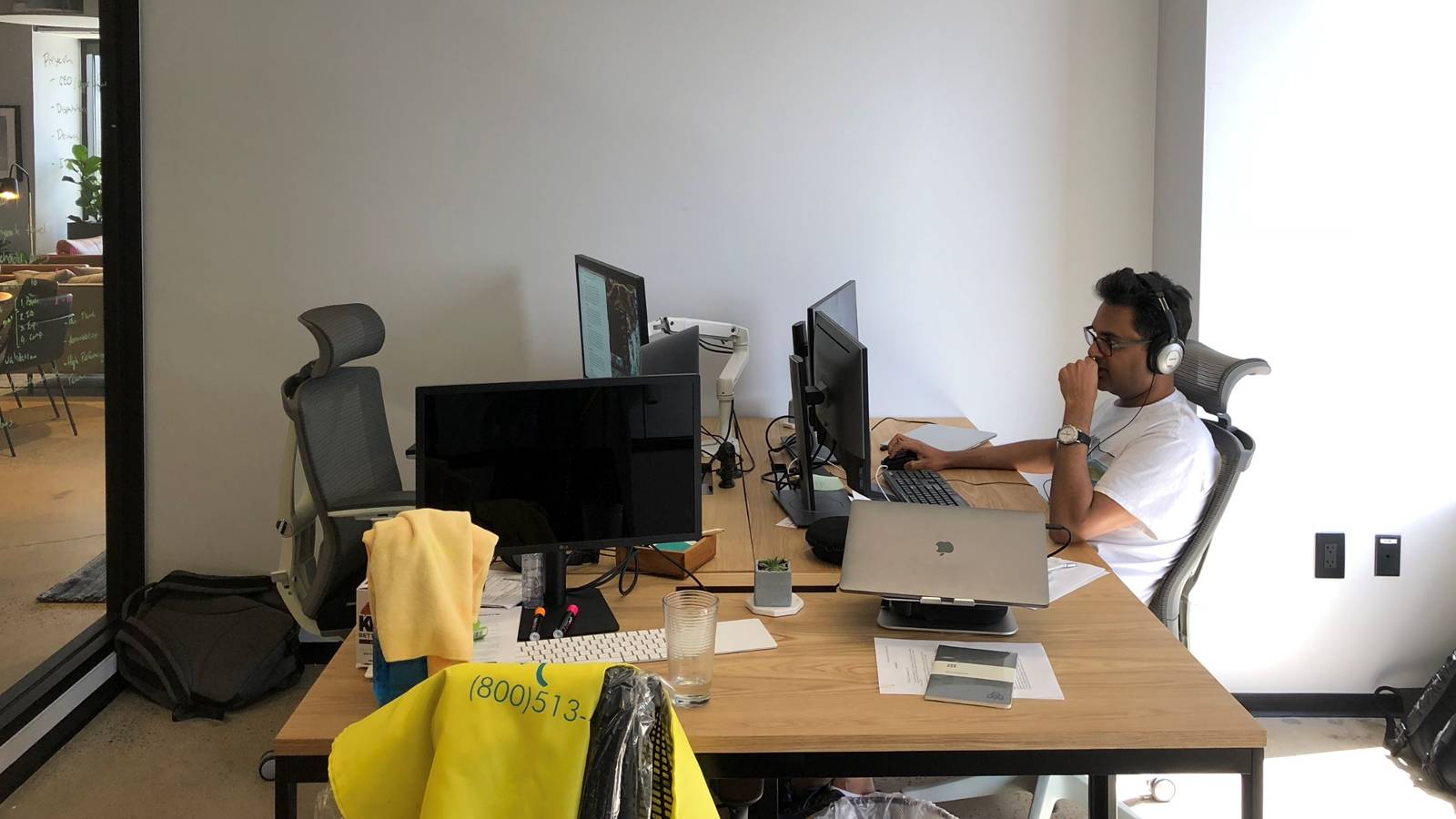
In a photograph from 2018, Priyesh Ranjan sits at a desk wearing headphones, his hand close to his mouth, surrounded by screens. A laptop rests on a stand. Cables gather beneath the monitors. Through the glass wall, a whiteboard is visible. It is an ordinary office scene, which is part of its charm. A company proposing to reorganize the movement of goods has started with the familiar business of finding room for another computer.
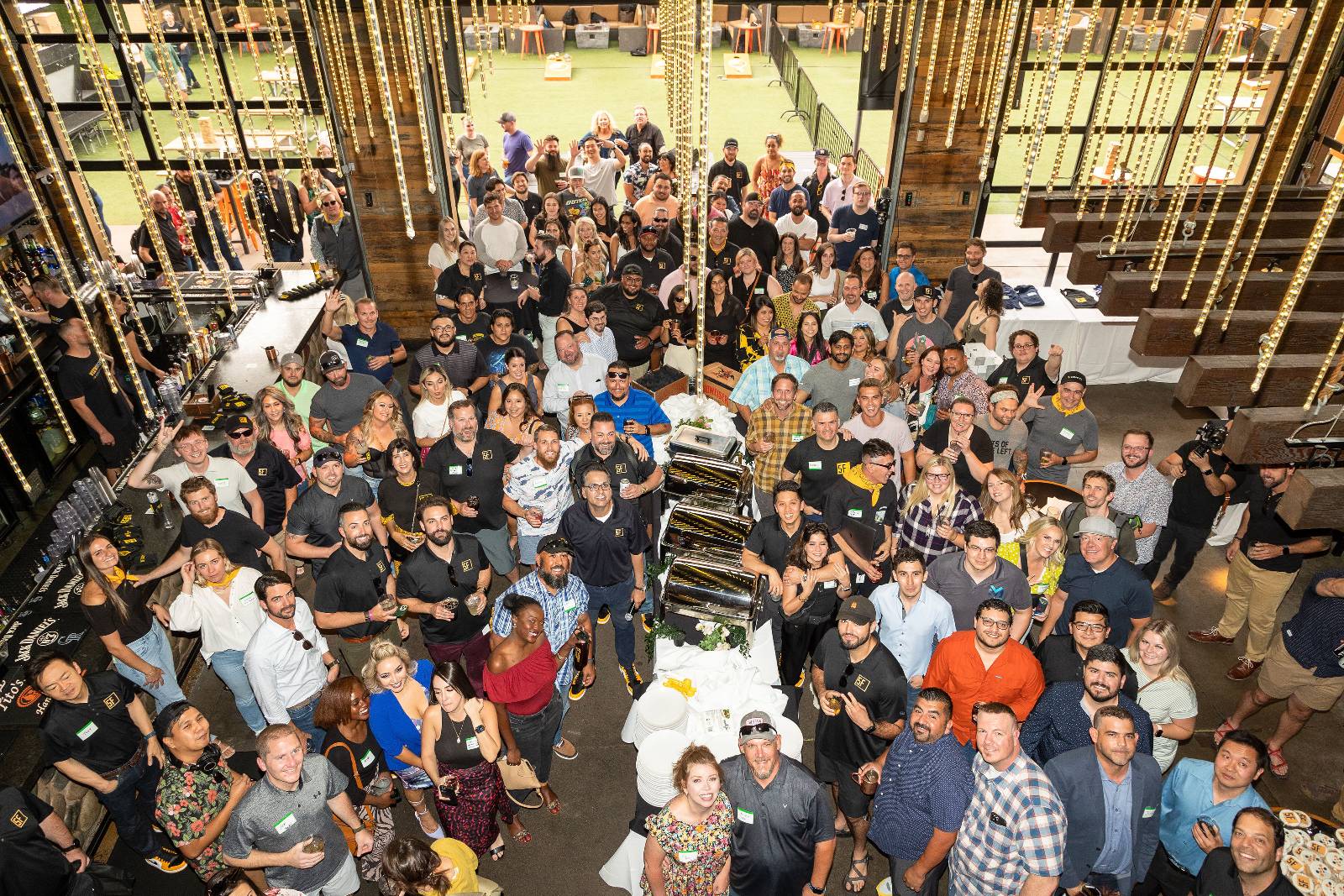
Vorto says that office held its entire four-person company. By its fall 2022 town hall, it counted more than 300 people. Put the two photographs together and the room seems to expand before your eyes. Yet the more revealing expansion happened in Ranjan’s definition of the problem. He wanted truck drivers to spend more of their working time carrying freight. Eventually, that meant reconsidering decisions made well before a driver turned a key.
The first answer was too small
Ranjan’s account of the early business includes a conspicuously unceremonious decision. Vorto had been a transportation management software company, concerned with driver utilization and efficiency. The team came to believe that approach could not address the connected choices governing a shipment. Procurement, appointments, carrier selection and dispatch all mattered. Improving one part would leave the others free to spoil the result.
“So, we shut the company down and we started a new platform,” he recalled in a September 2022 interview. The replacement brought procurement and logistics together. The sentence has none of the careful upholstery that usually surrounds a corporate change of direction. He describes a solution that proved insufficient, followed by a decision to build a broader one.
That is a useful place to begin understanding him. A founder can become attached to the thing already built: the software, the sales explanation, the category that makes the company legible. Ranjan’s telling gives priority to the original question. If drivers were still losing productive hours, a more polished version of the same tool would leave the essential disappointment intact.
Consider the ordinary logic of a purchase. A buyer finds an attractive price. Someone else arranges transport. Someone else discovers when the supplier can load. Every decision can be defensible in its own little jurisdiction. The combined journey may still be expensive. Freight has a talent for turning departmental competence into collective inconvenience.
An engineer enters the loading queue
Ranjan came to this work through industrial technology. An electrical engineer educated at the University of Oklahoma, he held leadership positions at Halliburton and Baker Hughes across strategy, business development, technology solutions and operations. His work included digital oilfields and monitoring assets. His professional biographies also credit him with patents and publications in digital energy.
Those details locate his career in a world where software has physical consequences. A decision travels beyond a screen into equipment, raw materials, people and schedules. In that setting, a handsome chart can be perfectly accurate and arrive too late to be useful. The attraction of automation is partly the prospect of closing that gap between knowing and acting.
In his 2021 writing about supply chains, Ranjan described managers confronting more changes than they could quickly process. His proposed alternative gave software the ability to make adjustments: purchase materials, revise allocations and reroute trucks. The ambition was to let managers devote more attention to longer-term planning while machines handled the incessant rearranging.
His colleague Sam McLaughlin, Vorto’s chief product officer, developed a related argument in 2022: visibility tools could collect information while leaving people to reconcile a moving network of suppliers, buyers and carriers. A disruption could change again before a response was implemented. Seen together, their arguments explain the company’s impatience with software that merely supplies another place to look.
- 01Anticipate demand
- 02Choose supply
- 03Coordinate pickup
- 04Dispatch freight
The arithmetic of an empty return
The human consequence appears in Ranjan’s writing about independent trucking. In September 2022, he described small operators facing expensive equipment, rising fuel bills and administrative chores that consumed time without moving freight. Load selection, insurance verification, carrier setup and contracts all competed for attention. A working day could be full without being sufficiently productive.
He argued that the familiar discussion of a driver shortage overlooked poor utilization and inconsistent income. That was his diagnosis of the industry, with direct implications for the business he was building. Attracting people to trucking would be harder if the available work continued to come wrapped in unpaid waiting and uncertain next loads.
There is a peculiar unfairness in an empty return journey. The truck still needs fuel. The driver still spends time. The distance remains stubbornly real, even when the revenue has disappeared. Any proposal to improve that situation has to reach beyond an individual load and consider what can happen before and after it.
Ranjan’s explanation of 5F, Vorto’s trucking platform, put different participants into the same network: shippers and brokers with volume, owner-operators with trucks, asset owners, maintenance infrastructure and drivers. The attraction of that arrangement is straightforward. A small operator cannot personally maintain relationships with every potential customer. A shared network can widen the available combinations.
The economic aspiration is appealing because it allows two parties to want different things without requiring either to lose. A shipper wants dependable capacity at a manageable price. A driver wants enough productive work to earn a living. Reducing wasted time creates room for both. Whether it succeeds has to be judged in the actual working day, where a missed appointment is considerably more persuasive than a sales presentation.
Seven days to a decision
Inside Vorto, Ranjan applied a comparable impatience to recruiting. In August 2021, he described a hiring process that took seven days or less. Candidates completed technical assignments and two to four interviews in the same week, then heard back within 24 hours. Interviewers had backups so that one person’s calendar did not stop the process.
He said the team had grown from 20 to about 150 in ten months. The numbers were a snapshot of an expanding organization, rather than a current headcount. More interesting was the mechanism: candidates were assessed on their own fit, without waiting for a comparison against a queue of other applicants.
“We trust our teammates’ decision-making abilities,” he said. In a business devoted to shortening delays, that is a revealing management choice. Permission can become another queue. Trusting interviewers enough to let them proceed removes one, although it also makes the quality of their judgment matter more.
“We trust our teammates’ decision-making abilities.”
Priyesh Ranjan, 2021
Speed had a demanding companion. Vorto’s 2022 culture essay emphasized ownership, comfort with ambiguity and the expectation of hours beyond a conventional working week. It called its recruits “Pioneers” and even presented its expectations as “Nutrition Facts.” The packaging was playful; the demands described underneath were substantial. This was an employer making a fairly explicit offer about the kind of effort it expected.
That combination complicates the easy portrait of a founder who simply wants everything faster. Ranjan’s public management philosophy ties pace to responsibility for an entire outcome. The question for such a company is how to preserve that ownership as more people arrive. A four-person office makes shared understanding easier. A larger organization has to build it deliberately.
A wider circle around the same problem
As Vorto pursued more industries, Ranjan also assembled experience from outside the company. In December 2024, it announced advisers with backgrounds at businesses including Beam Suntory, Coca-Cola and Amazon. The mix reflected a practical need: a supply-chain platform has to make sense inside companies with different goods, habits and commercial relationships.
An April 2025 announcement added eight more executives, including former UPS US operations president George Willis and former Clorox chief supply chain officer Rick McDonald. Vorto described expansion across building materials, consumer goods, food, packaging and retail. Ranjan said he wanted to extend the technology’s use cases across industries. The circle of advisers was becoming a map of the places the company hoped to work.
The same release reported annual user savings exceeding $510 million. Figures on that scale can make a founder’s story drift into abstraction. The more useful test stays close to the original desk: what decision changed, whose time was recovered, and what happened to the cost of delivering the goods? Those questions explain the work more clearly than the size of the headline number.
Ranjan’s public story follows an unusual resource: time that already exists but is being badly used. A loading delay, an empty leg and an interview waiting for a calendar slot are different problems. Each gives him something concrete to question. In the 2018 photograph, the monitors are crowded together and the room is small. The work ahead is to make fewer people spend their day waiting for the next thing to happen.