Spencer Penn helped launch a car that could change how people drove. What stayed with him was the email. At Tesla, the business of getting physical parts into the Model 3 involved spreadsheets and conversations that could run to hundreds of messages. The future of transport had arrived with an attachment.
There is a particular indignity in making an ambitious machine depend on ordinary office administration. A drawing changes. A price needs checking. Somebody has the answer, somewhere. Penn worked close enough to engineering's finances to see how these small delays met the very large demands of bringing a car to market. Eventually, he made that frustration his own business.
Today he is co-founder and chief executive of LightSource, which builds procurement software for the materials and components manufacturers put into their products. His path runs through Tesla, Harvard and Waymo. The thread connecting them is a practical question: how do you get a complicated physical thing built when the people responsible are working from different versions of reality?
A car with a price to meet
Penn joined Tesla in 2015 and left in 2018. His work covered the financial and business operations of engineering, including labor costs and the bill of materials, the list of components needed to build a product. On the Model 3, those numbers had to accommodate a planned $35,000 base price and a three-year development schedule.
Those constraints give his procurement story some weight. Buying a component was part of a larger equation involving design, timing and cost. A good price arrived too late could still be a bad outcome. An engineering decision that seemed settled could require another conversation with a supplier. Penn's vantage point was where the engineering ambition met the arithmetic.
Moving west had itself required a decision. Born in Manhattan, he went to the Bay Area to join an electric-car company that people around him regarded skeptically. He wanted to work on next-generation hardware with an environmental purpose. He arrived before the Model 3's launch, when building a mass-market electric vehicle remained an undertaking with plenty left to prove.
The experience gave him an unusually concrete starting point for a software company. He had watched the work happen. He also knew how easily the work could disappear inside a chain of messages. The car was visible; the coordination behind every part was harder to see.
Cost and timing had to meet in the same vehicle.
The class that kept going
Before Tesla, Penn studied at the University of Pennsylvania's Wharton School and pursued a master's in robotics. Later he joined the inaugural cohort of Harvard's joint MS/MBA program in Engineering Sciences, the class of 2020. Business and engineering were already sharing space in his education, much as they would in his company.
At Harvard, he used a startup project to investigate the procurement problem. The useful discovery was its familiarity elsewhere. Conversations with other companies suggested that the reliance on email and spreadsheets extended well beyond one carmaker. What had looked like a local irritation began to look like a business worth pursuing.
He subsequently worked at Waymo, leading its simulation organization. His eventual co-founder, Idan Mintz, brought experience from Google and Google X. Their backgrounds joined an operator's understanding of a manufacturing problem with the technical work required to build a shared system around it.
LightSource was founded in 2021. Its premise can be expressed without much software vocabulary. Engineers need to describe what a product requires. Buyers need to find suppliers and compare offers. Suppliers need enough clear information to quote and deliver. A company benefits when those activities remain connected as the product changes.
The spreadsheet gets a speaking part
The company has an origin anecdote that is almost too obliging. During its first funding negotiation, Penn and Mintz were on a call while working together in a Google Sheet. They used the cells to exchange messages as they modeled the deal. A stretch of roughly 30 cells became a makeshift conversation.
When Penn asked whether they should proceed, Mintz typed: “close it dude.” They did. It is an entertaining detail from a company devoted to improving business coordination: even its founders found an improvised use for a spreadsheet. The episode also gives their partnership a recognizable texture, two colleagues moving quickly in the same document.
That is a more human foundation than the usual founding myth of a solitary revelation. Penn had a problem he understood, a partner with complementary experience, early customers and investors willing to back the effort. Conviction accumulated through those relationships. Leaving established jobs became a decision they could take together.
“close it dude.”
Idan Mintz's message to Penn during their first funding negotiation
By March 2025, LightSource had a much more public financial milestone. It announced $33 million in seed and Series A funding at a $130 million valuation, with Lightspeed Venture Partners and Bain Capital Ventures co-leading and J2 Ventures participating. The valuation belonged to the company; the task ahead remained selling and delivering the software.
At the time of the announcement, Bain Capital Ventures described more than $1 billion in spending processed through the platform since 2024 and more than 1,100 awarded sourcing projects and events. These were reported platform figures, an early indication that the founders' problem had traveled beyond their own experience.
A New Yorker on the exchange floor
In 2025, Penn joined Judy Shaw for NYSE FloorTalk. The setting offered a pleasing return journey for someone born in Manhattan: a founder from the Bay Area walking the New York Stock Exchange floor beneath screens carrying his company's name. In his own public reaction to seeing those screens, he sounded delighted.
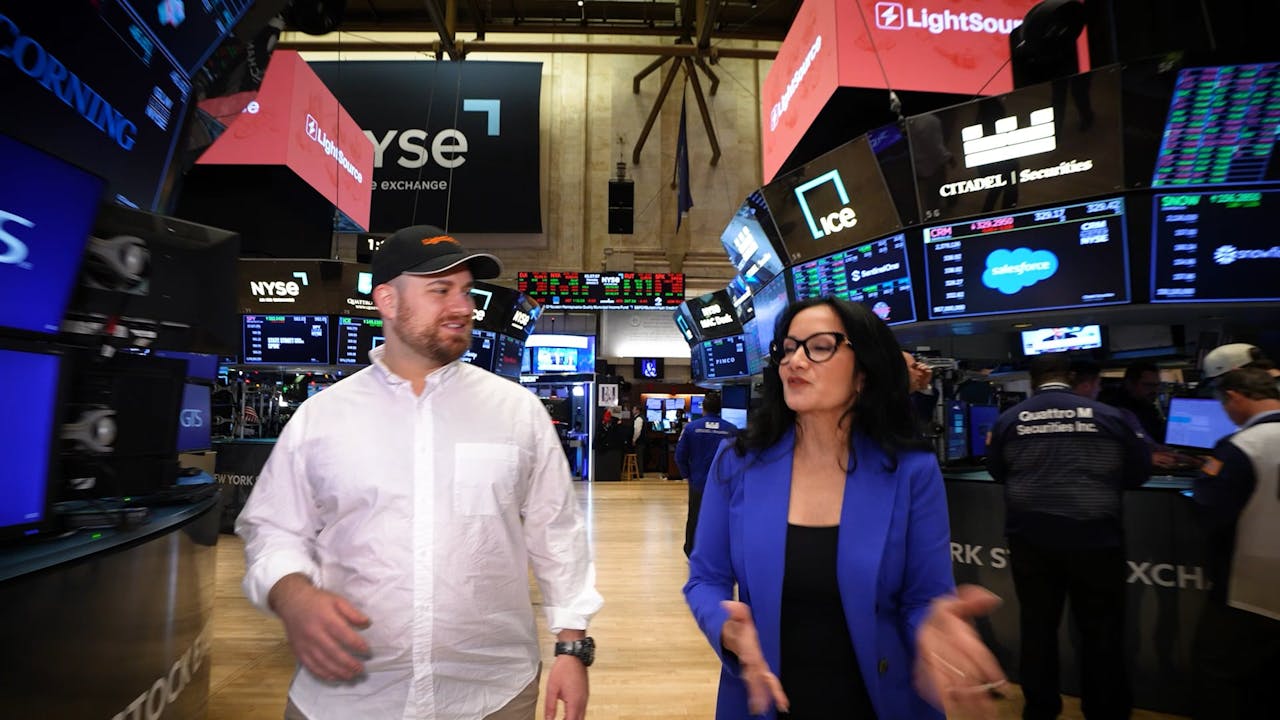
The subject under discussion was less ceremonial. Trade uncertainty and tariffs were making sourcing decisions more complicated. Manufacturers had reasons to revisit where parts came from and what alternative arrangements might cost. Software promising a clearer view of suppliers had a timely conversation to join.
Penn has become a regular participant in that conversation, appearing in procurement interviews and on podcasts about manufacturing and technology. His explanations tend to make an unfamiliar function legible through familiar systems. Salespeople have tools for managing customers. Procurement teams, on the opposite side of the transaction, need tools for managing the work of buying.
The elective hiding in the business plan
One of Penn's more revealing stories concerns a university course. During his robotics master's at Penn, he enrolled in a controls class with Bruce Kothmann largely because it fit his schedule. He says it changed how he saw systems. A convenient timetable choice turned into an intellectual habit.
In his June 2026 writing, that habit shows up in his approach to procurement. A system has a target, a way to measure what happens, and a way to correct its course. If a purchasing team checks its results infrequently, costs can drift before anyone responds. Better information matters partly because it makes earlier action possible.
It is an engineer's way of looking at administration. Penn connects the behavior of a vehicle's controls to the behavior of a purchasing organization. The analogy suits a career spent around cars and software: both depend on receiving useful signals in time to do something about them.
He also places limits on the enthusiasm for automation. Faster reactions need reliable data and appropriate permissions. A system that responds to every small change can create trouble of its own. His argument leaves room for human judgment, especially where supplier relationships and consequential decisions are involved.
Give the buyer a better day
Penn's writing about AI adoption is similarly concerned with sequence. He asks procurement leaders to gain experience using the tools themselves, then build the organizational foundations, and only afterward consider changes to how teams are structured. Familiarity should precede major decisions about a technology's role at work.
That position reflects the audience he is trying to persuade. Procurement professionals already have expertise in materials, negotiations and suppliers. Learning a new application is an additional demand on their time. The software has to earn that time back through work it actually handles: organizing requirements, comparing quotes or keeping a sourcing process moving.
By September 2026, Penn was describing LightSource's goal in terms of helping customers bring products to market faster at competitive prices. He also expressed an eventual ambition for a public listing. For now, the company is pursuing the less glamorous work between a product specification and a finished item.
There is an appealing consistency to that choice. Penn went west to help build a new kind of car, studied business alongside engineering, and returned to the coordination problem he had encountered on the way. The Model 3 had given him a close look at what manufacturing required. His company is an attempt to make some of those requirements easier to manage.
It is possible to spend an entire career admiring the finished machine. Penn became interested in the messages that had to be answered before it could exist. Somewhere between the drawing, the quote and the revised spreadsheet, he found work he wanted to keep doing.