Aatish Dedhia did not set out to spend his working life thinking about procurement. His team had software that could classify information from the internet. During a pitch, a venture capitalist asked whether it could do the same thing with procurement catalogues. Dedhia knew little about the business of corporate buying. He went back, investigated, tried a proof of concept with a customer, and found a direction that would occupy him for decades.
It is a pleasingly unceremonious beginning for an enterprise software company. No sudden revelation about the future of commerce was required. Someone asked a useful question about an existing piece of work. The answer became Zycus's route into procurement in the early 2000s, and a recurring idea in Dedhia's career: pay close attention to the job people are already struggling to finish.
Procurement has an image problem. Buying things sounds straightforward until a company has to establish what it bought, which division bought it, what the supplier called it and whether another division paid less. A catalogue can contain the raw material for a financial decision while making that decision infuriatingly difficult. Dedhia's early opportunity lay in helping a machine make sense of those descriptions. There is a certain satisfaction in discovering that a grand corporate problem begins with untidy nouns.
Before the purchase order, a processor
Dedhia's training was in electrical engineering. He graduated from IIT Bombay in 1990 and went on to Cornell University for a master's degree. At Intel in the United States, he worked on the core design team for the Pentium II processor. His early engineering record includes a patent assigned to Intel for reducing power usage within a domino logic unit, filed in December 1995 and granted in March 1999.
That work belongs to a different scale from the purchase orders and supplier contracts he would later discuss on conference stages. At the circuit level, unnecessary activity has a physical cost. In a purchasing department, it costs time and attention. The resemblance is an interpretation of his career, rather than a philosophy he has claimed, but it helps explain its continuity: an engineer keeps finding work that could be arranged more intelligently.
Zycus Infotech was incorporated in September 1997. The procurement chapter developed later. An early customer, GE, wanted to organise spending information from across its group companies. Dedhia has described a small team unwilling to turn the task into a labour-intensive service. Could software do what people were doing by hand? Their classification technology offered a way to tackle the problem repeatedly, without treating each new pile of data as an invitation to hire another pile of people.
- 1990Electrical engineering
IIT Bombay - 1990sProcessor design
Intel - Early 2000sCatalogue classification
Procurement - 2018Merlin AI
Zycus
A machine needs something useful to do
The early classification product was called AutoClass. It gave Zycus a practical application for machine learning well before the current enthusiasm for generative AI. Dedhia has described the original approach with an unusually serviceable image: “It was not a hammer in search of a nail.” The customer had troublesome data. The team had a possible way to organise it. The value depended on whether that combination worked.
His later product ambitions widened. Zycus developed software across sourcing, contracts, suppliers and payments, and launched Merlin AI in 2018. Its current leadership description puts Dedhia in charge of a company pursuing connected procurement workflows through its Merlin Agentic Platform. The vocabulary has changed considerably since catalogue classification. The underlying commercial test remains familiar: does the software help the buyer finish a worthwhile task?
Consider the space before an employee even reaches a purchasing system. A request may begin in an email or a call, with someone explaining what they need and someone else working out what happens next. Dedhia's intake-to-outcomes argument starts there. He wants the request, the purchasing work and the eventual result treated as a connected sequence. A neatly managed transaction offers limited comfort to an employee still wondering where their request has gone.
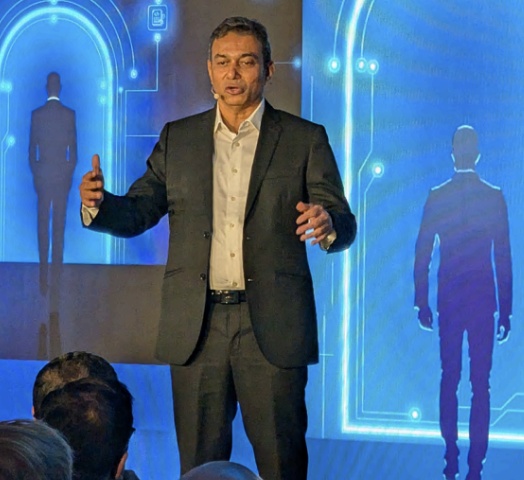
The trouble with a very obedient machine
By September 2026, Dedhia was discussing that next phase with Philip Ideson on The Agentic Procurement Diaries. Their conversation included a customer whose process required approval for everything above $500. Adding AI did not make the rule more sensible. The software followed it. His warning was blunt: “You cannot put technology on a broken process.” Bureaucracy, given a faster assistant, can become remarkably punctual.
He also acknowledged a product lesson: individual AI helpers scattered through a software suite had failed to produce the returns customers wanted. His emphasis moved towards coordinated flows that begin with a desired result and organise the necessary steps. That is a consequential admission from a vendor selling the next wave of software. An impressive answer on a screen and a completed piece of work are different things to measure.
Dedhia's proposed safeguards are correspondingly practical. A system of record holds formal rules and authority. Policies constrain what an agent may do. People enter the workflow where the organisation chooses. Earlier, he described a customer gradually allowing autonomous purchasing decisions below $20,000 after beginning with human oversight. That threshold belongs to one customer's experience, rather than a universal instruction. Trust has to survive an actual purchase, with an actual supplier and an actual bill.
A conceptual view of Dedhia’s approach to oversight. Review points vary by organisation and purchase.
The long game has customers in it
For someone enthusiastic about autonomous systems, Dedhia spends considerable time talking about human judgement. His AI Council brings procurement leaders into the discussion about what should be built. He has described the 2008 financial crisis as a period when Zycus increased its attention to customers and product development. His advice to prospective founders includes five distinctly unfashionable words: “Don't startup for quick gains.”
The newest customer announcements put his ideas into particular workplaces. In August 2026, marine services company AMSOL announced a phased procurement transformation with Zycus, covering shore teams and vessel operations. In September, Nordea selected the Merlin Agentic Platform for its source-to-pay transformation. Neither announcement is a completed scorecard. Both describe organisations committing to changes whose usefulness will have to emerge in daily work.
There is a difference between advocating a future and getting it through a customer's operating procedures. Dedhia occupies both positions. His forecasts for AI are expansive; the systems he sells must still handle supplier information, contracts, approvals and the occasional awkward exception. The unglamorous detail is where the forecast meets its customer. A purchasing department cannot settle its invoices with a stirring keynote.
“We say time is money, let's save both for our customers.”
Aatish Dedhia · 2025
A different sort of listening
Away from purchasing software, Dedhia's attention has other destinations. His interest in Hindustani classical music began with attending a concert. He and Alpa Dedhia are founders of the Dedhia Music Foundation, a nonprofit financially supported by Zycus Infotech. Its activities include performances, opportunities for younger musicians and a digital archive intended to bring the music to wider audiences.
The foundation's programmes put some detail behind that intention. Its live concerts include Thumri Tarang and Raag Ras. Its Studio Series offers professionally recorded performances for emerging artists, including winners and runners-up from Yuva Sur Sartaj. An audience needs somewhere to encounter a musician; a musician needs somewhere to be heard. The foundation works on that meeting, through stages and recordings rather than leaving discovery entirely to chance.
Dedhia and Alpa are also founders of Ataavi Bird Foundation, which promotes birdwatching, education and conservation in India. The organisation includes citizen science, community involvement and technology among its interests. These activities broaden the picture of a software founder whose public conversation often concerns efficiency. A bird walk and a classical performance invite people to notice things. Their pleasure depends, in part, on resisting the urge to hurry past them.

Back to the workshop
His support for engineering students brings the story back to its beginning. At IIT Bombay, Dedhia established the Dedhia Engineering Excellence Accelerator, or DEXA, Fund. Its first cohort supports the institute's Rocket Team and AUV-IITB, the autonomous underwater vehicle team. The work spans designing, building, testing and deploying systems. These are projects with a stubborn advantage over a polished presentation: eventually, the machinery has to function.
Explaining the gift, Dedhia put his emphasis on experience: “Some of the most valuable learning happens when students build real systems”. His hope is to help students attempt ambitious engineering projects and compete internationally. The fund supports an environment in which ideas have to meet materials, constraints and tests. For an electrical engineering graduate who went on to design processors and build enterprise software, the choice of beneficiaries is particularly apt.
Taken together, these commitments make his career more interesting than a sequence of product launches. There is the engineer working on a processor, the founder trying a catalogue problem, the listener helping music find an audience, and the donor backing students who need to build. The connection is a reading of those choices, rather than a claim to know his private motives: each creates conditions in which somebody can do something with greater purpose.
The catalogue question still makes a useful place to leave him. It arrived from outside his field, attached to a problem he had not planned to own. Dedhia followed it long enough to make a business. His present ambitions are larger, but the early lesson has lost little of its force. Before deciding what the technology ought to become, look carefully at what someone is trying to do. Sometimes the next chapter is sitting in a badly organised list.