The most revealing thing about Zycus is the purchase its founder keeps mentioning: a $10,000 order. It is not important enough for a strategic buyer to spend a Tuesday gathering bids, yet it is large enough that paying list price feels irresponsible. Multiply that neglect across a global company and “tail spend” becomes a long, expensive shrug. Zycus has built an AI agent to do the chasing, comparing and negotiating that people rarely have time to do. It is a modest job with an immodest implication: enterprise software no longer just records work. It performs some of it.
That is the wager behind the Merlin Agentic Platform, the newest layer of a company founded in 1998. Zycus sells the decidedly unglamorous machinery of corporate buying - spend analysis, sourcing events, contracts, supplier records, purchase orders and invoices. It serves more than 500 brands, displays names including Heineken, Danone, Delta Air Lines, Hapag-Lloyd, Porsche and UPMC, and says its systems have processed more than $1 trillion of spend.
For chief procurement officers, the sales pitch is not a robot with a company credit card. It is a collection of bounded agents: one gathers an employee's request, another analyzes spend, another watches supplier risk, another negotiates small purchases. Humans set policy, approval rights and acceptable suppliers. The agents handle the clerical middle. In a category famous for lengthy implementations and unloved forms, that division of labor is the whole story.
The first AI job was cleaning up a spreadsheet
Zycus did not begin with generative AI. It began with eight people in a rented apartment and a content-aggregation product. Founder and CEO Aatish Dedhia had previously worked on Intel's Pentium II processor. When an early customer - GE, according to Dedhia's later retelling - confronted the young company with immense volumes of purchasing data, people were manually sorting transactions into categories. Office supplies here. Machine parts there. The work was slow, inconsistent and essential to finding savings.
Dedhia's response was AutoClass, an early machine-learning system for spend classification. “There has to be a better solution,” he recalled. The line sounds obvious now, but it captures why the origin matters. The algorithm had a narrow task, a visible pile of work and an output a buyer could check. It was, as Dedhia later put it, “not a hammer in search of a nail.”
Spend analysis became the wedge. Zycus expanded into e-sourcing, planning, contracts, supplier management, e-procurement and invoicing. Crucially, it says it built those modules rather than assembling them through acquisitions. In 2014 the company made an unusually explicit promise: remain private, take no venture capital and resist the exit clock. That choice denied it the splashy funding timeline of a Silicon Valley SaaS company. It also gave management time to build a suite around one product lineage.
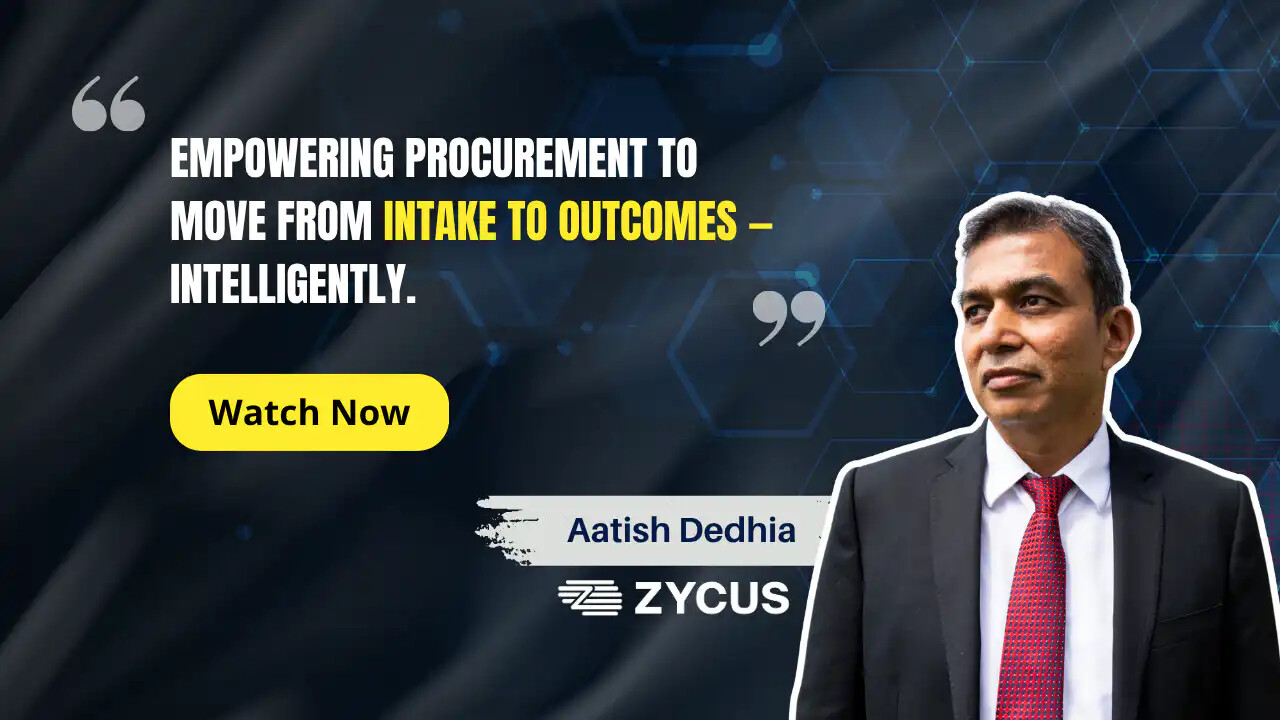
“It was not a hammer in search of a nail. We had a problem, we wanted to solve the problem.”Aatish Dedhia, founder and CEO
There is no public price tag for the original build, and today's enterprise contracts are custom quotes shaped by modules, integrations, users and implementation. The more useful cost is visible on the buyer's side: manual classification, unnegotiated purchases, invoices that require human correction and spending that slips outside approved suppliers. One Zycus customer case study says a home-and-office manufacturer cut its cost per invoice by 62 percent. Another says a light manufacturer found $4.3 million in annual benefit through autonomous negotiation. These are vendor-published cases, useful as evidence of possibility rather than universal promises.
What failed first: the front door
Traditional source-to-pay software begins with a neat request. Real employees do not. They send an email, call a buyer, type into Slack or arrive with an urgently needed supplier and half the required information. Procurement then becomes a translation bureau. Someone finds the right form, identifies the category, checks policy, asks for the missing fields and routes the request. By the time the official workflow begins, frustration has already won.
This was the failure that changed Zycus's map. Source-to-pay described the software's territory, but not the employee's experience. The model started too late - after demand had been cleaned up - and ended too early, at a completed process rather than a saving, signed contract, onboarded supplier or paid invoice. Zycus began calling the larger loop “Intake to Outcomes.”
The map Zycus wants buyers to use
The outcome feeds the next request: supplier performance, prices, risk and compliance become context for the following decision.
Merlin Intake is the practical expression of that rethink. It runs inside Microsoft Teams as well as Zycus's web application. An employee can describe a need conversationally. The system asks relevant follow-ups, applies policy, looks for catalogs or existing contracts and sends the request into the appropriate path. Microsoft lists Merlin Intake in its app-certification program, and Zycus announced an Azure OpenAI collaboration in 2024.
Putting the interface in Teams is less dazzling than inventing an AI agent, and possibly more important. Procurement transformations often stumble on adoption: if the compliant route is slower or harder than an email, people route around it. Zycus changed its mind about where the product begins because the old starting line ignored human behavior.
An agent for the purchases everyone ignores
The Autonomous Negotiation Agent, or ANA, attacks the neglected tail. It can identify eligible suppliers, issue requests for quotes, compare price and non-price terms, conduct multiple rounds and recommend or complete an award within preset rules. Warranty, payment terms and delivery can matter alongside unit price. The human buyer defines the playing field; the machine runs more games on it.
This is where Zycus looks different from a chatbot pasted on top of a procurement suite. The company argues that agents need the underlying contract, supplier, risk and spend data - plus the ability to execute in the same system. A thin intake layer can route a ticket, but every connection to a separate application is another place for context to disappear or an upgrade to break. Zycus's “organically built” refrain is not just corporate history. It is now an architectural argument.
The suite still covers conventional source-to-pay: spend analysis, strategic sourcing, contract lifecycle management, supplier information and performance, risk, purchasing and accounts payable. Zycus Data Core is meant to give those applications a common foundation. AppXtend lets customers connect adjacent systems or create tailored workflows. IBM adds buying-desk and category expertise in a joint tail-spend offer. The result is a broad enterprise subscription, usually accompanied by implementation and services, sold against SAP Ariba, Coupa, Ivalua, GEP SMART, JAGGAER and Oracle.
Depth across the whole cycle
SAP Ariba, Coupa, Ivalua, GEP, JAGGAER and Oracle compete for the enterprise system of record.
Adoption before transaction
Procurement orchestration players such as Zip emphasize intake, routing and a cleaner requester experience.
The recipe worth copying
Zycus offers a sensible sequence for teams tempted by agentic AI. Begin with a bounded pool of repetitive decisions. Clean the data those decisions require. Write down authority limits before granting authority. Keep an audit trail. Escalate exceptions to people. Measure completed outcomes, not the number of AI conversations. Tail-spend negotiation works as an opening move because the value of each event is limited, the volume is high and the rules can be explicit.
- Choose a repeated, low-risk task with a measurable baseline.
- Give the agent approved suppliers, price limits and escalation rules.
- Connect policy at the moment of request, not at the final approval.
- Track savings, cycle time, adoption and exceptions - not demo applause.
The copyable idea is not “buy an autonomous procurement platform.” It is to redesign the work from the user's first sentence to the business result. A request that ends as a well-routed ticket has still left the outcome for somebody else. Zycus is betting that an agent becomes useful when it can cross that gap safely.
Where the bet breaks
Autonomy is a poor fit when supplier records are unreliable, categories are mislabeled, policies conflict, approval rights live in people's heads or the purchase carries unusual legal, safety or reputational risk. An agent can execute ambiguity faster; it cannot make ambiguity safe. High-value strategic sourcing also depends on relationships, market judgment and internal negotiation that should not be reduced to a price bot.
Zycus itself supplies the caution. Its strongest story is not that AI arrived and changed everything. It is that spend classification, a connected suite and years of procurement data created the conditions for agents to do narrow work. The company reports 32-plus procurement AI patents and has earned a 2026 Leader position in Gartner's source-to-pay assessment, but implementation remains the test. Buyers must decide whether the breadth is an advantage or more platform than they need.
The company now employs roughly 1,300 people by supplied estimates, with headquarters in Princeton and major operations in Mumbai, Pune and Bengaluru. It describes its culture through agility, innovation and customer focus, and says it reinvests heavily in research and development. Its independence is a useful counterpoint to the familiar venture-backed playbook: no disclosed funding rounds, no public valuation, no acquisition parade. Just a long build in a category most people notice only when the expense report refuses to cooperate.
That patience may be Zycus's real asset. It spent years turning purchases into data, then workflows, then a connected record of suppliers, contracts and behavior. Now it wants to turn that record back into action. The $10,000 order is small. The bet behind it is not.