The most dangerous competitor in enterprise software is often free, familiar and already open on somebody's laptop. For Scout RFP, the company that became Workday Strategic Sourcing, that competitor was the spreadsheet. It had no sales team, no roadmap and no support desk. It also had one decisive advantage: people knew how to use it.
- Four Case Western alumni founded Scout RFP in 2014 after interviewing hundreds of procurement professionals.
- The product organizes sourcing intake, projects, RFPs, RFQs, RFIs, reverse auctions, suppliers, evaluations and contract handoffs.
- Scout raised $60.3 million, reported more than 175 enterprise customers, and was bought by Workday for roughly $540 million in 2019.
- Its useful lesson is adoption: begin with a narrow workflow people dislike, make it easier than the workaround, then expand.
- It fits complex enterprises best. Small teams with few events may find the implementation and governance heavier than the problem.
First, they declined to be experts
Alex Yakubovich, Stan Garber, Chris Crane and Andrew Durlak did not arrive from the priesthood of procurement. They arrived with a blank slate and the good manners to admit it. Before building, they set a target of speaking with 200 procurement professionals. They passed it. One later account says Durlak connected with more than 7,000 people while refining the pitch.
The interviews exposed an oddity. Large companies already owned elaborate procurement systems, yet sourcing teams still retreated to emailed files and Excel. Yakubovich said adoption of strategic sourcing tools was around 10 percent. The problem was not an absence of software. It was an abundance of software people found too cumbersome to use.
“Since we weren't from procurement, we really started with a blank slate.”Alex Yakubovich, Scout RFP co-founder
The founders chose TurboTax as a usability reference. That comparison is more revealing than the usual enterprise incantations. Taxes are complicated; TurboTax tries to make the next action obvious. Sourcing is complicated too. A manager wants to request new laptops. Procurement needs requirements, potential suppliers, price sheets, stakeholder scores, approvals, negotiation records and, eventually, a contract. Scout's proposition was that none of this complexity entitled the interface to be obscure.
A request enters. A decision comes out.
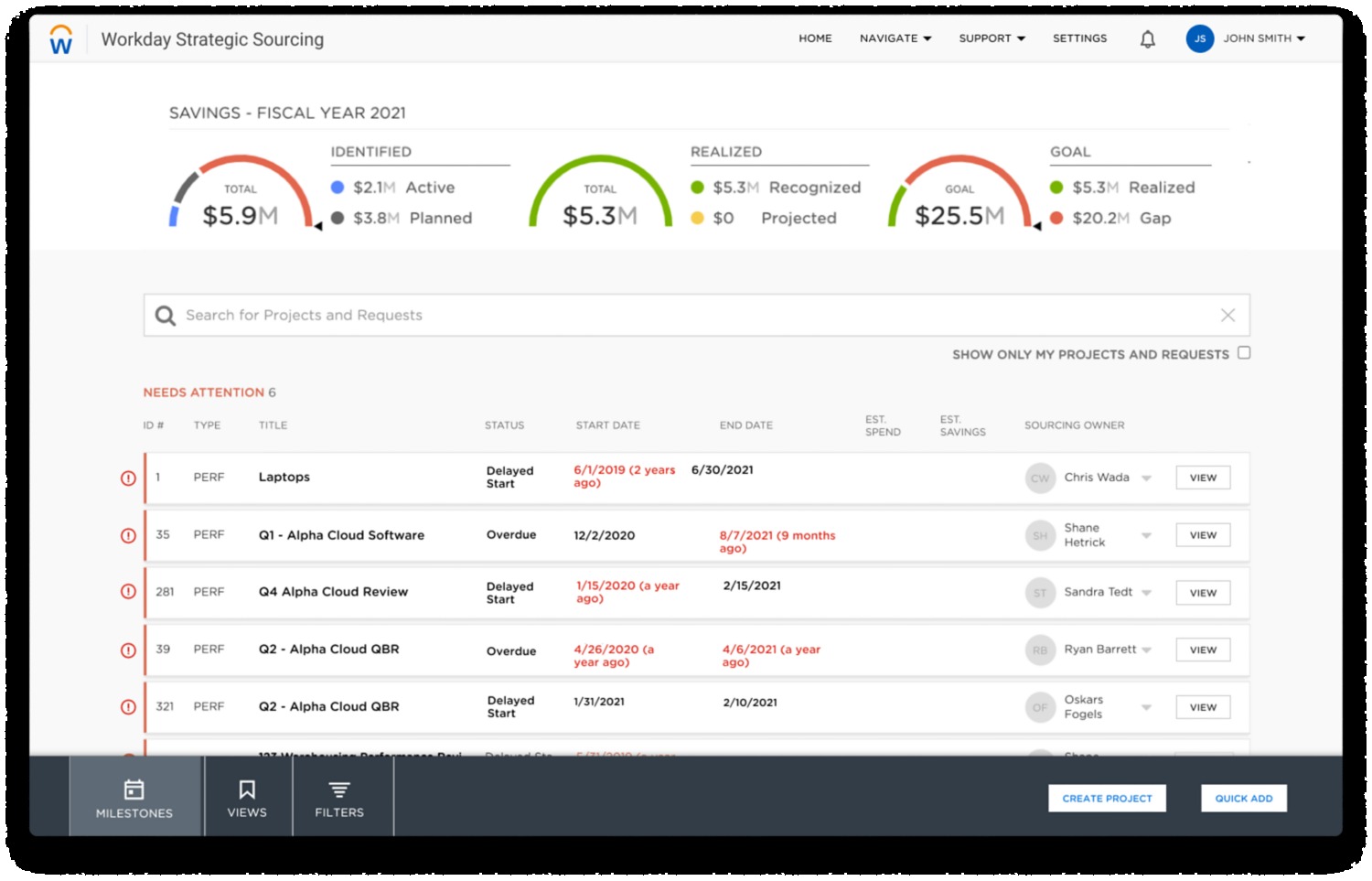
Workday Strategic Sourcing now covers the path from an internal request to a supplier award and contract. Employees submit requests through a central intake. Rules route the work to an owner. Procurement can turn it into a project, invite suppliers to an RFP, RFI or RFQ, conceal price information from technical evaluators, compare answers side by side and run a reverse auction when live price competition suits the category.
The quiet product is visibility. A requester can see where work sits without chasing procurement. A sourcing manager can see deadlines, spend and expected savings. Suppliers answer in the same system. Executives get a portfolio rather than a rumor. Current Workday materials add AI-assisted response summaries, supplier comparisons, risk signals and contract drafting through Workday Contract Lifecycle Management.
The proof arrived in unromantic numbers
By January 2019, Scout said it managed more than $20 billion in project spend. It had more than 175 enterprise customers, among them VMware, Starbucks, Gilead, Conagra and Beam Suntory, with users in 117 countries. Annual recurring revenue had doubled during the preceding year and nearly 100,000 users had joined the platform. These were company-reported figures, but they describe what made Workday's interest intelligible.
Sharp HealthCare supplies the sharper case study. Its RFPs moved through PDFs and email, often taking 12 weeks or more. After adopting Workday Strategic Sourcing, Sharp reported $4.2 million in savings during the first six months and said the RFP cycle lost four weeks. ChenMed reported about $70,000 saved in its first reverse auction. VMware made the platform its sourcing pipeline hub and said it did not need to spend additional money or headcount on administration and customization.
The numbers are not a magic spell. Sharp paired the tool with a wider transformation, cleaner data and redesigned routing. OU Health likewise emphasized process design and relationship-building while using Workday products to exceed savings goals. Software can stage the decision; it cannot supply the institutional will to make one.
Workday dated before it married
Scout raised an early $2.75 million round, a $9 million Series A and a $15.5 million Series B. In January 2019, Scale Venture Partners led a $33 million Series C. Workday Ventures and Salesforce Ventures joined as strategic investors. Scout entered Workday's software partner program, and the companies planned an integration with Workday Procurement.
Eleven months later, Workday completed its acquisition of Scout for approximately $540 million. The sequence matters. Workday did not merely admire a slide deck. It invested, partnered, examined the joint proposition and then bought the company. In 2020, Scout RFP became Workday Strategic Sourcing. What began as a focused RFP tool now sat beside finance, procurement, supplier management and, later, AI-powered contract intelligence.
What does it cost?
There is no public standalone list price. Workday sells the product through a custom enterprise sales process. Subscription scope, modules, integrations and implementation services can all change the bill. The only clean public price is the historical one: Workday paid roughly $540 million for Scout.
What failed first changed the thesis
Durlak has described testing new business ideas every few months and watching many fail. Yakubovich and Garber had previously built ONOSYS, an online-ordering company, which gave them the supplier's view of cumbersome RFPs. The founders might have answered failure with more invention. Instead, they answered it with more interviews.
That is the useful thing to copy. Pick a workflow where the authorized system routinely loses to an improvised one. Talk to the people doing the work before drawing the grand platform. Remove the first piece of friction so thoroughly that a customer can get value quickly. Then let adjacent problems pull the roadmap outward. Scout began with RFP automation; intake, pipeline, auctions, supplier management and contracts followed.
Where the model fits
Many sourcing events, distributed stakeholders, regulated approvals, a meaningful supplier base and a need to connect procurement with Workday finance or contracts.
Where it strains
Small teams, rare or informal purchases, weak master data, no owner for process change, or categories where reverse auctions would damage supplier relationships.
It also helps to know what not to copy. A reverse auction is not a universal negotiating philosophy. It works when specifications are comparable, enough credible suppliers can compete and price deserves real weight. It is a poor instrument for unique services, strategically dependent relationships or ambiguous requirements. Likewise, a connected Workday suite is an advantage for an existing Workday customer, but a company centered on SAP, Oracle or another procurement stack must weigh integration effort against the product's sourcing strengths.
The market sells suites. Users buy relief.
Workday Strategic Sourcing competes with SAP Ariba, Coupa, Ivalua, JAGGAER, GEP and Oracle, plus specialists in sourcing, intake and negotiation. Workday's distinction is not that rivals lack RFPs or supplier records. It is the combination of Scout's adoption-first design with Workday's system of record for money and people. Intake can become sourcing work; an award can become a contract; supplier and financial data can travel farther without being retyped.
The risk is the same one Scout diagnosed at the beginning. Integration can become architecture, architecture can become complexity, and complexity can send users back to Excel. The company that once won by making a narrow task lovable now belongs to a broad platform. Its job is to gain the platform's reach without inheriting the old suite's indifference to the person clicking the buttons.
That tension makes Workday Strategic Sourcing more interesting than its category suggests. Procurement is where a company's ambitions meet a supplier's price, a lawyer's clause, a finance team's budget and an employee's patience. Scout RFP made that intersection visible. The founders' finest feature was recognizing that visibility begins not with data, but with use.