The least glamorous machine in electronics manufacturing may be the spreadsheet that decides whether a million-dollar product line keeps moving. One tab holds contract prices. Another holds a bill of materials. An engineer has a preferred component, a buyer has a distributor page open, and someone in supply chain is trying to remember whether the part was merely scarce or actually approaching end of life. Part Analytics exists because its founders had lived inside that scene and decided the spreadsheet had been promoted far beyond its competence.
Jithendra Palasagaram and Jesil Pujara brought years of engineering and sourcing work at GE HealthCare to the problem. Palasagaram had spent 13 years across engineering and procurement; the pair knew the awkward gap between product lifecycle management systems, which govern designs, and enterprise resource planning systems, which govern transactions. The judgment needed to source electronic components - current prices, aggregate demand, alternates, lead times, compliance, obsolescence - often lived between those systems. Usually in files emailed between people.

Operator turned founder Jithendra Palasagaram developed the idea while earning his MBA at Chicago Booth. The company says the founding premise came from decades of combined procurement and engineering experience, not from a search for somewhere to apply AI.
The first product was allowed to be rough
The idea entered Chicago Booth's Global New Venture Challenge in 2017 and reached the finals. Part Analytics officially became a company in February 2019 after closing seed funding. The pivotal moment, though, was a paying customer. In a candid first-year retrospective, the founders said they had taken the risk of showing target users a “half-baked” product. That phrase is more useful than the usual startup folklore. It tells you exactly what they did: exposed unfinished software to people who understood the workflow, watched where they pulled it, and changed the roadmap.
Their original market was original equipment manufacturers. An early customer suggested they show the product to the contract manufacturers that build for those OEMs. Those manufacturers faced the same data chase while quoting jobs, with a painfully measurable clock: one or two weeks to assemble a quote. With a few changes, the software could cut that to one or two days. Part Analytics followed the evidence and signed its first contract-manufacturing customer within months.
“Users don't want another clickfest.”Part Analytics' first-year retrospective
That changed the product's standard of usefulness. A senior manager needed a 1,000-foot view, while a buyer needed to reach an individual component and a recommended action in two or three clicks. A dashboard that merely admired the problem would not do. The system had to tell a sourcing team where the savings sat, which part created the risk, and what alternate or negotiation move might fix it.
One parts list, six ways to interrogate it
BOM IQ was the opening wedge. Upload a bill of materials and it rolls up cost, compares contract and market prices, identifies savings, and calculates a health rating from lifecycle, lead-time, compliance, and single-source risks. Part IQ moves down to the component: inventory from authorized suppliers, cumulative usage across the company, specifications, pricing, and suggested form-fit-function or functional alternates. Category IQ zooms back out to spend and supplier performance by commodity, manufacturer, region, or business unit.
Then the product crosses from analysis into work. RFQ IQ runs sourcing events, collects bids, supports supplier messaging, compares responses with market and benchmark data, and records awards. LOA IQ, launched in 2024, handles the peculiar paperwork of letters of authorization - documents that let contract manufacturers use negotiated component prices. Executive IQ gives leadership the portfolio view: which BOMs, products, sites, or suppliers carry the most savings opportunity or risk.
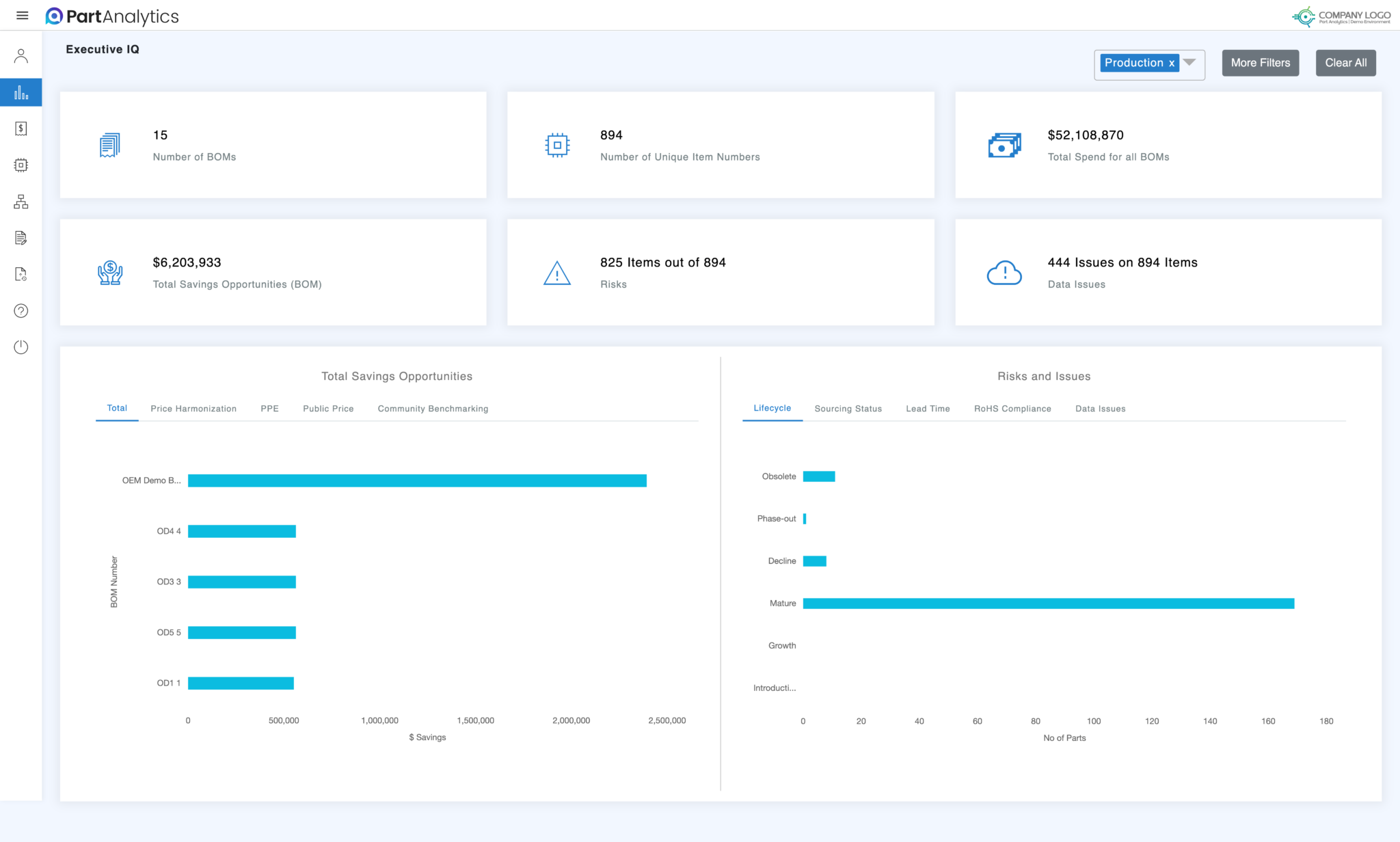
The differentiation is specificity. Broad procurement suites cover contracts, purchasing, invoices, and supplier management across every category. Component databases can return technical records and lifecycle warnings. Part Analytics concentrates on direct materials for electronics and tries to connect the engineering decision to the sourcing consequence. It harmonizes the manufacturer's internal data with supplier and market data, then carries an insight into an RFQ, an LOA, or an alternate-part decision. Its direct competitors include component-intelligence platforms such as Z2Data and SiliconExpert. Its stubborn incumbent is the home-built stack of Excel, email, ERP reports, distributor websites, and a specialist risk database.
The price is private. The outcomes are unusually public
Part Analytics sells enterprise SaaS through a consultative process. It does not publish list pricing. Prospects can run their own BOM or shortage list through a trial or proof of concept, see the opportunities, and negotiate an annual contract. That makes the acquisition cost opaque, but it also creates a sensible buying test: use your data, not a theatrical demo, to decide whether the economics work.
The company's case studies supply the other half of the equation. EMS-Tek said BOM costing fell from one or two weeks to less than five minutes, direct-material costs dropped by as much as 20 percent, and its team could process 20 to 30 percent more RFQs. Digi International reported a 50 percent productivity gain in part searches and used the platform with Arena PLM to reduce manual synchronization. A home-fixtures manufacturer reported 9 percent savings and 10 times its investment within three months.
An unnamed Fortune 500 manufacturer reported full ROI in three months, a 97 percent efficiency gain in quarterly costed-BOM analysis and price-compliance work, and a 67 percent reduction in time spent preparing annual component negotiations. Emerson's implementation reported about a 90 percent reduction in quarterly pricing-analysis time and 27 percent more savings opportunities than the manual process. These are vendor-published customer results, not universal benchmarks. Still, they identify the value pool precisely: fewer analyst hours, earlier risk detection, tighter price compliance, broader competition for spend, and less money lost between a negotiated price and the bill that arrives.
What failed first - and what changed their minds
The original assumption was too narrow. OEMs looked like the customer because that was the world the founders knew. Customer feedback revealed an adjacent buyer with an even more obvious bottleneck: the contract manufacturer racing to cost and quote a BOM. The other early idea that needed correction was the dashboard itself. Customers did not need more data arranged attractively. They needed disparate data normalized, contextualized, and turned into prescriptive steps.
The company also learned that the software had to coexist with systems already in place. It integrates rather than pretending the ERP or PLM can be ripped out. Digi's Arena PLM story makes the case: accurate product data flowed into Part Analytics, where it gained component-level market and supply context. Engineering, sourcing, and external partners could work from the same current BOM instead of reconciling copies.

The $4 million path into Altium
Part Analytics raised roughly $4 million across publicly reported rounds, including $625,000 in 2019, $380,000 in 2020, and a $3 million round led by MK Capital in 2021. MK Capital later said the company grew more than 50 percent annually after its investment and expanded across electronics, automotive, and medical-device customers. In January 2025, Altium completed its acquisition of the Milwaukee company. The price was not disclosed.
The strategic logic is clearer than the transaction value. Altium already sits near the engineering side of electronics creation through its design tools and Altium 365 collaboration platform. Part Analytics adds enterprise component catalogs, procurement workflows, and program-scale supply intelligence. A design choice can now travel toward sourcing with more of its cost, availability, and lifecycle context attached. Part Analytics has continued operating under its name, publishing product material and appearing at supply-chain events; in 2026 it previewed further work connecting design intelligence with sourcing execution.
The playbook to copy - and its limits
The transferable move is not “add AI to procurement.” It is narrower. Begin with a workflow whose pain has a clock or a dollar sign. Ask users for the ugly real input - in this case, a BOM - and return a finding valuable enough to test. Ship before every edge case is polished. Listen for an adjacent user who handles the same object for a different reason. Then expand from insight into the action users take next. BOM analysis led naturally to part searches, category management, RFQs, LOAs, and executive prioritization because each module followed the same component data.
Conditions that help
- Large, changing BOMs and meaningful electronics spend
- Data available from ERP, PLM, suppliers, and distributors
- Repeated RFQs, price files, shortages, or lifecycle exposure
- Teams willing to standardize data and act on alerts
Conditions that break it
- Small catalogs and infrequent component buying
- Bad source data with no owner accountable for cleanup
- Suppliers unwilling or unable to provide usable inputs
- A culture that buys dashboards but keeps decisions in email
This approach will not work everywhere. A company with a tiny parts catalog or little direct-material spend may never recover enterprise implementation effort. Prescriptive insight is only as trustworthy as part matching, contract data, demand, and supplier feeds. Alternate components still require engineering validation. An alert does not create inventory, and software cannot force a reluctant supplier to share sub-tier information. The strongest fit is an electronics manufacturer complex enough to feel the fragmentation, yet organized enough to clean inputs and change how teams work.
Part Analytics occupies a practical corner of the market: deeper than a component search engine, narrower than a general procurement suite, and closer to execution than a risk dashboard. Its story is a reminder that vertical SaaS can be built by tracing one costly object through an organization. Here, that object is the bill of materials. Engineering designs it, procurement prices it, suppliers respond to it, factories depend on it, and executives discover its hidden risk at the worst possible moment. Part Analytics made that object legible enough to act on. Customers did the rest of the product design.