Somewhere in a large company, a buyer needs binder components. The request looks too minor for a strategy meeting. Yet Simfoni says that when one office-supply manufacturer moved such a purchase into a reverse auction, the result was more than $400,000 in savings and a 20% cut in category spend. The figure belongs to that customer project, not to every auction. What makes it interesting is the scale of the opportunity hiding inside an ordinary line item.
- Simfoni helps enterprise procurement teams classify spending, source suppliers and control purchases.
- Its special interest is the “tail”: many small transactions spread across many vendors.
- Its software is paired with buying services, and it advertises pay-as-you-save options.
- The useful test is whether an insight becomes a changed purchase, not merely a dashboard tile.
Tail spend has a misleading name. The purchases may be small, but the administrative work is not. Every new supplier may need checks. Every invoice must be matched, approved and paid. A department can save a few dollars on a product and quietly spend more processing the transaction. Procurement teams can concentrate on major contracts while hundreds of employees make entirely reasonable purchases through channels that never join up.
Simfoni, founded in the mid-2010s and led by co-founder Chirag Shah, sells a way to see and manage that sprawl. Its customers are procurement and finance teams, primarily in large enterprises. The company says its tools serve more than 350 customers and 20,000 users. Named users include DocuSign, Visa, Ryder, IFF, ALPLA and Fulton Bank. That list spans software, payments, transport, manufacturing and banking. The common denominator is an organization with more suppliers, systems and invoices than any one spreadsheet can comfortably explain.
The spreadsheet knows where the money went. Then what?
The first part of Simfoni’s proposition is analytical. Its Spend Analytics product collects data from enterprise systems, payment cards and other sources, normalizes supplier names and classifies purchases. The output is meant to let a category manager ask practical questions: Why do different sites pay different prices for the same item? How much business goes to diverse suppliers? Which purchases bypass a preferred contract? Ryder’s sourcing leader Manoel Gerlach described the old difficulty neatly: the company’s ERP view served finance, but it did not line up with procurement’s needs.
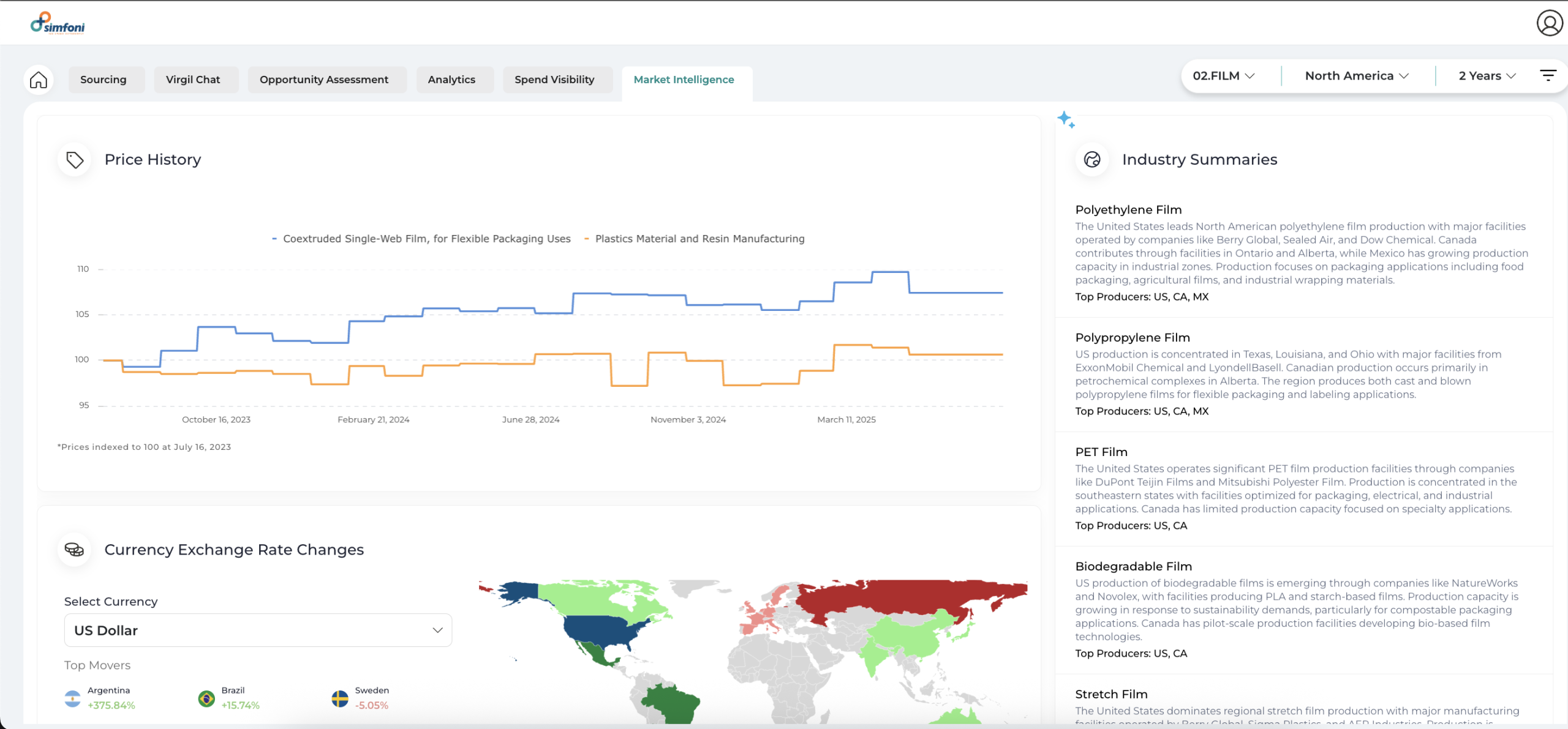
The next part is where the company tries to distinguish itself. An identified opportunity can enter a sourcing pipeline, become an RFx or auction, and be tracked through a savings program. Simfoni’s eSourcing software handles supplier events and award decisions. Its Strategic Spend Hub, launched on Snowflake, puts analytics, sourcing execution and savings tracking into one interface. A dashboard is persuasive; a purchase order using the better supplier is evidence.
Even procurement data wants a clean desk. Simfoni’s Strategic Spend Hub is built on Snowflake and joins spend analysis to sourcing work.
The architecture matters because enterprise purchasing rarely lives in one system. A customer may have several ERPs, card feeds, supplier records and local practices. Connecting those records is the expensive, unglamorous precondition for the clever part. Simfoni says its analytics can usually be implemented in four to six weeks, with initial insights sooner. That is a company estimate, and the experience will depend on the state of a buyer’s data and integrations.
Two acquisitions, one awkward gap
The company’s product map did not emerge in one stroke. In 2022 Simfoni acquired EC Sourcing Group, bringing in eSourcing and award optimization. Later that year it acquired Xeeva, whose indirect-spend technology included data enrichment and payment automation. The combination makes commercial sense: know what was bought, compete or renegotiate the next buy, then process the transaction without losing the trail. It also explains why Simfoni sells a set of modules rather than insisting every customer replace an entire procurement system.

Chirag Shah has spent the past few years assembling the pieces of a procurement loop. The acquisitions added sourcing and indirect-spend muscle to Simfoni’s analytics base.
Kearney’s $8 million investment in 2023 brought a consultancy into the same argument. The firms said they would work together on tail-spend management. That partnership matters because software alone does not decide who should buy a replacement part or negotiate with an obscure vendor. Simfoni’s BuyDesk supplies human buyers for requests that need quotes, supplier coordination or judgment. The company’s pitch is therefore a blend of software and service, an arrangement that can appeal to teams with too many transactions and too few procurement staff.
The value of each step depends on the quality of the underlying supplier and transaction data.
One door for a thousand small suppliers
In August 2026 Simfoni introduced Vitesse, a more literal answer to the tail-spend problem. Employees route purchases through a controlled workflow. Simfoni handles supplier vetting and onboarding, coordinates the buying, and consolidates payments so finance deals with a master vendor while the underlying suppliers still get paid. The product says it can classify transactions across more than 200 procurement categories and bring most suppliers live in one to three business days. Its first-quarter plan is almost prosaic: configure the rules, route purchases, send the first consolidated payment, then build catalogs from repeat patterns.
That prosaic sequence is the point. A beautiful dashboard cannot stop an employee from buying the urgently needed item through an unapproved seller. A buying route that takes too long will be ignored. Simfoni must make the approved path easier than the workaround. IFF, a named customer, has described using Simfoni to bring more rigor and visibility to fragmented tail spend. ISC’s published case describes a single invoice and payment arrangement that relieved its team of handling hundreds of supplier invoices. Both are company-published cases; neither proves every customer will see the same result.
“Simfoni has been super helpful in taking all of our spend data & making sense out of it.”Frank Rey de Perea · Head of Procurement, DocuSign
The price of a promise
Simfoni does not publish a standard price list. It promotes modular, on-demand software and a pay-as-you-save model with zero upfront costs for some offerings. The appeal is obvious to a finance chief: make the work earn its way. The difficult part is measurement. Savings from a new supplier, a lower unit price or fewer invoices are different things. A serious buyer should agree on the baseline, the category scope and who signs off realized savings before treating a projected percentage as cash.
Its newest AI layer, Virgil, is embedded in source-to-contract workflows rather than sold as a separate chat destination. Simfoni says it can surface spend opportunities, help move them into sourcing, and monitor contract renewals. It won a 2026 Stevie Award for an AI-powered product. Awards tell us the feature attracted notice; the operational question remains how often it makes a buyer act in time to change an outcome.
The larger procurement market offers suites from Coupa, SAP Ariba, Ivalua and GEP, along with specialist analytics and sourcing vendors. Simfoni’s position is a narrower, practical proposition: connect enough of the spending cycle to make neglected purchases manageable, and add people when software cannot finish the job. That can be valuable where a company has scattered data, a long supplier tail and the willingness to route employees through a common process. Where spend is already centralized, data is clean and buyers follow preferred channels, the incremental gain may be smaller.
There is a pleasing irony in a company built around the little things: its case is cumulative. One cleaned supplier record is hardly a story. Neither is one approved invoice. But a procurement team that sees the same small problem repeat thousands of times may discover that the “tail” has been wagging the budget all along.