The first thing to break was not the procurement strategy. It was the spreadsheet. At Compass, the real estate brokerage, a lean sourcing team was trying to manage hundreds of projects in Google Sheets while purchase-order spend, card spend and non-PO spend sat in separate places. Executives kept asking a fair question: what savings did procurement actually deliver? The team could hunt for the answer, reconcile versions and dress the result for a meeting. It could not produce the number with the calm certainty of a bank balance.
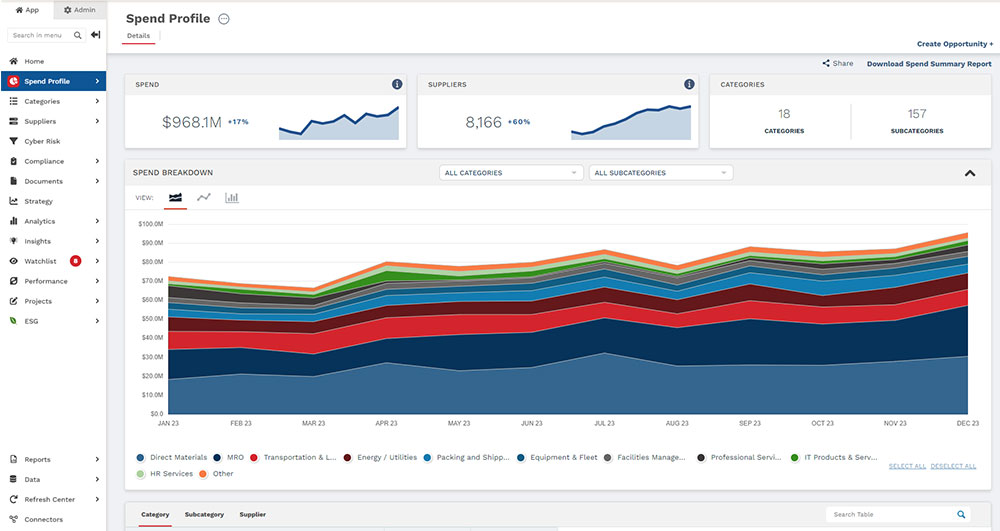
SpendHQ lives in that awkward gap between a promising opportunity and a Finance-approved outcome. Its software collects purchasing data from ERPs, cards, source-to-pay tools and warehouses; cleans supplier names; sorts transactions into a usable taxonomy; and gives category managers a view of who bought what, where and from whom. Then a second product tracks the projects created from those discoveries: owner, forecast, milestone, approval and realized value. The point is not another colorful pie chart. The point is closing the loop.
The originA tool built by people who were tired of fixing the data by hand
SpendHQ began in 2012 inside Insight Sourcing Group, an Atlanta procurement consultancy founded by Tom Beaty. The origin matters. Consultants arrive after enterprise purchasing data has been scattered across subsidiaries, languages and systems, which means they learn quickly that “IBM,” “I.B.M.” and a local reseller can describe one commercial relationship while appearing as three suppliers. Before anyone negotiates, somebody has to normalize the record.
The team built an internal answer, then commercialized it in 2013. By the 2020 release of SpendHQ 2.0, the company said it had processed more than $4 trillion in spend. It became independent in 2021. Today it reports more than $10 trillion analyzed, more than 500 customer organizations and 100-plus employees across 10 countries, with operations in Atlanta, Lyon and Naperville. The supplied company record puts headcount around 150. SpendHQ is private, so the useful operating numbers are the ones it chooses to publish, not quarterly filings.
The product thesisFind it, assign it, finish it, defend it
The platform has three layers now. Spend Intelligence performs the data work and analysis. Performance Management turns opportunities into projects and reporting. AI assistants and agents answer questions, prepare structured deliverables and, in selected workflows, move work forward. SpendHQ does not pretend to replace every purchase order, invoice, contract repository or sourcing event. It connects to systems such as SAP Ariba, Coupa, Snowflake and common ERPs, acting as a procurement control center above the transaction layer.
That sequence distinguishes SpendHQ from a pure analytics vendor and from broad source-to-pay suites. Sievo, Ignite and Suplari compete closer to the intelligence layer. Coupa, SAP Ariba, GEP, Ivalua, JAGGAER and Zycus sell wider procurement suites. A homegrown combination of ERP reports, Power BI, Jira and Excel remains the familiar alternative. SpendHQ's pitch is narrower than “run all buying here” and broader than “look at your spend here.” It wants to be the daily operating system for strategic procurement.
“SpendHQ sits at the centre of everything we do and allows us to manage all our work in one place.”Anna Barej, Vice President of Procurement, Best Buy
What changed the planCustomers wanted the work after the insight
Analytics could reveal that too many business units bought similar services from too many suppliers. It could not make someone own the consolidation, negotiate the deal, settle a savings definition with Finance and report the realized result. SpendHQ's management has said customer and market feedback pushed it toward that missing half.
In July 2022, Pamlico Capital invested $65 million as a minority investor while SpendHQ joined forces with Lyon-based Per Angusta. Pierre Laprée had founded Per Angusta around procurement performance management: project pipelines, savings tracking, collaboration and reporting. The fit was unusually literal. SpendHQ could show where an opportunity lived; Per Angusta could show whether anybody captured it. The teams combined, Laprée became chief product officer, and the Per Angusta brand was retired in 2023.
What did it cost? The corporate bet has a public number: $65 million in growth capital. The customer price does not. SpendHQ sells by demo and custom quote, a normal but inconvenient feature of enterprise software. Data volume, number of source systems, modules, refresh cadence, integrations and services can all change the bill. Any buyer comparing vendors should ask for a five-year total that includes implementation, internal data owners, taxonomy maintenance and change management, not just the license.
The proof pointCompass traded spreadsheet archaeology for a visible pipeline
Compass offers SpendHQ's neatest case study because it includes the before, the sequence and a result. The procurement team adopted Performance Management first, replacing Google Sheets with a central project pipeline. It later added Spend Intelligence to combine PO, non-PO and card data. Deployment of the performance module took a reported six to eight weeks, with custom reports and hands-on support.
Compass says it managed 118 projects, averaged $91,704 in savings per project and achieved $12.7 million in actual savings against a $10 million target. Those are company and customer-reported figures, not an audited experiment, and software cannot claim every dollar by itself. Still, the case shows the mechanism: centralize work, agree on reporting, expose the workload, connect the underlying spend, and make the outcome visible to management.
Best Buy supplies the messier warning label. Its transformation involved consolidating 38 legacy systems, overcoming resistance and handling turnover. The retailer reported doubling procurement's financial impact, with SpendHQ at the center of project tracking and forecasting. The software helped provide one view. It did not eliminate the cultural work of persuading category managers to change habits or leaders to use common definitions.

The AI turnClean data first, agents second
SpendHQ introduced Spendy, a procurement-specific assistant, in 2025. A user can ask for top categories, drill into a supplier spike, find cybersecurity flags or create a pre-filled savings project from an identified opportunity. The mascot is a fox, because enterprise procurement was apparently one woodland creature short. Beneath the whimsy is a sensible constraint: answers are grounded in the customer's structured spend and project data rather than a generic chatbot's memory.
In October 2025, SpendHQ announced an investment and exclusive partnership with Sligo AI. In April 2026, it acquired the company and appointed founder Matt McCarrick chief AI officer. Sligo brought infrastructure for agents that can generate sourcing strategies, supplier evaluations and contract analyses. Customers can deploy the technology inside their own cloud, on dedicated managed infrastructure or through APIs. That flexibility targets regulated businesses where data sovereignty and security can stop an AI pilot before clever prompts matter.
The useful tension
SpendHQ argues that poor data blocks enterprise AI. Its own recent guidance also says companies should not wait for perfect readiness. The practical middle is to start with a bounded workflow, put governance beside it, measure the output and improve the data as the use case expands.
What readers can copyBorrow the operating discipline before buying the operating system
The most portable lessons do not require a software contract. Start by defining a savings opportunity in the language Finance will approve. Give it one owner, a baseline, a deadline and an approval path. Build a taxonomy with two customers in mind: the procurement professional making a decision and the machine classifying the next transaction. Connect analytics to a project record immediately, while context is fresh. Finally, report realized value separately from pipeline ambition. A forecast is not a saving, however attractive the dashboard.
Put spend insight and project ownership in one workflow, with no re-keying between them.
Track forecast, approved and realized value as different states, not one optimistic number.
Can Finance trace the claimed result back to a baseline, an action and an accountable owner?
Where it breaksNo owner, no taxonomy, no miracle
SpendHQ is built for organizations with real complexity: multiple ERPs, fragmented suppliers, regional business units, substantial addressable spend and a procurement team with the authority to act. It becomes less compelling when a company has simple purchasing, a handful of systems or too little savings potential to justify enterprise implementation. A small operation may get farther with disciplined accounting data and a well-run project tracker.
It will also disappoint a large buyer that treats data preparation as a vendor chore and adoption as a launch-day event. Taxonomies encode judgment. Savings definitions require agreement. Integrations need owners. AI outputs need controls. If category managers keep private spreadsheets, Finance rejects the baseline or leadership never reviews the pipeline, the closed loop opens again. SpendHQ can make the work visible; it cannot make an organization care.
That is what makes the company more interesting than the usual enterprise dashboard story. SpendHQ's growth follows a sequence of admitted insufficiencies. Spend visibility was useful but incomplete, so it added performance management. Recommendations were useful but still manual, so it added agents. Each expansion attempts to shorten the distance between seeing and doing. The wager is that procurement's value is not the number of transactions it processes. It is the quality of the decisions it can prove.