The least celebrated piece of infrastructure in electronics may be the spreadsheet asked to behave like a supply-chain command center. One tab has contract prices. Another has a bill of materials. A buyer keeps a distributor page open. An engineer has already chosen a component. Somewhere between the enterprise resource planning system and the product lifecycle system, somebody is emailing the file that contains the decision everyone needs.
Jithendra Palasagaram knew this scene before he sold software to fix it. He had spent 13 years at GE Healthcare in engineering and global sourcing, close enough to the machinery of electronics procurement to see both its scale and its improvisations. His work included a strategy to digitize electronics spend management across four GE businesses. Part Analytics credits that program with $15 million in savings, along with earlier visibility into supply risk.
This is the useful distinction in his founder story: he did not discover a fashionable market from a distance. He had been one of the prospective users. He knew the workarounds, the departmental borders, the late decisions, and the particular indignity of expensive judgment traveling as an attachment.
A sensor engineer learns to read systems
Palasagaram was born in Miryalguda, India, in 1979. He earned a bachelor's degree in electronics and communication engineering from Bangalore University in 2001, then arrived at Auburn University in 2003 as a graduate research assistant. He later received a university fellowship and completed a master's degree in electrical engineering.
His academic work focused on microelectromechanical systems. With Ramesh Ramadoss, he published research on capacitive pressure sensors made from liquid-crystal polymer using printed-circuit-processing techniques. It was careful work at tiny scale: layers, cavities, electrodes, diaphragms, and changes in capacitance measured under pressure.
There is a tidy line available in hindsight. First he built devices that turned physical pressure into a readable signal. Later he built a company intended to turn procurement pressure into a readable decision. Careers are seldom experienced with such literary symmetry, but the habit carries: locate the hidden condition, collect the right data, and present a signal while somebody can still act.
“The way we think about this is actually a mindset of going early in the design phase, or shift left.”Jithendra Palasagaram on design-to-procure
The expensive gap between design and buying
Traditional procurement software tends to organize what happens after demand is clear. Part Analytics went upstream. Palasagaram described the company's territory as design-to-procure, a deliberate step before source-to-pay and procure-to-pay. If sourcing teams do not see and influence a component decision during design, he argued, managing risk later becomes much harder.
That gap is where an innocent engineering preference can become a sourcing constraint. A component may be nearing end of life. Its price may have drifted above the market. There may be a viable alternate from another manufacturer, but nobody has put lifecycle, availability, cost, compliance, and internal demand into the same view. By the time procurement learns the full story, changing the design can be slow and costly.
The decision window
Part Analytics' premise: the cheapest supply-chain problem is often the one exposed while the design can still move.
Palasagaram and co-founder Jesil Pujara brought experience from engineering and procurement into the business. At Chicago Booth, where Palasagaram studied from 2015 to 2018, the idea entered the New Venture Challenge. The team finished among the finalists in 2017. The official Part Analytics biography dates the company's founding to 2019, when the operator's complaint became a formal enterprise-software bet.
The product combined a company's internal information with market and component data. It offered views of spend, supplier exposure, bills of materials, availability, alternate parts, and obsolescence risk. The promise was less time assembling the picture and more time deciding what to do about it.
Capital by way of the side door
Building in the Midwest gave Part Analytics proximity to manufacturers and distance from the easiest venture-capital routes. Palasagaram has spoken plainly about the friction. Finding investors who understood the market took time. One consequential connection began at a demo day with an investor who could not participate. That person made an introduction to someone who could.
“You never know where your first check might come from,” Palasagaram said later. It is a charmingly unscientific sentence from an engineer, and a useful one. Networks do not always deliver the requested result directly. Sometimes the person across the table is a bridge, not a destination.
His advice after raising money was similarly practical: choose investors for more than the check. Consider the introductions they can make, the advisors they can bring, and the value they can add after the wire arrives. In August 2021, Part Analytics announced a $3 million venture round led by MK Capital to grow the team and customer base.
“Be thoughtful about who you raise money from. Because it's not just the check or money, it's more about what value they bring to the table.”Palasagaram on investor fit
Proof that could travel
Part Analytics did not have to persuade electronics manufacturers that shortages and messy component data existed. The customers already carried the bruises. The harder work was proving that a new layer of software could produce measurable change across engineering, sourcing, and procurement.
Palasagaram pointed to ITW as an example. He said the platform helped produce a 5 percent reduction in spend and cut shortages by more than 70 percent while consolidating sourcing information. Those numbers became portable. Customer testimonials and referrals, he said, worked especially well because users could explain the value to peers in the same language of costs, shortages, and time.
Reported ITW outcomes
The bars use a common 0-100 percent scale. Figures are outcomes Palasagaram reported from Part Analytics' work with ITW.
This customer-led growth also shaped the product. A senior manager needed a broad portfolio view; a buyer needed to reach one component and one action in a few clicks. The company had to serve both without turning the interface into another thicket. Product category, sales story, and customer evidence evolved together.
There was another advantage to letting customers carry the message. Electronics sourcing is full of specialized language, and enterprise buyers have finely tuned defenses against a software pitch that floats above their daily work. A peer can describe the useful moment with greater precision: the alternate component found before a shortage, the supplier exposure noticed across several products, the negotiation entered with a market benchmark instead of a hunch. Each example makes the platform less abstract. It also returns the founder to the discipline that produced the company in the first place - stay close to the work. Palasagaram's public comments keep circling back to customer outcomes, not novelty for its own sake. The software mattered when it shortened a search, exposed a cost, or gave engineering time to choose differently.
Palasagaram's retrospective regret was not that the company had stayed in the Midwest or taken an indirect route to funding. It was pace. Once the team had evidence, he wished they had moved sooner and faster. Operators are trained to manage risk. Founders eventually learn that delay has a risk column too.
An exit, then a return to the room
On January 21, 2025, Altium announced that it had completed the acquisition of Part Analytics. The strategic fit put procurement and component planning beside Altium's electronics design and collaboration tools. Palasagaram described a connected environment in which customers could move through design, sourcing, component acquisition, and lifecycle management on a shared platform.
For Part Analytics, the deal widened the original ambition. Palasagaram had spoken of becoming connective tissue between original equipment manufacturers and contract manufacturers, helping them share enough information to innovate faster. Inside Altium, that bridge could become part of a larger electronics lifecycle system.
A few months after the acquisition, Palasagaram returned to Chicago Booth for the New Venture Challenge dinner. Years earlier, he had sat in the audience, learning and pitching. Now he stood in front of a new group of founders and told the story of a company launched from the Booth experience and carried to an exit. He called the moment surreal and thanked professors Steven Kaplan and Mark Tebbe for bringing him back.
The circle is almost too neat, so it helps to notice the untidy material inside it: a career change, a finalist finish rather than a victory, investors who needed educating, customers who revised the product, and an introduction from someone unable to invest. The clean arc was assembled from crooked lines.
Palasagaram's story leaves operators with a particularly stealable question. Which workaround in your job has become so ordinary that nobody remembers it is absurd? Look closely. A spreadsheet may be doing unpaid product discovery.
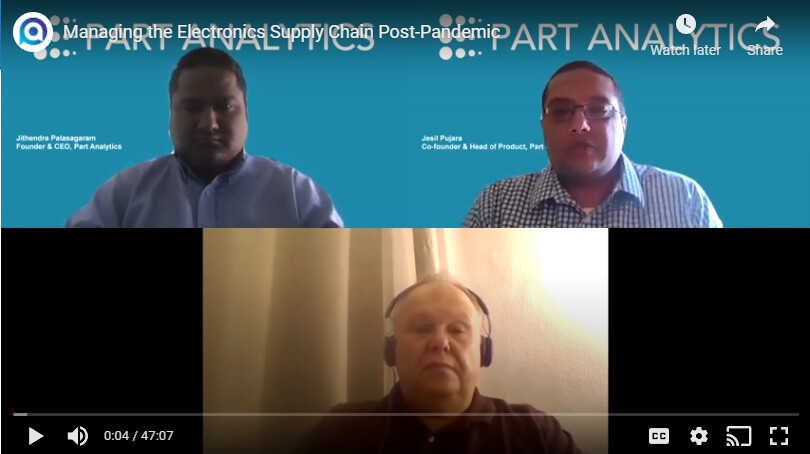
Watch Palasagaram, Pujara, and David Collins discuss electronics supply-chain management in Part Analytics' 2020 webinar.