The surprising object in Spencer Penn’s account of Tesla’s Model 3 years is a spreadsheet. The company could remake the automobile, but, Penn says, its team managed $30 billion in parts spending through spreadsheets and email. A car contains thousands of components. Each has drawings, suppliers, quantities, prices, deadlines and revisions. That is an awkward amount of institutional memory to entrust to someone’s inbox.
The short version
- LightSource sells sourcing software for the materials and components inside manufactured products.
- It connects engineering records, RFQs, supplier responses, bid comparisons and awards.
- Suppliers use the platform for free; enterprise buyers pay for the software.
- Customer accounts point to shorter cycles and savings, while public software pricing remains undisclosed.
Penn took the question to Harvard Business School, where a startup assignment let him investigate whether Tesla’s problem was peculiar. Procurement leaders at other large companies told him much the same story. Sales teams had software that remembered every prospect. The people buying the ingredients of a product often had no equivalent record. Penn called the idea “Salesforce in reverse.” With Idan Mintz, a former Google Research colleague who became chief technology officer, he started LightSource.

The drawing is the story
A purchase order is the last chapter of a sourcing decision. Before it comes the bill of materials, or BOM: the list of parts and quantities that make a product. Engineers change a drawing; buyers request prices; suppliers reply in whatever format their own systems can produce. A quoted part can acquire a new tolerance while the bid is still open. If the team cannot tell which revision a price belongs to, a cheap quote may be expensive fiction.
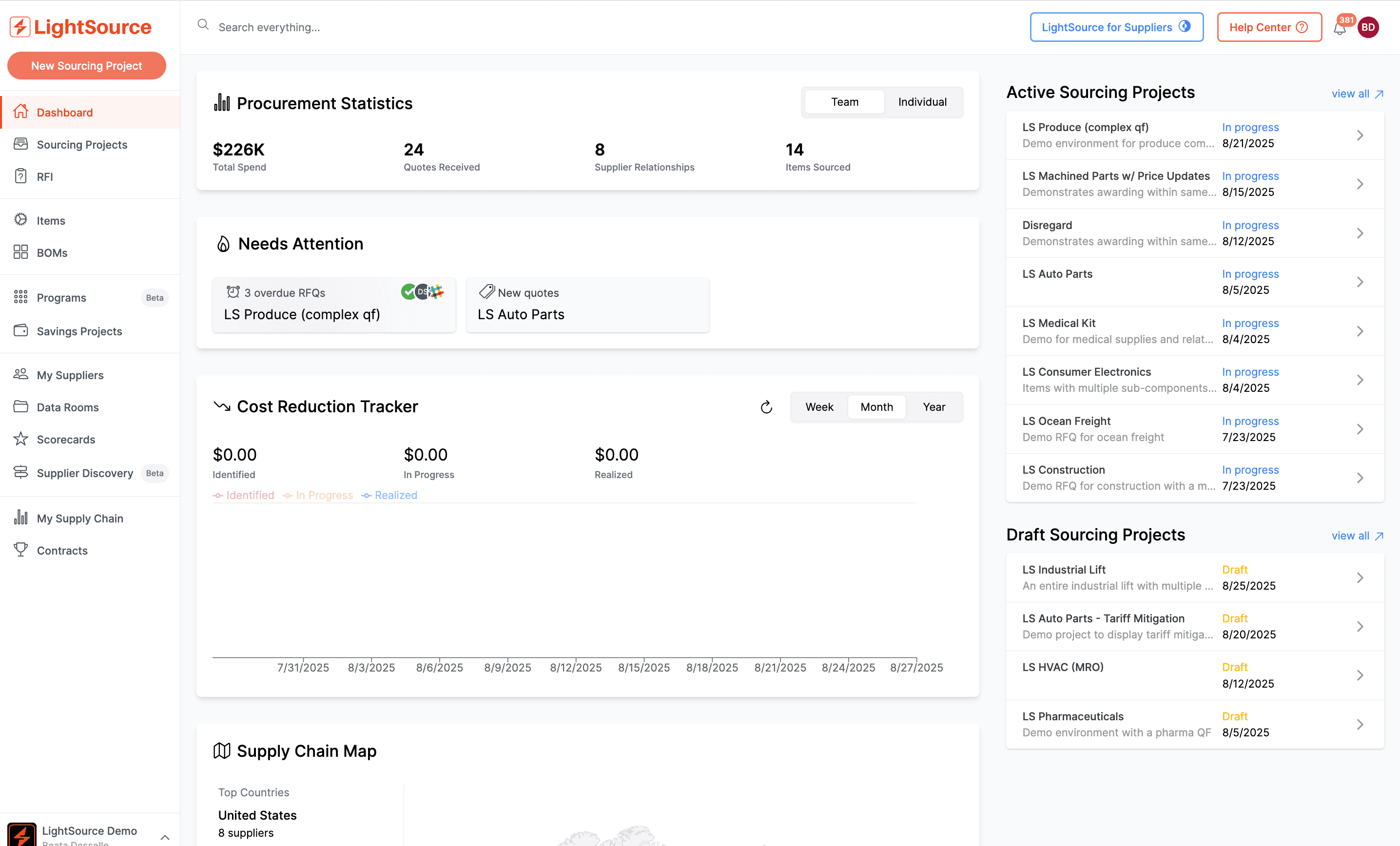
LightSource starts with the part record. It ingests BOMs from product lifecycle systems, flat files and supplier material, then keeps versions tied to drawings and sourcing events. Buyers can build RFQs, invite suppliers, compare bids line by line and test award scenarios. The platform records who quoted what, when, and against which revision. This sounds clerical until a design change alters the cost of a production run. Then the clerical detail becomes the commercial argument.
One part, one trail of decisions
The distinction matters in the software market. Broad procurement suites help organizations buy office supplies, software and other indirect goods. Spend analytics is useful after a purchase. LightSource concentrates on direct materials: steel, wiring, batteries, precision-machined pieces and the other things a manufacturer puts into its product. Its main rival in many purchasing departments is still the spreadsheet, admired because it bends to local habits and already sits on every laptop.
Who pays to remember?
LightSource sells to enterprise buying organizations on a platform-and-seats model; the company does not publish list prices. Implementation is described as included, and suppliers can respond without paying. The arrangement has a plain commercial logic. A buyer gains little from a tidy system if a supplier refuses to enter a quote. Free supplier access lowers that barrier, while the enterprise pays for the record and the workflow.
Its named customers span food, vehicles, bedding, chemicals, industrial equipment and specialty distribution: Yum! Brands, BRP, HelloFresh, Serta Simmons Bedding, Shure, Arxada, Time Manufacturing and Aramsco among them. That variety is evidence of a horizontal problem rather than a single-industry trick. LightSource also says its network contains more than 20,000 suppliers. For a new program, a buyer can look for a supplier, send a part-level request, receive structured quotes and keep the award attached to the part. For an old program, the buyer can ask why a price moved.
The bucket truck test
Time Manufacturing, maker of Versalift equipment, offers one of the clearer public tests. Its highly configurable products made BOM costing difficult, and its sourcing team relied on email and spreadsheets. Global sourcing director Nico Orduz brought LightSource in as the primary RFQ tool. The company says it ran more than 200 projects involving over 2,500 items through the platform. It identified more than $10 million in possible savings; over $5 million became awarded savings. Those are customer-reported results, and the distinction between possible and awarded is important. Only the latter reflects sourcing decisions actually made.

Aramsco, a distributor, describes a different nuisance. It ran a large number of recurring RFPs, yet supplier contacts, specifications and previous decisions lived outside a durable system. Reopening a project after a year could mean reconstructing it. The company says its cycle times fell from months to weeks after centralizing the work, and that it achieved seven-figure savings across sourced spend. The useful lesson is almost embarrassingly simple: saving a decision can be as valuable as accelerating the next one.
What the AI is asked to do
LightSource came out of stealth in 2025 with about $33 million in combined seed and Series A funding, co-led by Lightspeed Venture Partners and Bain Capital Ventures, with J2 Ventures participating. The announcement gave a $130 million valuation and said annual recurring revenue had grown tenfold over the preceding 18 months. It did not disclose revenue in dollars. Penn and Mintz used the capital to scale a product that had already processed, by the company’s count, more than $1 billion in spend since 2024.
In July 2026 the company launched AI Workforce. Its five capabilities answer questions about sourcing data, clean incoming item files, set up RFx events, prompt suppliers and model awards. One advertised example reduces quote-format setup from two weeks to 15 minutes. That is a product claim, not a guarantee for every manufacturer. The more durable feature may be the connection between steps: if the system knows the part, the supplier, the last quote and the latest engineering change, an AI prompt has a useful context in which to act.
There are limits. A plant buying a handful of simple parts may be well served by email and Excel. A complex organization must still provide reliable specifications, persuade suppliers to participate and decide how much authority software should have over awards. LightSource’s own sales argument depends on a buyer keeping those judgments while software takes on the clerical chase. The best first move for a team curious about the approach is modest: take one recurring RFQ, keep the drawings and quotes in a single record, and compare its next revision with the last. If nobody has to reconstruct the story from old emails, the experiment has already taught something.