A purchase request is a tiny confession. Somebody needs a centrifuge, a replacement laptop, three cases of gloves or a suspiciously ergonomic chair. The employee wants to buy it now. Finance wants to know the budget, vendor, account code, approver and policy. The invoice will arrive later, often carrying a different description and an urgent note. Procurify exists in the awkward space between that desire and the final debit.
The Vancouver company sells a cloud control layer for the whole trip: request, approval, purchase order, receipt, invoice, payment, expense and card transaction. It does not primarily ask a mid-market company to replace its accounting system. It gives employees a friendlier front door, then sends cleaner records into NetSuite, QuickBooks, Sage Intacct or Microsoft Dynamics 365 Business Central. That is the unglamorous trick. Procurify tries to make spending easy enough to follow and structured enough to trust.
Its public customer list stretches from biotech and healthcare to schools, nonprofits, manufacturers and transportation operators. These are organizations where purchases scatter across locations and departments, but a Coupa-sized implementation can feel like acquiring a second bureaucracy. Procurify’s pitch is the middle lane: more control than email and spreadsheets, less machinery than a global enterprise suite.
01 / The wedgeThe software people will actually open
Aman Mann, Eugene Dong and Kenneth Loi met in a British Columbia Institute of Technology business program and began working on Procurify in Dong’s parents’ basement. Their observation was simple: procurement software existed, but affordable and usable procurement software for smaller organizations was thin on the ground. Many employees still requested purchases by email, paper form or spreadsheet. Finance learned what had been bought when the bill arrived - precisely when leverage had disappeared.
Procurify moved the control point forward. A requester enters what they need. The system checks the relevant budget and routes the request according to amount, department, location or other rules. An approved request becomes a purchase order. Receiving records provide the second piece of evidence; the vendor invoice provides the third. Matching the three tells accounts payable whether the organization got what it approved at the price it expected.
One controlled line from intention to cash
The value is easiest to see when the old process is truly bad. Canal Barge, a New Orleans marine transportation company, said its requisition cycle once took about 29 days. Physical purchase orders, duplicate data entry and multi-step approvals had left it roughly a month behind. After standardizing the workflow and connecting an Amazon Business PunchOut, the company reported cutting the cycle to one day. Sahara Kuwait described requests falling from seven to ten days to a few hours. Reena, a Canadian nonprofit with multiple locations, reported moving about 90 percent of spend into Procurify and reducing average approval time from 100.7 hours to 48.6.
“We were able to get our requisition cycle time down from about 29 days to one day.”Skye Durant, Canal Barge
Those numbers are customer case studies, not a universal guarantee. They still reveal the best sales lesson in this category: measure the clock before touching the workflow. “Transformation” is mush. Twenty-nine days becoming one is a story a CFO can repeat.
02 / The productFrom clean forms to agents that act
The original product concentrated on purchasing and budget control. Procurify has since expanded across accounts payable, payments, employee expenses, physical and virtual cards, contract records, vendors and spend analytics. Its PunchOut catalog connections let an employee browse a supplier such as Amazon Business, Staples, Home Depot, Grainger or Uline, then bring the cart back for approval. The shopping feels familiar; the control happens before checkout.
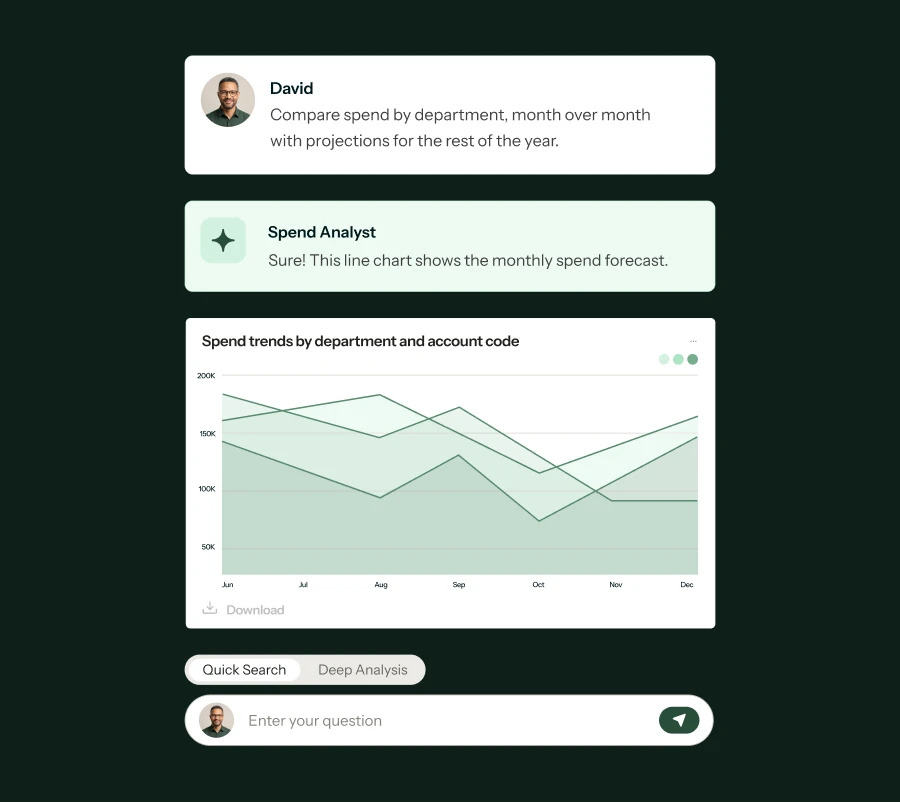
The latest turn is “agentic procurement,” a phrase with a generous marketing allowance but a concrete product underneath. Guided Intake lets an employee describe a need in ordinary language. The agent drafts the request, checks prior orders and policies, and asks for missing details. Order Autopilot suggests the vendor, general-ledger code and budget line using the organization’s own purchase history. Spend Analyst answers questions about trends and suppliers. A rebuilt AP engine extracts and matches invoice data; Procurify claims accuracy above 99 percent.
The distinction Procurify wants buyers to notice is context. A generic chatbot knows language. This system knows that the marketing team buys laptops from one vendor, charges them to a particular code and needs approval over a set amount. Users can accept, edit or clear what the AI drafts before submission. In financial software, the interesting feature is not that a machine can guess. It is that the guess arrives inside permissions, budgets and an audit trail.
AI is useful here only when it knows the policy, shows its work and hands the exception back to a person.
That also explains what failed first in the old world. It was not invoice payment. It was intake. Incomplete requests created follow-up email; follow-up delayed approval; poor coding polluted reporting; the bad record then traveled downstream. Procurify’s product evolution follows that chain backward. Better AP automation matters, but preventing dirty data at the request is cheaper than repairing it at month-end.
03 / The economicsWhat it costs, and what it really sells
Procurify is subscription software sold on annual, custom contracts. Purchasing is the base. Customers can add AP, Expense & Card, Contracts and Guided Intake, with quotes shaped by products, integrations and the number of Pro users. Basic users who mainly request or receive items can be unlimited. The company does not publish a universal price. One public AWS Marketplace contract lists the platform at $30,000 for twelve months, a useful reference point but not a promise of anyone else’s quote.
Implementation is part of the cost. Procurify publishes target packages from four weeks for a basic deployment to twelve weeks or more for premium work, with NetSuite configuration occupying its own tier. That is faster than the many-month enterprise stereotype, but it is not plug-and-play magic. Someone must define approval routes, clean vendors and account codes, map the ERP, train approvers and decide who owns exceptions.
Three customer clocks, before and after
Relative bars visualize company-published customer results. Different customers, workflows and measurement windows are not directly comparable.The business model is classic land-and-expand SaaS. Get purchasing into the company, invite a broad base of requesters, then add adjacent workflows as complexity grows. The deeper defense is integration and historical context. Once approval rules, vendors, budgets, orders and invoices live in one system, replacing it is not merely a software switch. It is process surgery.
Funding has financed that expansion. Disclosed rounds include $4 million of seed funding in 2015, $7 million in Series A funding, $20 million in Series B funding and a $50 million Series C in 2023. CIBC Innovation Banking added $20 million in growth capital in 2024 alongside the AP launch. In early 2025, SaaS veteran Chad Gaydos became chief executive while Mann moved to chief strategy officer - a founder-to-scaler handoff before the agentic product push.
04 / The odd lessonA smaller week survived a financial scare
Procurify’s most memorable operating experiment began under stress, not abundance. When the pandemic darkened its outlook, leadership wanted to avoid layoffs. The company reduced salaries by 20 percent and paired the cut with a four-day workweek. Within months it restored salaries to full levels. It kept the shorter week after reporting gains in productivity, efficiency and morale.
The detail that changed the idea from austerity to policy was not the day off by itself. It was evidence that output held up after pay returned. The lesson is easy to flatten into “work less, win more.” The copyable version is stricter: make the sacrifice temporary, reduce hours with pay, define the output that must remain healthy, restore compensation quickly and let results decide whether the schedule survives.
The playbook worth stealing
- Measure the ugly baseline: cycle time, approval time and off-system spend.
- Put a simple request in front of the transaction.
- Encode budgets, ownership and exceptions before adding AI.
- Connect to the existing ledger instead of demanding a rip-and-replace.
- Automate the common path; route unusual money decisions to humans.
05 / The marketThe useful middle is not for everyone
Procurify competes from several directions. Coupa and SAP Ariba offer broad enterprise suites. Zip emphasizes intake and orchestration. Ramp, Airbase and Spendesk begin closer to cards and expenses. Precoro and ProcurementExpress.com court teams that prize simpler purchasing. Tipalti and Stampli approach from accounts payable. Procurify’s answer is procurement-led breadth for mid-market organizations: one workflow from request to payment, with ERP integrations and a mobile interface ordinary employees can tolerate.
When it earns its keep
Multiple locations, meaningful approval chains, recurring vendor spend, an ERP already in place and enough transaction volume to make visibility valuable.
When it probably will not
A tiny team with a handful of vendors, undefined policies, unwilling approvers, or a global enterprise that needs deep sourcing and highly bespoke supply-chain controls.
The conditions matter because software cannot rescue an organization that refuses to choose owners or enforce policy. AI compounds the point. If vendor names are duplicated, account codes are inconsistent and exceptions are the norm, historical context becomes historical clutter. The agent may move faster, but it will move through fog.
Procurify’s wager is that enough mid-market companies have crossed a specific threshold: too large for the shared spreadsheet, too impatient for an enterprise overhaul, and newly willing to let software prepare routine decisions. The company has turned the evidence of past spending into product context. If that context stays clean, its agents can remove clerical work without removing control. If it does not, the best feature will remain the oldest one: a clear request, sent to the right human, before anybody buys the chair.