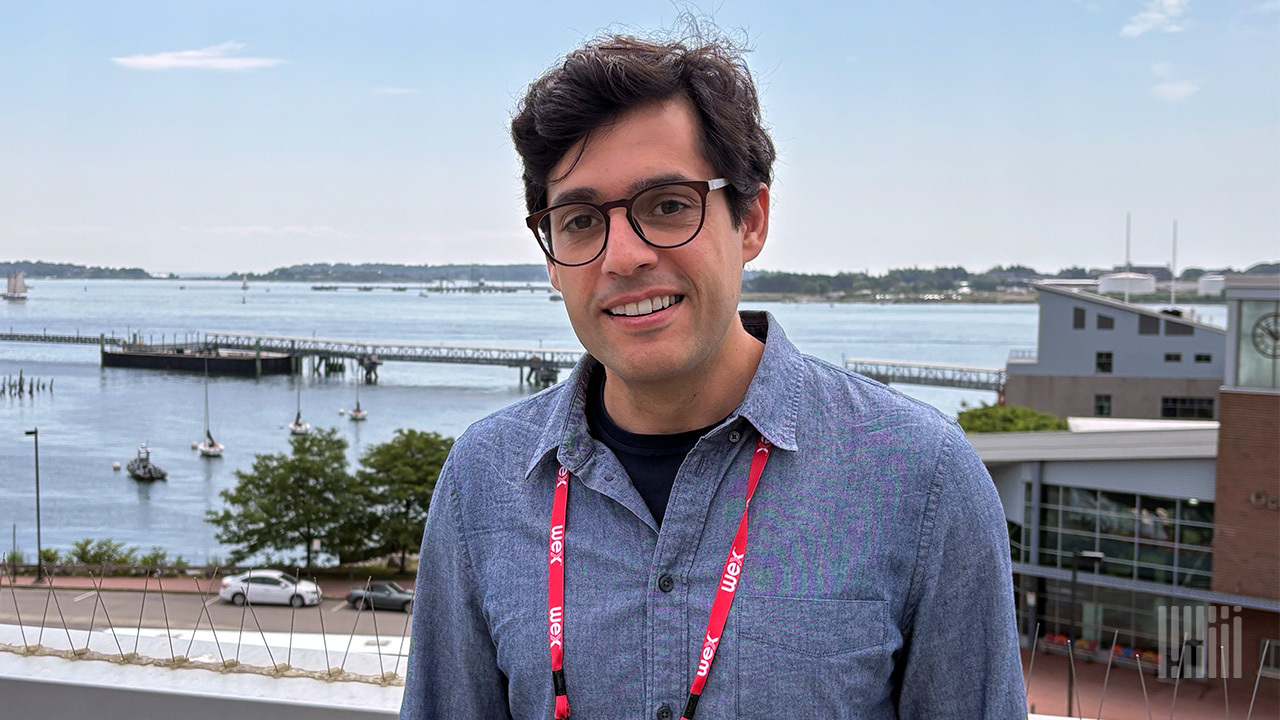
By July 2025, Marc El Khoury had a trucking company of about 200 vehicles and a question for the people financing the future of freight. Why had so much technology money gone into brokerages when the wasted capacity he wanted to fix was sitting inside fleets? At a WEX-backed gathering in Portland, Maine, he was making the case for algorithms while his trucks continued to burn diesel. The setting offered a tidy visual joke: an entrepreneur talking about the future, with a very present-day fuel bill.
His proposition began with an everyday indignity. A driver finishes a delivery, then waits to discover what happens next. The truck exists. The driver is ready. Time passes anyway. El Khoury wanted the next assignment arranged before that moment arrived. In an industry measured in miles, he had become interested in the hours between them.
“A driver should never have to call their dispatcher and say, ‘I’m waiting for my next load,’” he said in 2022. It is a modest-sounding ambition for a venture-backed founder. It also commits him to a difficult promise: the system must keep working after the presentation ends.
El Khoury’s route to that promise ran through engineering, business school, consulting and a strategy job inside a trucking company. He eventually chose to run a carrier himself. That decision put his ideas in contact with drivers, customers, equipment and invoices. By late 2025, it would also put them in contact with a severe contraction.
An engineer changes the material
He earned a bachelor’s degree in civil engineering at the American University of Beirut, followed by a master’s in civil engineering at the University of California, Berkeley. An MBA at NYU Stern added another kind of system to his education: the business. His early career included project management at Langan Engineering and work at Booz & Company. At A.T. Kearney, his roles progressed from associate through manager to principal.
The progression matters because aifleet did not emerge from a founder discovering trucks on a spreadsheet one afternoon. Before starting it, El Khoury worked as chief strategy officer at U.S. Xpress. He had seen the industry both as a consultant and from inside an operator. His public career story, including a 2023 Beyond Consulting appearance, follows that move from engineering into advising businesses, then taking responsibility for one.
There is a practical difference between recommending that a company change and having to make payroll after it does. Founding a carrier meant accepting that difference. With co-founder Mark Farkas, a programmer who had encountered similar industry problems in Europe, El Khoury started aifleet in 2020. The pair chose to build their own operations around the technology they wanted to use.
Their starting point was driver utilization. El Khoury argued that carriers could hire large numbers of drivers and still struggle because they could not retain them. Waiting time and poorly sequenced work made the job less productive. More recruiting, in his view, could leave that underlying arrangement intact.
A calendar with wheels
An assignment looks simple when written on its own: collect a load here, deliver it there. The complication arrives with the next load. Where will the driver be afterward? When can the receiving warehouse accept the truck? How much time remains? Does this sequence make it possible to get home? A locally attractive job can produce an awkward week.
Aifleet’s planner assembles sequences of loads rather than treating each move as an isolated purchase. Its stated aim is to reduce empty travel and gaps between assignments while fitting drivers’ schedules. The company also built pricing tools, tracking and its own transportation management system. The technology reaches into the booking process and the office work surrounding the trip.
For El Khoury, that connection is the point. A booking decision has consequences on the road. An appointment has consequences for the next booking. The driver experiences those consequences as an actual day, rather than separate departmental results. A route can be elegant on a screen and miserable to work. Designing around the person driving it makes that mismatch harder to ignore.
In his August 2025 essay, he argued that software vendors face an execution problem: a recommendation only creates value if an operator can carry it out. He described a carrier that combines software and operations as a way to shorten the distance between an idea, a deployment and a measurable result. It is an argument for taking on more responsibility, along with more opportunities for things to go wrong.
The driver gets a vote
The human side of El Khoury’s model is unusually concrete. Aifleet describes guaranteed home time, greater earning opportunities from increased mileage and a commitment to treating drivers with respect. Those promises give the scheduling work a purpose beyond improving a chart. Time reclaimed from waiting can become paid work; a better sequence can make a return home possible.
There is a useful restraint in how to read that promise. A company’s description of its approach is an ambition and an operating claim. The test happens in the schedules people receive and the pay they take home. El Khoury chose a business in which the people affected by the model can tell him, trip by trip, how it is working.
By September 2024, he described automatic load assignments and fully automated spot pricing. Driver feedback went back into the technology. He also spoke about preparing planning tools for autonomous trucks, while observing that a vehicle without a driver would still encounter warehouse schedules and receiving constraints. Removing one constraint would leave others in place.
That observation makes his interest in trucking more specific than a general enthusiasm for AI. He keeps returning to the organization of work: which load belongs with which truck, and what should happen next? His algorithm has to accommodate an appointment. The appointment is under no obligation to admire the algorithm.
The app needed a trucking company
On September 10, 2024, aifleet announced a $16.6 million Series B led by Tom Williams at Heron Rock. Volvo Group Venture Capital joined a group that included Obvious Ventures, Ibex Investors and Compound. The announcement put total funding near $50 million and directed the new money toward research, operations, sales and infrastructure.
The company reported more than 40 percent higher utilization than the industry average. That figure describes aifleet’s own comparison, rather than a universal performance guarantee. It helps explain the attraction of El Khoury’s thesis: spread a truck’s fixed costs over more loaded miles and the arithmetic can improve without requiring a more expensive piece of equipment.
He expressed the workload plainly in his funding announcement on LinkedIn: “We know it will take much more than an app to create real, long-lasting impact in the trucking industry.” He thanked office employees and truck drivers alongside investors. The acknowledgment suited a business where writing the software and running the fleet were happening together.
Ibex’s investment account traced its relationship with him back to his U.S. Xpress role, then through backing aifleet’s Series A and investing again in 2023. Its explanation concentrated on integrating the technology with the business using it. For El Khoury, those connections brought capital and partners to an idea he had already chosen to operate himself.
“We know it will take much more than an app to create real, long-lasting impact in the trucking industry.”
Marc El Khoury · September 2024
The market sends its own instructions
The November 2025 reversal belongs in the same story. Aifleet was reducing its fleet and cutting jobs after a key supplier terminated a contract. El Khoury declined to identify the supplier. A fleet recently around 180 trucks was headed for a substantial reduction; he said the personnel cuts would approach 100 and include office employees. He said the company continued operating.
He also described moving toward a fully contract-based freight business from a mix weighted toward contracts. These were decisions about survival and profitability in a difficult market. A better scheduling engine did not exempt aifleet from the need for funding, dependable counterparties and freight that paid enough.
The episode complicates the earlier growth story. It would be easy to make the funding round the climax, place a photograph beside a large number and stop there. El Khoury’s subsequent decisions supply a more demanding ending to that chapter. Running the company required him to reduce the operation he had built.
The distinction between efficiency and durability matters here. More output from an asset can improve the economics of a job. It does not, by itself, determine demand or make every commercial relationship dependable. His experiment in organizing freight remained exposed to the ordinary pressures of freight. The technology had to earn its place inside a business that still needed to endure.
Still asking about the missing hours
In August 2026, El Khoury appeared on David Quick’s The High Performance Herd to discuss fleet utilization, asset productivity and building technology around drivers. The conversation returned to the question that had shaped aifleet: how much capacity can a trucking operation find inside the assets it already has? The continued emphasis is revealing without requiring a claim about the company’s eventual outcome.
Aifleet’s subsequent public updates have described automating repetitive office work so staff can spend more time handling exceptions and customer relationships. That work is less photogenic than a truck. Yet a carrier has to collect money, reconcile transactions and answer questions as well as move freight. El Khoury’s proposal reaches into those tasks because they belong to the operation too.
What distinguishes his career is the decision to make an argument operational. An engineer became a consultant, then a trucking executive, then a founder responsible for the fleet testing his ideas. The sequence gave him several ways to look at the same problem. Building aifleet meant choosing a way to answer it that could be inspected in practice.
His ambition is to make trucking more productive while giving drivers a better working life. The difficult part sits in that “while.” The company must arrange commercially useful work around people who have places to be. El Khoury keeps asking where the lost hours went. A satisfactory answer would show up in something refreshingly ordinary: the next load ready, and a workable route home.