Before Clarence L. “CL” Werner could haul anybody’s freight, he needed a trailer. He had bought a 1956 Ford truck, using his car to get started. The trailer required a different kind of capital: a grandfather with a welding shop, and a grandson who had paid attention. Together, they built it. The first piece of Werner Enterprises had a family workshop in its supply chain.
There is something reassuringly awkward about that beginning. A truck without a trailer is an ambition with a missing part. Werner filled the gap with a skill learned on the farm. He was 19. The business that would eventually trade on Nasdaq began with work he could do himself, equipment he could put together, and the need to earn a living.
Seventy years later, the blue trucks offer a familiar sight on American roads. Yet the more interesting distance in Werner’s life runs from doing the work himself to depending on other people to do it. Eventually, it ran all the way to letting somebody else lead the company.
A trailer before a fleet
Werner was born in 1937 on a farm near Petersburg, Nebraska, the third of seven children. The household lived without electricity or hot running water. Winter could leave snow on the bedcovers. He remembered a happy childhood nonetheless, with room to roam and chores that gave the day its shape. Comfort and contentment, in his telling, had different addresses.
Farm life supplied an early acquaintance with machinery. He drove a tractor at seven and pickups by ten. He left school in ninth grade expecting to farm. Drought changed the calculation. At 18, he went to Omaha, where he found work in a steel foundry. The route into trucking began with an agricultural plan that the weather would no longer support.
Those details help explain the homemade trailer. Welding belonged to the world he already knew. His grandfather’s workshop had given him something useful before he knew precisely how he would use it. A childhood interest became a way to equip a business. The lesson came without a prospectus.
Thirty years to the stock market
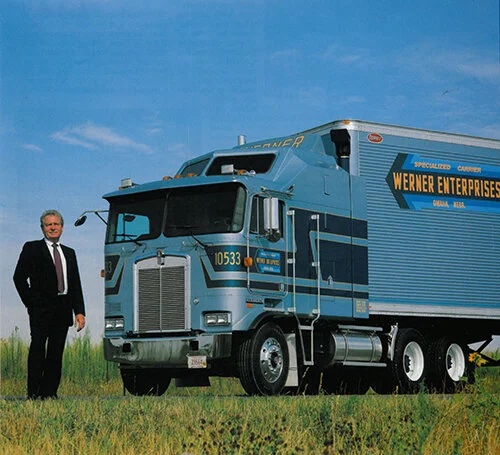
The business acquired the Werner Enterprises name in 1959. Expansion brought more vehicles and a move out of the house into a shop in Council Bluffs, Iowa. In 1971, Werner made a purchase of ten Freightliners. Maytag became its first Fortune 500 customer in 1975. These are useful milestones because they describe the less cinematic business of becoming dependable to somebody larger than yourself.
A customer needs the shipment to arrive. A growing fleet needs drivers, maintenance, office work and a way to coordinate them. Every additional truck adds opportunity, along with another set of obligations. The founder who starts by driving must gradually learn to organize a working day he cannot personally see from beginning to end.
In 1977, the company established its Omaha headquarters. Werner operated the business as a sole proprietorship until incorporation in September 1982. He became CEO in 1984. The public listing followed in 1986, under the ticker WERN. Three decades separated the first Ford from the stock market. That is a considerable amount of ordinary work for an origin story to swallow.
First driver.
Ticker: WERN.
The handoff.
By the mid-1990s, the fleet had reached about 4,000 trucks, compared with 630 at the IPO. That change asks more of an organization than multiplication alone suggests. A driver can decide what to do next in one cab. Thousands of cabs require people making good decisions at the same time, often a long way from the founder’s desk.
The public company added another audience to the business. Werner’s service had to satisfy customers, while its results also had to make sense to shareholders. The surname on the trailer now appeared beside a stock ticker. The distance between those two uses of a name is one measure of the change in his working life. The truck still had to deliver; a public company had many more people waiting to see how the whole operation performed.
A driver’s license behind the desk
Werner’s first job at the company never entirely disappeared under the later titles. In 2020, Derek Leathers described a founder who had kept his commercial driver’s license and still drove at points along the way. The license is an unusually concrete executive credential. It allows a conversation about trucking to include the person who actually has to put the vehicle on the road.
Leathers also described a company where long service was common, including careers measured in several decades. That gives the usual language about a founder’s influence some substance. People who stay carry memories, habits and expectations into the next working day. A company can change its equipment much faster than it changes everything its colleagues know about one another.
The equipment and systems did change. Satellite communications entered the fleet in the 1990s. In 1998, Werner implemented electronic logging devices nationwide, well ahead of federal requirements. The farm-trained driver’s company became an adopter of technology that could make the work of a dispersed fleet more visible. The practical problem remained recognizable: knowing what was happening to the freight and the people moving it.
“Be honest, work hard, and treat people right.”
CL Werner
At the company’s sixtieth anniversary in 2016, Werner described his continuing interest in customer value and career opportunities. It was a useful pairing. Freight provides the commercial reason for a trucking business to exist; the work also provides a livelihood for the people who keep it operating. His attention extended to both sides of that exchange.
The second handoff
Werner’s withdrawal from executive life came in stages, with a return along the way. He served as CEO until 2007 and remained chairman until 2011, when he became chairman emeritus. In August 2015, he returned as chairman and again assumed the CEO responsibilities. His sons Gary and Greg had also held senior leadership positions in the business.
By 2016, Leathers had taken over as CEO, and Werner became executive chairman. The title left him closely connected to the company he had founded. Four years later came another transfer of responsibility. Effective May 31, 2020, he stepped down as executive chairman while remaining chairman of the board. Leathers became vice chairman, with the next step already contemplated.
On May 11, 2021, the board approved Leathers as chairman and named Werner chairman emeritus. Werner publicly praised the decision to hire Leathers. The first driver was putting his confidence in somebody whose work would determine what happened after his own period of control.
The sequence matters. A retirement date can make succession look like the closing of a door. Here, responsibilities moved across several years. For a company so closely identified with a founder, the transfer becomes part of the business he built: an arrangement through which other people acquire the authority to carry on.
The paperwork caught up
The later record includes a regulatory settlement. In December 2021, Werner agreed to a $486,900 civil penalty to settle charges that acquisitions of Werner Enterprises stock had failed to comply with Hart-Scott-Rodino reporting requirements. The transactions included stock-option exercises, open-market purchases and restricted-stock vesting.
The reporting rules can apply when additional purchases, combined with existing holdings, cross a filing threshold. The complaint covered acquisitions over several years. A federal court entered final judgment in April 2022. The episode belongs alongside the growth and honors in an account of his career: ownership of the business also carried obligations under rules governing large share acquisitions.
What the farm sent forward
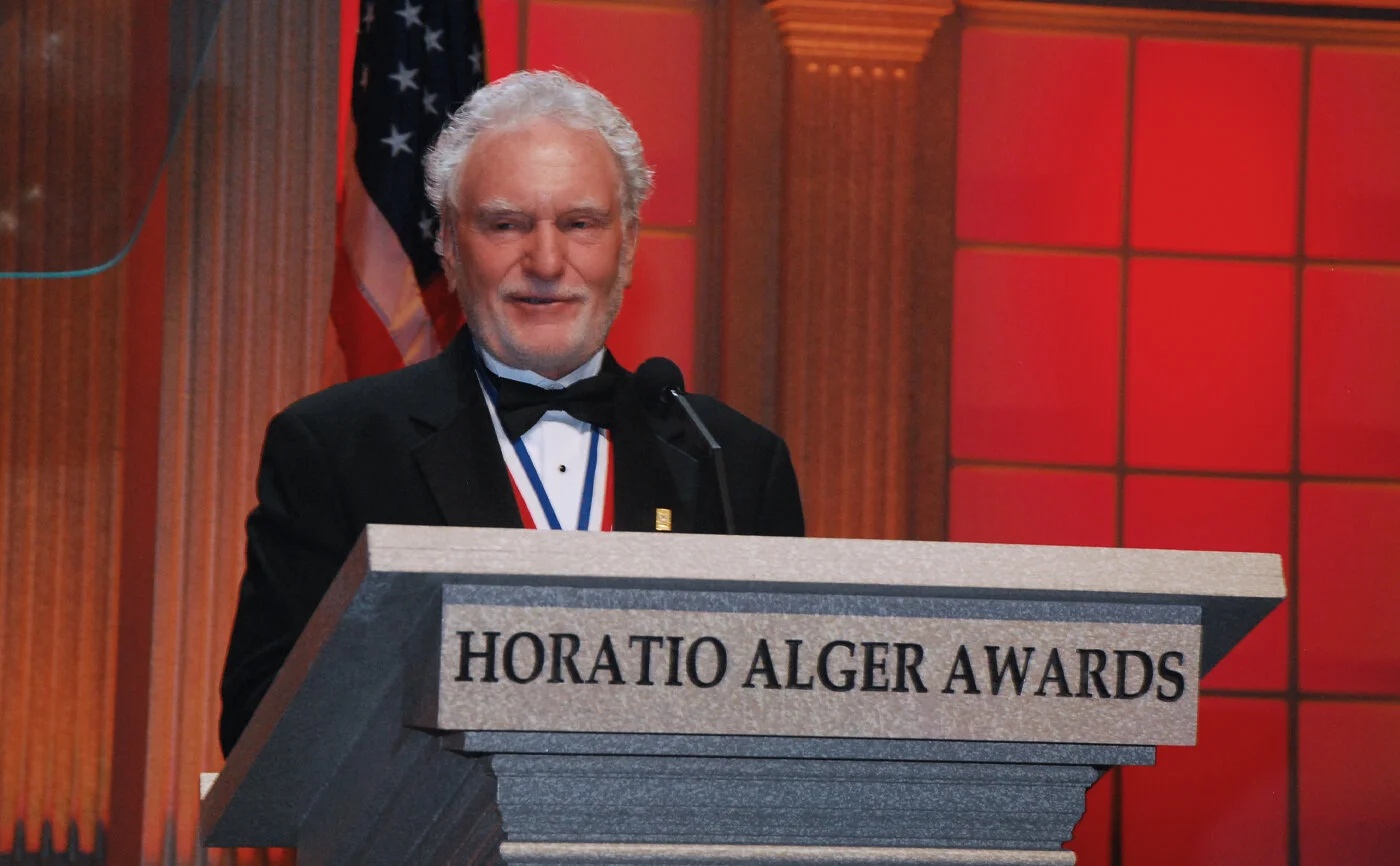
Recognition arrived in forms far removed from the first trailer. Werner received the Horatio Alger Award in 2012. Creighton University awarded him an honorary Doctor of Business Administration in 2018. The honorary degree makes a striking companion to his early departure from school. A working life had taken him into rooms his ninth-grade self had little reason to expect.
Giving offered another way to carry family experience forward. The CL Werner Foundation was established in 2008. His wife Rachel, a director from its formation, became president in 2011. Werner serves as honorary chairman. The foundation has supported local and national charities as well as organizations working internationally. He traces the habit to parents and grandparents who gave despite having little.
Its stated hopes for future generations include perseverance and generosity. That connects the later chapter to the earlier one without making them identical. The grandfather’s workshop helped one young person put equipment on the road. A foundation can help other people find the resources to act on their own plans. The scale changes; the usefulness of a helping hand remains easy to understand.
In 2026, Werner Enterprises marked 70 years in business and 40 years as a public company. Its anniversary announcement looked back to the single truck. An August announcement planned a Nasdaq bell ceremony led by Leathers with employees and drivers. The company’s next chapters were already being written by other people.
Return, finally, to the trailer. Even at the beginning, Werner had help. The boy who learned in his grandfather’s shop became the founder who needed colleagues, customers and a successor. The business grew beyond what one driver could do. Getting other people into the story was part of how it kept moving.