A dollar is a wonderfully misleading price for a building. In 2021, Reset Ventures, the foundation associated with Brad and Kathleen Playford’s WheelFish Group, acquired Muskegon’s Hackley Administration Building for $1. The number made a tidy headline. The building supplied the complications: a clock tower, old masonry, an immense amount of history, and the question of what people might use it for next.
For Brad Playford, founder and former CEO of AvaSure, it belonged to a growing collection of projects in Muskegon. There were existing businesses to build upon, organizations to support, and familiar places whose useful lives could be extended. The appealing purchase price was the smallest part of the undertaking. Old buildings have an excellent technique for collecting the balance.
His career offers an unusual route into that world. It passes through network software, circuit boards, a public offering, and the company he founded in 2008. Yet the local work has its own history. Years before he handed over AvaSure’s CEO role, Playford was already looking at another Muskegon school and considering what might happen when a growing business moved inside.
A career before the founder title
Playford graduated from Michigan State University in 1983 with a bachelor’s degree in materials and logistics management. His early executive experience included sales and marketing at V-Systems from 1989 to 1994, followed by senior roles at Power Circuits and TTM Technologies. At TTM, his work included marketing, strategy, and the company’s renaming and rebranding before its September 2000 public offering.
Those roles placed him in the practical business of making an enterprise understandable: to customers, colleagues, and prospective investors. A company needs a product, but it also needs people to understand why it deserves their attention. The rebranding assignment is a useful early detail in a career that would later involve founding an enterprise of his own.
AvaSure followed in 2008. Playford led the company through its formative years and subsequent expansion. By November 2020, its leadership structure was changing, with longtime colleagues moving into senior positions and his own emphasis shifting toward strategy and vision. Kyle Pett became president and chief operating officer; other appointments divided responsibility across the growing organization.
In March 2022, Adam McMullin succeeded him as CEO. At that handoff, Playford continued as board chairman and adviser. “Adam is the right person to lead AvaSure and advance its mission,” he said. The announcement marked a clear change in responsibility after roughly fourteen years. It also supplies a useful dividing line in his working life, although his Muskegon projects had already begun crossing it.
An old school, an earlier clue
Nims Elementary School had closed in 2012. By 2017, AvaSure was proposing a new set of uses for the property: professional offices, research and development, light assembly, and a small business incubator. The proposal had to go through the city’s planning process because the building stood in a residential district. A school’s next chapter required rather more than changing the sign.
The plans included room for the company’s own expansion and an innovation, research, and mentoring center. That center would support ideas beyond AvaSure’s immediate business. The proposed mix placed employment and enterprise in a building whose corridors had been designed for a different kind of daily activity.
In September 2018, the move was approaching. Playford described an initial group of fifteen to thirty employees at the site, with the possibility of more. The distinction matters: projected capacity and opening headcount are different numbers. What made the project interesting was the attempt to fit a growing company into an existing neighborhood asset.
The broader plans also made room for community gardens and public playfields. They suggest an approach to reuse that considered the grounds as well as the rooms. A neighborhood does not encounter a former school only through its front door. It encounters the edges, the grass, the paths, and the activity around it.
By late 2022, AvaSure’s headquarters arrangements were changing again, and Playford was considering further uses for Nims. A business can outgrow the space that once solved its problem. The building then presents its owner with another assignment. In Playford’s story, that repeated question helps connect the entrepreneur to the later investor.
The clock tower comes with responsibilities
The Hackley building raised the same question on a more conspicuous stage. Built in the 1890s with support from lumber businessman and philanthropist Charles Hackley, it had served as a school and later as the school district’s administrative offices. Its tower belongs to the visual vocabulary of downtown Muskegon. Whatever happened inside, people would notice what happened to it.
The 2024 plan was to convert it into a boutique hotel, under the proposed name Hackley Castle Inn and Suites. The announced scheme included approximately forty-five rooms and additional public-facing spaces. The renovation estimate was $11.5 million. That gives the dollar transaction its proper scale: entry was inexpensive; making the property useful again was a substantial project.
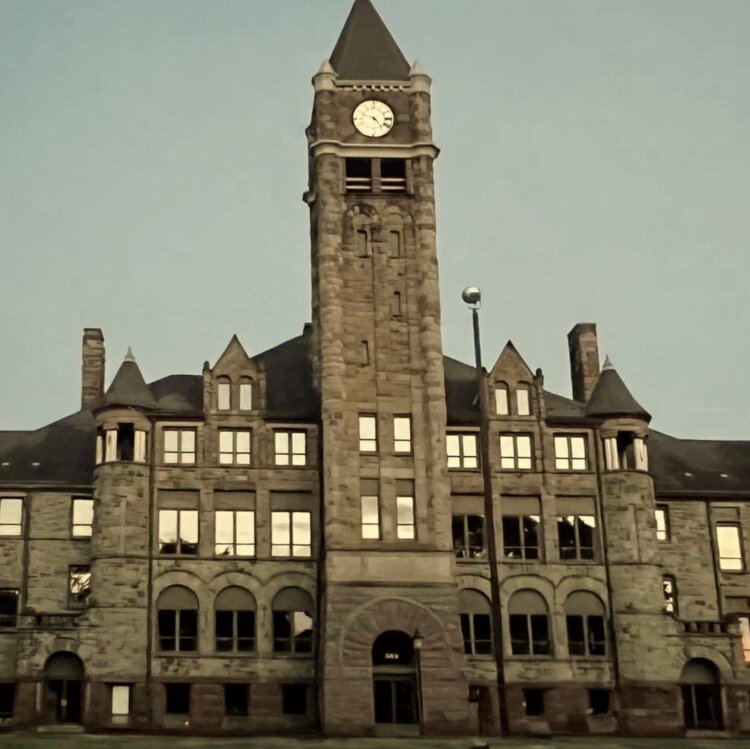
Structural repairs came first. A $2 million state allocation supported work on the roof and an exterior wall. Frank Peterson, then WheelFish’s vice president of operations, described the effort to save the failing south wall. A proposed room count attracts attention. A wall capable of staying where it belongs is a more immediate requirement.
Peterson brought his own local experience: he had been Muskegon’s city manager before joining WheelFish in 2022. The work therefore connected the Playfords’ investment office with someone familiar with the city’s institutions and development processes. Preservation here involved public decisions, private money, contractors, and a building that had already outlasted several uses.
The commercial rehabilitation districts approved for the Hackley and nearby Third Street projects added another piece. Local government could influence the cost of investment; the developer still had to give the space a workable purpose. That negotiation between an old structure and a future use is where the attractive idea acquires a budget.
“Listening is difficult. Practice listening and provide understanding as best you can.”
Brad W. Playford, LinkedIn
The rooms a gift can make
Alongside the property work sits a record of giving. Brad and Kathleen are named in the Muskegon Museum of Art expansion campaign’s $500,000-plus donor category. The expanded museum held its public opening in February 2025. Its new spaces included galleries, classrooms, collections storage, and areas for public events.
Those details give a contribution a physical meaning. A gallery needs enough space to show work properly. A classroom lets a group gather without displacing another activity. Storage helps an institution look after objects that visitors may never see. The museum’s expanded footprint serves all those purposes, including the less photogenic ones.
The Playfords joined other families, foundations, companies, and the city in supporting the campaign. Their place on that list puts the giving inside a shared undertaking. A museum addition depends on many decisions being made in the same direction, and on an institution prepared to use the result after the opening celebrations end.
Their earlier Reset Ventures Fund also supported local housing rehabilitation, cleanup work, literacy programs, and youth opportunities. One 2018 account connected summer work experience with adventure sports, including swimming, kitesurfing, and wakeboarding. The combination is specific enough to resist a vague label: a job, time on the water, and something new to learn.
That history adds another date before the AvaSure succession. The local giving was already part of the Playfords’ activities while Brad was running the company. His later investment office gave those interests another organizational home. The change in career emphasis expanded an existing thread.
A different kind of workday
WheelFish Group was formed in 2021 as the Playfords’ investment management and philanthropic office. Its projects connect commercial decisions with community ambitions: reuse of historic space, housing investment, and support for local organizations. The current Muskegon Growth Collaborative member list names Brad and Kathleen together as WheelFish’s owners and founders.
The partnership is visible in more personal details, too. The couple’s collection of early twentieth-century antiques featured in the proposed furnishing plans for some Hackley hotel rooms. Their interest in gardens also appears in accounts of their time in Muskegon. Objects and outdoor spaces bring a different texture to a biography otherwise full of company names.
None of these projects has the neat finish of a leadership announcement. A foundation continues making decisions. A building continues needing attention. A museum has programs to run. The work can be measured in occupied space and supported activity, but its timetable extends well beyond a single deal.
Playford’s second chapter is compelling for that change of scale. A founder who spent years building an enterprise now has a set of commitments that can be located on a walk through Muskegon. There is an old school, a museum, a clock tower. The next use of each place matters to people who may never need to know his former job title.