Before Michael Rea had a software company to sell, he had a Word document to send. The early version of Rx Savings Solutions involved handwritten research, individual requests, and answers delivered in a format familiar to anyone who has ever attached the wrong file to an email. It was a modest container for an idea that would occupy him for fifteen years.
There is something useful about keeping that document in view. In 2022, McKesson bought the company for $600 million upfront, with up to $275 million more contingent on performance. The price makes a convenient destination for a business story. The document tells us more about how Rea began: doing a job himself, slowly, before building an organization that could repeat it.
The unglamorous first version
Rea trained as a pharmacist, completing pre-pharmacy coursework at the University of Minnesota Morris before earning his doctorate at Creighton in 2007. His professional experience included managing a Walgreens pharmacy and working at OptumRx. He had spent time on the operating side of a complicated industry, where a useful answer had to survive contact with an actual customer.
He founded Rx Savings Solutions in 2008. At first, he fitted the work around his employment. Requests arrived; he researched them; he sent back an answer. The company’s first tools placed very little distance between its founder and the work. A document could be produced for one person. Repeating the process for many people required a different method.
The distinction matters because software businesses are often introduced at the moment the software becomes impressive. Rea’s beginning offers the less photogenic part: learning enough about a recurring problem to describe the work that a system would eventually need to perform. Stationery has rarely enjoyed such consequential employment.
A buyer changes the business
The early business also had to find its customer. An initial direct-to-consumer approach proved difficult to sell. An organizational buyer offered another route, asking whether the service could work for a group. By 2011, Rx Savings Solutions had undertaken an eight-month actuarial study with an insurer. A January 2014 account described a company increasingly working through employers.
This was a substantial business decision. Selling an individual on a service and persuading an organization to make it available to a population are different kinds of work. The buyer changes. The sales conversation changes. An idea that makes sense in a one-to-one exchange must acquire a repeatable commercial arrangement.
Rea left his day job in spring 2012. Two years later, a State of Kansas contract became an important turning point. Berkshire Hathaway Media and Blue Cross Blue Shield of Kansas City also became customers. The company was assembling the relationships that would allow its work to travel further than its founder could personally carry it.
- 01Do the workIndividual research
- 02Repeat the workA software system
- 03Find the routeOrganizational buyers
Persistence gets its paperwork
In August 2014, U.S. patent US8799018B1 was granted, naming Michael Rea and Douglas Besch as inventors. A business that had begun with manual investigation now had a formal record of its system. The patent provides a dated milestone in the years between the first requests and the later acquisition.
Those years were hardly a smooth procession of milestones. About six years into the company, Rea was ready to give up. That admission, made public after the sale, gives his preferred word, persistence, some weight. Continuing is easier to admire once the outcome is known. Before the outcome, it has bills attached.
By December 2017, the company had announced an $18.4 million funding round led by McCarthy Capital. Its customers included American Century Investments and Berkshire Hathaway Media Group. Capital and contracts were arriving around the same enterprise, giving the team resources to develop the business beyond its labor-intensive beginnings.
Recognition followed. Rx Savings Solutions appeared on the Inc. 5000 in 2018, then again in 2019, 2021, and 2022. In discussing 2018, Rea put hiring, client growth, and maintaining the company’s culture on the agenda together. Growth required attention to the people doing the work as well as the people buying it.
“Persistence is the most important character trait for an entrepreneur.”
Michael Rea · 2019 Kansas City Entrepreneur of the Year remarks
In November 2019, UMKC’s Regnier Institute named him Kansas City Entrepreneur of the Year. He told the gathering that knowing what one was fighting for helped during difficult periods. The honor arrived eleven years after he started. That is a respectable amount of time for an overnight success to spend getting dressed.

In a 2021 interview, Rea discussed a practical concern behind the company’s early sales strategy: it needed scale quickly. Large customers suited the economics of the model. Later, the business could serve smaller organizations too. That sequence adds another detail to the familiar account of entrepreneurial persistence. Staying with a company also means choosing an order for the work, deciding which customers it can serve now and which it must earn the capacity to serve later. Ambition still has to fit inside an operating budget.
The lawyer in the origin story
Brandy Rea belongs in the company’s beginnings as well as its award photograph. A lawyer, she helped Michael get the business running and later joined as its general counsel. The two had met at Creighton. Both graduated in 2007, carrying different professional qualifications into what became a shared enterprise.
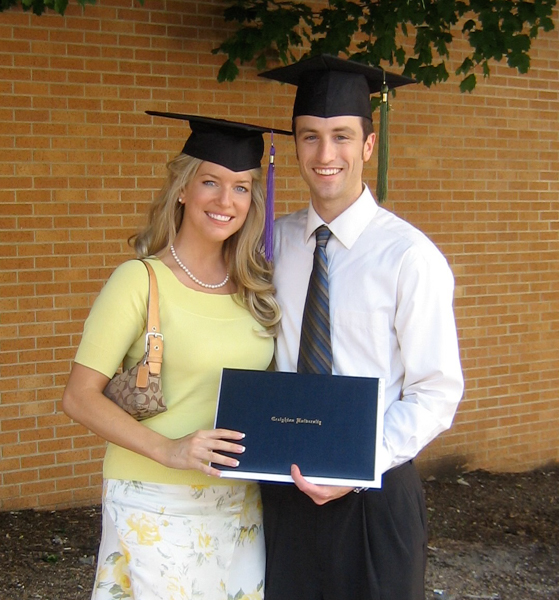
Michael has a reasonably economical explanation for the early arrangement: “I had to marry one.” It is a joke about affording legal help, and a reminder that a company’s requirements extend well beyond its founder’s original expertise. Useful ideas eventually encounter contracts. Contracts have a way of requiring someone who reads every sentence.
The partnership continued beyond Rx Savings Solutions. Their family foundation carries both names, and its work brings them together around decisions about grants and projects. The continuity is visible: two professional lives became involved in building a company, then in deciding where some of the proceeds could go.
The arithmetic of an exit
McKesson announced its acquisition agreement on September 19, 2022. At the time, Rx Savings Solutions reached more than 17 million members. Rea was still founder and CEO, speaking about the combination as a way to extend the company’s reach through a larger organization.
The announced transaction value was up to $875 million. Of that, $600 million was an upfront payment; a further maximum of $275 million depended on financial performance through calendar 2025. McKesson’s filing records the acquisition’s completion on November 1, 2022. The headline number came with conditions, as large numbers so often do.
Up to $875 million in total. Additional consideration depended on performance through 2025.
For Rea, the operating chapter continued into the next year. He left in fall 2023 after fifteen years as CEO. The company’s beginning and his departure bookend a long stretch of work: a manual service, a changed sales model, a software platform, institutional customers, and a buyer.
A cold call, a building, a playground
The next chapter has its own practical details. In 2025, Michael and Brandy committed $1 million to Haven on Main, a housing development in La Crosse, Wisconsin. The connection began after people involved in the project read a newspaper story about the family and called Michael. An unsolicited call, on this occasion, proved useful.
The project interested the Reas because of its approach to creating a shared residential community. Their contribution supported construction. For a founder accustomed to taking something from a proposition to an operating reality, a building offers an unusually tangible version of the question: what would help this get started?
Back in the Kansas City area, the family foundation partnered with Blue Valley Recreation and Variety KC on Brody’s Boundless Playground. Michael and Brandy attended the groundbreaking on April 9, 2026. Named for their son, the project placed shared play at the center of its design.
At that event, Michael described belonging as fundamental to the family’s support. The point was visible in the planned space: children and families could use it together. A public playground presents its own test of usefulness. People arrive, try the equipment, find their friends, and decide whether to return.
A different kind of opening day
On October 13, 2026, the playground held its ribbon cutting. Blue Valley Recreation announced public access beginning the following day. Its design incorporates shared play throughout the space, along with shaded areas and places to swing, slide, climb, and explore. The foundation’s support had become a place people could visit.
The Rea foundation describes itself as a private, non-operating foundation. It makes grants to eligible nonprofits, runs no public programs itself, and does not seek donations. Its published schedule has two grant-review periods each year. Even philanthropy, it turns out, benefits from a calendar.
That structure gives Michael and Brandy a defined role. Other organizations bring programs, local knowledge, and plans. The foundation provides resources. The projects differ in size and purpose, but each asks the family to judge whether its contribution can help useful work proceed.
Rea’s first business began with a person doing research and sending an answer. Years later, the tools include grants, partnerships, construction, and a gate opening onto a playground. The Word document has long since done its job. There are children waiting for a turn on the swings.