Jared Hollinger had a business to explain and a name to spell. On February 12, 2007, he appeared before Nebraska’s Banking, Commerce and Insurance Committee as president and co-owner of Homebuyers Incorporated. The company operated in Omaha, Lincoln, and roughly ten counties in eastern Nebraska. Before getting into the details, he warned the senators that he was a “first time testifier.”
Committee chairman Rich Pahls offered a little professional reassurance: “Watch us, we stumble ourselves.” Even a hearing about foreclosure protection could make room for a human moment. Hollinger supported the bill overall, while raising concerns about how particular provisions would affect transactions. He wanted lawmakers to understand the mechanics of the business he actually ran.
The exchange offers an unusually plain introduction to a future investment executive. Here was someone dealing with purchases, sales, lending, and contracts, obliged to explain them to people who could ask another question. Nearly two decades later, the vocabulary around him includes funds and investment platforms. That early scene still gives the career a useful starting point: a property business being asked to account for its workings.
Construction before capital
Hollinger graduated from the University of Nebraska-Lincoln in 2002 with a degree in construction management. The qualification belongs naturally beside a career in physical property. Buildings have schedules, budgets, and people responsible for getting things done. An investment in one eventually encounters all three.
By 2004, he was already a part-owner of Homebuyers Incorporated. That year also brought his marriage to Kimberly Leonard. A wedding announcement named Kirk Hanson among the fraternity brothers in the wedding party. Years later, Hanson and Hollinger would appear together again as general partners of Sower Commercial, alongside Darren Hicks. The connection predates the investment platform’s current name.
In 2009, Hollinger appeared on the Midlands Business Journal’s 40 Under 40 list, identified with Homebuyers Inc. The award recognized contributions to business and community. It placed him among a local group of entrepreneurs and professionals well before Sower’s later branding.
His career would encompass single-family houses, multifamily buildings, agricultural land, commercial property, retail, and tax liens. His professional biography puts his involvement in purchases and dispositions at more than 5,000 properties. The number describes participation across a career, rather than a personal collection of 5,000 front doors. It is a measure of repeated encounters with property in different forms.
Property purchases and dispositions involving Hollinger across his career, as reported in his professional biography.
Giving the separate businesses a common desk
In January 2022, Hollinger shared the introduction of Sower Investment Partners. The announcement described a rebranding effective January 1 and a mission built around relationships with accredited investors, independent registered investment advisers, and entrepreneurial real estate professionals. Behind those relationships sat finance and accounting, legal, technology, and operations teams.
There was a practical reason for bringing those functions together. The organization had invested across residential, multifamily, commercial, agricultural, distressed, and real estate securities strategies. Investors in that assortment needed a consistent approach to underwriting, analysis, and communication. A varied set of assets could share the same administrative discipline.
That is an unromantic part of an entrepreneurial story, and a consequential one. Buying a property produces a transaction. Owning it produces recurring work. Someone must track performance, explain changes, and keep the paperwork intelligible. The announcement made those supporting functions part of the proposition.
The name supplied a more pastoral image. Sower describes its namesake as a figure choosing the right soil and conditions, then tending what has been planted. For a firm that invests in farmland, the metaphor has a convenient literal application. It also leaves little room for the idea that the work ends when the seed goes into the ground.
- 01EvaluateUnderwriting & analysis
- 02AcquireStructure & execute
- 03AttendManage & measure
A seat beside the investor
Sower’s structure gives Hollinger’s philosophy a concrete expression. The firm says it participates as an active, invested equity partner and seeks a level of governance control in its investments. It pairs capital from its own balance sheet with investors’ money. Participation and decision-making are both parts of the arrangement.
Those choices make the organization’s role more involved than simply introducing an opportunity. Its stated approach joins financial resources, analysis, and operating expertise, followed by management and measurement. Hollinger’s emphasis on systems and processes has somewhere to live: in the work performed between the initial investment and the eventual outcome.
His colleagues’ roles make that work visible. Sower’s current team includes finance leadership, general counsel, transaction specialists, investor relations staff, and people dedicated to managing commercial and farmland portfolios. The list is a reminder that an executive’s investment decisions depend on many other people carrying out specific responsibilities.
At the center is a question of alignment. When a firm contributes its own capital, it shares exposure with its partners. Governance gives it an ability to act. Neither arrangement settles the outcome in advance. Together, they explain the kind of position Hollinger wants Sower to occupy throughout an investment’s life.
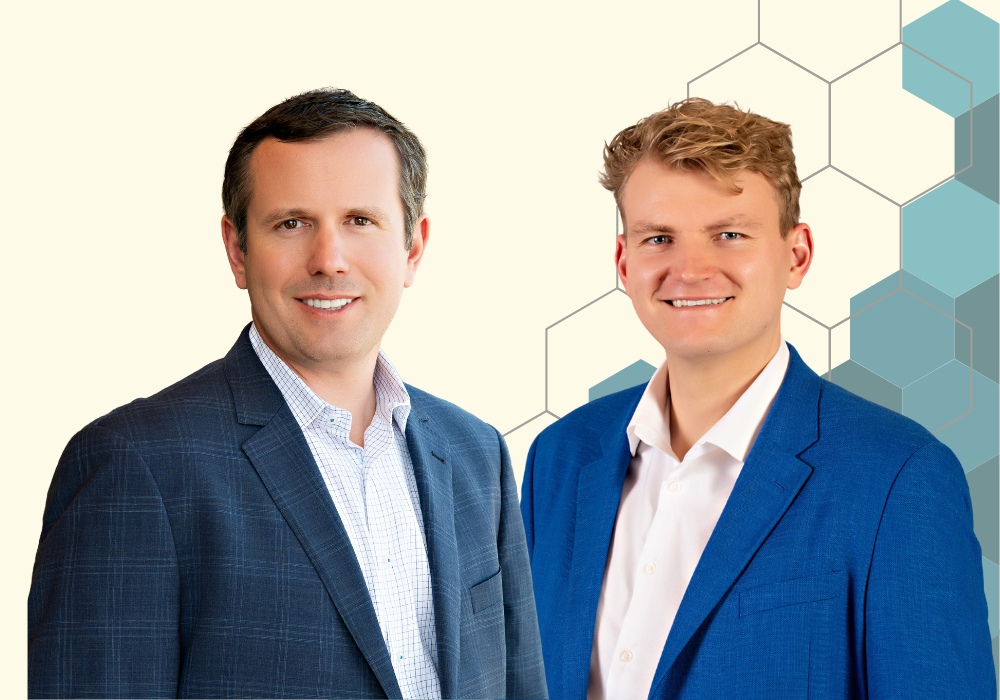
Hollinger, left, in a Sower Commercial press graphic. Partnership gets plenty of space in his investment vocabulary.
When normal stopped feeling normal
In March 2024, Hollinger began his quarterly investor update with a modest promise: a little news from Sower, a look at its people and partners, and an invitation to conversation. He acknowledged the abundance of investment commentary already arriving in people’s inboxes. The newsletter would have to earn its space.
The subject on his mind was interest rates. After a long period of unusually low rates, positive real rates could feel like a new condition. He described the shift as a return to normal following about fifteen years of departure. Familiar financial conditions had become unfamiliar through prolonged absence.
His response was to examine performance risks and stress-test existing investments and strategies. In that letter, he considered a leveling-off of rates more likely than a dramatic reduction over the next year or two. This was his assessment at the time, with implications for how Sower evaluated its holdings.
By January 2025, his account of the previous year included the launch of Longview II and the opening of Sower’s headquarters at Regency Landing. In April, he highlighted the redevelopment of Manawa Centre in Council Bluffs and a Series A milestone for Omaha fintech company Smartdata. The platform’s activities were widening, while his recurring concern remained durability through changing conditions.
The calendar keeps going after the deal closes.
An observation from this profile
Retail with an address and a rent roll
On July 31, 2025, Sower announced that Longview II had acquired Broadway Commons in Rochester, Minnesota. The open-air shopping center measured 136,757 square feet and was fully leased at acquisition. Its national tenants included Michaels, Petco, Five Below, Boot Barn, DSW, and Total Wine.
That tenant list brings the investment down to the level of ordinary errands. The fund’s strategy emphasized income-producing retail in secondary and tertiary growth markets. Broadway Commons was described as its largest acquisition to that date, following diligence, negotiation, and underwriting during the second quarter.
The proposed next steps included in-house asset management to support tenant performance and the property’s longer-term position. Here the sower metaphor becomes a work order: acquire the asset, then keep attending to the businesses that generate its income.
Back in Omaha, another project put the construction-management graduate near familiar terrain. In his August 2025 update, Hollinger described The Arthur, a 329-unit development at 48th and Dodge, developed with Access Commercial and Burlington Capital. He reported a planned September opening and the preservation of the historic Pittman Veterinary Building. The project combined new apartments with an existing piece of the city. Its story depended on both development and partnership.
Farmland requires someone who knows the land
Hollinger’s August 2025 update also described Sower’s farmland sale-leaseback strategy. Farmers could sell land to release capital and continue production as tenants. For the investment platform, the arrangement was intended to provide lease income and the potential for appreciation. The operator’s continuing presence was central to the structure.
In October, he highlighted the lease of Welsh Farm, a 186-acre property in Johnson County, Iowa. His discussion included soil testing, conservation practices, and tenant support. These are tangible tasks attached to an asset often represented by a clean number in a portfolio.
During the first quarter of 2026, Sower formed a strategic partnership with Peoples Company, the Iowa-based farmland brokerage and land management business. The relationship was intended to strengthen sourcing and stewardship. Peoples Company brought a national network and local agricultural knowledge, as well as information about land values, rents, and regional crop economics.
The sequence gives substance to Hollinger’s emphasis on partners. Agricultural property requires decisions informed by the place itself and the people using it. A national platform still needs local understanding. His firm’s ambition to expand therefore comes with the practical task of finding people who can judge and manage land beyond its Omaha base.
The Nebraska connections remain
Hollinger’s work also extends into Nebraska’s banking and entrepreneurial communities. West Gate Bank lists him among its directors, identifying his affiliation with Eleven Talents, LLC. The bank operates across Lincoln and Omaha. EO Accelerator Nebraska lists him as a coach, bringing his real estate experience into a program for early-stage and first-time business owners.
That program includes business fundamentals such as strategy, cash, people, and execution, with continuing support from coaches and peers. It provides another setting for the practical subjects threaded through his career. Experience accumulated in transactions becomes something to share with people building businesses of their own.
His personal geography remains close to the professional one. Hollinger and his wife Kim live in Springfield, Nebraska, with their four children. His biography describes involvement at Mercy High School and St. Columbkille Catholic Parish. Creighton Prep’s 2025 BASH supporter catalog also lists Sower with Kim and Jared Hollinger, identifying him as a 1998 alumnus.
In his March 2026 letter, Hollinger returned to patient selection, experienced operators, and investment structures built for market cycles. Sower’s second-quarter newsletter carried the same emphasis on investing for the long term. The career has grown from a regional property business into several investment disciplines. The unfinished work remains recognizable: understand the asset, choose the partners, and stay involved after the purchase. A name like Sower makes patience sound picturesque. Hollinger’s career gives it a schedule of tasks.