Before Terry Kroeger ran a newspaper company, he bought the paper. Literally. Newsprint and ink were among his responsibilities as an assistant purchasing agent at the Omaha World-Herald. So were vehicles, equipment, real estate arrangements and the fuel that kept delivery trucks moving. The job put him close to the unromantic facts of publishing: a grand civic institution is also a machine with invoices, tires and a morning deadline.
There is an old temptation in executive biographies to treat the first job as a small prologue, included mainly to improve the view from the corner office. In Kroeger's case, it looks more like the governing chapter. He learned the business from its bolts outward. He also kept a pair of sneakers under his desk so he could mow the office lawn when the grass became untidy. A chief executive who knows how much the ink costs is useful. One who notices the grass is rarer.
Kroeger, an Omaha native, had graduated from the University of Nebraska-Lincoln in 1984 with a degree in finance and economics. His first decade in newspapers carried him through operations in Columbus and Kearney, Nebraska, before a larger assignment arrived in 1994: president and publisher of The Record in Stockton, California. Five years away from Omaha broadened the map. Then he returned and began moving through the World-Herald's senior ranks.
A career built from the machinery outward
The view from the fifteenth floor
By 2008, Kroeger was president and chief executive of the Omaha World-Herald Company and publisher of its flagship newspaper. It was an elegant title acquired at an inelegant moment. The financial crisis was punishing advertising, while readers were changing how they found news. The familiar newspaper bundle - reporting, classifieds, display ads and doorstep delivery - was coming apart piece by piece.
Then Warren Buffett entered the story. Berkshire Hathaway bought the World-Herald in 2011, and a year later Kroeger was selected to run the newly assembled BH Media Group. From a fifteenth-floor Omaha office, he oversaw a portfolio built around dozens of newspapers. The scale was national. His argument remained stubbornly local.
“The community aspect of what we do is so important.”Terry Kroeger on the enduring value of local newspapers
Kroeger believed urgent local information still gave community papers an advantage. He also believed the reporting had to be paid for. “You can't spend millions of dollars assembling something and then give it away,” he said while defending digital subscriptions. He pursued online video and sponsored topic sites, and he did not disguise the industry's mistakes. His verdict was wonderfully short on executive perfume: newspapers had done “kind of a crappy job” evolving with what people wanted.
That combination - loyalty to the work, impatience with the habits - explains more than a dozen strategic memos could. Kroeger was not selling nostalgia. He was trying to preserve a valuable local function by changing the business around it. Some decisions were severe. An unprofitable Virginia newspaper was closed when management saw no reliable route back. Elsewhere, paywalls and new products were meant to give reporting an economic spine.
The adventure on 108th Street
After leaving BH Media Group, Kroeger could have turned an admired career into a sequence of lunches, boards and introductions. Instead, he went shopping for responsibility. In January 2019, he bought all the shares of SKAR Advertising, a 57-year-old Omaha agency founded by Wayne Smith. Kroeger became president and CEO. He said he had been looking for his “next adventure” and had found it.
The move was adjacent to publishing without being a continuation of it. Newspapers and agencies both live where attention meets commerce, but their customs differ. One gathers an audience around reporting and sells access to it. The other begins with a client's problem and assembles strategy, words, images, media and measurement. Kroeger admitted that the former newspaper guy had plenty to learn about the creative world.
He did not arrive with a bonfire for the old agency. His plan was to build on its advertising, marketing, design and digital work, then add services suggested by his own experience: business consulting, public relations, strategic planning and crisis communications. The agency's “check-your-ego-at-the-door” culture suited a leader whose most memorable office accessory was a lawn-mowing shoe.
Learn the machinery. Listen to the people doing the work. Protect what customers actually value. Change course before habit becomes strategy.
His public advice is plain enough to fit on index cards. Follow your gut. Keep your ears open. Stay in touch without turning every conversation into a sale. Do not fear changing your mind or admitting you were wrong. Keep looking over the hill instead of staring only at today's position. The language has none of the lacquer of management consulting, though Kroeger now sells management consulting.
There is a humane edge to it as well. He has urged leaders to communicate consistently in uncertain periods and to treat employees as people rather than units of output. At Smith Kroeger, he has pointed to an unlimited vacation policy and the importance of asking for help. He calls work-life balance a juggle, which is both less graceful and more accurate.
An Omaha-sized theory of scale
Kroeger's career has reached well beyond Nebraska, but it keeps snapping back to Omaha. He has served across an unusually dense mesh of civic and professional organizations: the Greater Omaha Chamber, Creighton University, the Associated Press, the News Media Alliance, the Knights of Aksarben Foundation and the Westside Community Schools Foundation among them.
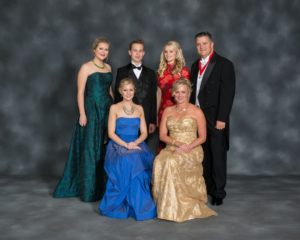
With his wife, Jackie, he spent years supporting Westside schools while their three daughters participated in district activities. The couple volunteered in classrooms and around the swim team, raised money, supported performing arts improvements and helped revive a show-choir camp for younger students. Terry coached girls' and boys' youth basketball and arranged for students to shadow World-Herald reporters. It is possible to read that record as philanthropy. It is more revealing to read it as participation.
The same local habit appears in his business judgment. Kroeger says opportunities may be overheard at a restaurant, a child's school or a golf course. That is not networking as a mechanical exchange of cards. It is a theory of information: people tell you what is changing if you remain near enough to hear them. Dashboards report the recent past. A candid conversation occasionally reports next year.
“My professional goal has always been to challenge the status quo.”Terry Kroeger, after moving from publishing into advertising
Smith Kroeger has continued to change around him. In early 2024, Sara Wilson became president while Kroeger continued as chairman and CEO, a division of leadership that gave an eight-year agency veteran greater operating responsibility. In August 2025, the company acquired Redstone Communications Group, another long-running Omaha advertising business. Kroeger emphasized the cultural resemblance between the firms and said no staff reductions were planned as part of the transaction. The combined operation brought together more people, clients and capability under the Smith Kroeger roof.
There is a neat symmetry here, though neatness should not be overindulged. The executive who once helped assemble a newspaper group is now combining agencies. The publisher who argued that local information matters now leads work built on close knowledge of customers and communities. The purchasing agent who learned the nuts and bolts still describes leadership through practical verbs: listen, communicate, adapt.
What remains after the title changes
Kroeger's story does not offer the fashionable drama of a twenty-two-year-old founder discovering an industry on Tuesday and disrupting it by Friday. It offers something more useful: the long apprenticeship, followed by the deliberate beginner's mind. He knew how to be a CEO when he bought an agency. He did not pretend that meant he knew how to be an advertising CEO.
That distinction may be the hinge of his second act. Experience can become a lens or a blindfold. Kroeger used the newspaper years to bring financial discipline, crisis judgment and relationships into Smith Kroeger, while publicly acknowledging the creative and technical terrain he had to learn. The agency has since widened its services, promoted leaders from within and made an acquisition of its own.
On a résumé, the distance between assistant purchasing agent and chairman looks enormous. In temperament, it may be only a few steps, repeated carefully over decades. Notice the cost. Notice the customer. Notice the colleague who knows what you do not. Notice the lawn. Then decide what the morning requires.