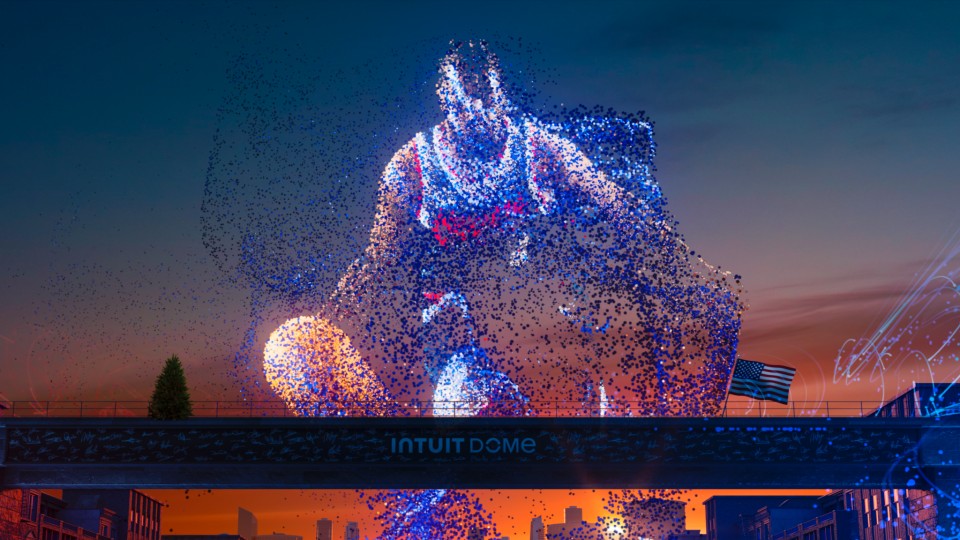
There is an acre of television hanging above a basketball court in Inglewood, California. It is called the Halo, though it looks less like heavenly furniture than a very confident spaceship. The double-sided scoreboard at the LA Clippers' Intuit Dome is more than five times the size of the next-largest screen in the NBA. Spinifex, one of Project Worldwide's agencies, helped make it move, shimmer and turn a game into a programmable world.
The Halo is also a useful diagram of Project itself. The thing you notice is the spectacle. The thing that makes the spectacle possible is hidden: designers, engineers, producers, strategists and client teams passing work around without letting the seams show. Project's business is those seams.
Founded in 2010 around the century-old George P. Johnson experience-marketing business, Project now connects 13 agencies, 45 offices and 2,300 people across 42 markets. Its shops cover advertising, PR, commerce, digital products, media, events, gaming, sports, entertainment and live broadcast. The network calls this “Hyperconnected Creativity.” Translated from agency dialect, that means: bring in the right specialist before the brief becomes a committee.
01 / The mechanismThe holding company that dislikes holding-company behavior
Traditional agency groups became enormous by buying expertise. Then they developed a familiar problem: every newly acquired expert had a revenue target, a boss and reasons to keep the client nearby. Project's answer is structural. It says the alliance operates without a single P&L, while individual agency brands and entrepreneurial leaders remain visible. Most unusually, the enterprise is 100% employee-owned through an ESOP.
Ownership does not automatically produce cooperation. It does, however, change the argument. Sending a useful assignment to a sister agency is easier to defend when employees share in the value of the larger company. The client can start with Praytell for public relations, add GPJ for a physical experience, Spinifex for screens and spatial storytelling, OS Studios for gaming culture, and NOMOBO for broadcast. One brief becomes a temporary company.
How the alliance is supposed to work
“My goal as Global CCO isn't to centralize creativity from the top down, but to amplify it.”Matt Statman, Global Chief Creative Officer
02 / The editGrowth, followed by the awkward business of choosing
Project's history is not simply a row of trophies on an acquisition shelf. It bought Partners + Napier in 2011, Motive in 2012, Praytell and Wondersauce in 2016, Darkhorse in 2018, OS Studios in 2021 and Paris agency MNSTR in 2024. Yet the first revealing moment may be the least celebratory. In 2019, Project retired the Pitch name and folded its clients and Los Angeles office into Motive. In 2025, it integrated commerce agency Shoptology into Motive. Networks accumulate; operators eventually edit.
What changed their minds was not one cinematic failure. Public accounts do not offer one. The pattern is subtler: client work kept crossing categories while specialist brands multiplied. Project responded by merging overlap, adding missing disciplines and strengthening the connections between them. OS Studios brought gaming and esports into the center. NOMOBO added the technical discipline of global live production. In 2026, Wondersauce became the home for the alliance's AI and digital transformation practice.
03 / What clients buyNot an ad. A cast.
Project sells professional services through negotiated scopes, retainers, media and production work. There is no public rate card, and deal prices are usually kept private. The cost depends on how many crafts, markets, venues, screens and deadlines a client decides to invite to the party. That makes comparisons with a single creative studio nearly useless.
The better question is what the orchestration removes. Salesforce used GPJ for Dreamforce strategy, design, production, operations and execution across one million square feet, serving more than 45,000 attendees from over 140 countries and millions online. Major League Soccer used OS Studios to combine a museum takeover, gaming, music, panels and the eMLS Cup broadcast. AMD's CES 2026 keynote paired GPJ's experience architecture with Spinifex's cinematic visual work. These are not jobs that fit neatly into “make us a campaign.”
Project fits between two familiar alternatives. A client could hire a global holding-company network and receive enormous reach with more centralized machinery. Or it could assemble independent shops itself and become the unpaid general contractor. Project's pitch is specialist identity with a pre-wired backplane.
04 / The copyable bitBuild the handoff before selling the bundle
Most companies cannot copy Project by buying a dozen agencies, and should be grateful for that. They can copy the useful part. First, keep expertise legible. A specialist with a reputation is more attractive than a vague “solutions” department. Second, make referrals economically rational. Shared ownership is Project's version, but common goals and revenue credit can do some of the work. Third, appoint an operator for the whole brief. Collaboration without ownership of the handoff is merely a group chat.
The model has conditions. It works when the problem truly crosses disciplines, the client values specialists and the teams share systems, timing and accountability. It adds drag when budgets are small, procurement wants one interchangeable vendor, or agency leaders protect their own utilization at the expense of the assignment. No amount of alliance language can rescue a brief with six captains.
Chris Meyer, who succeeded founder Robert G. Vallee Jr. as CEO, has spent 2025 and 2026 making those connections more explicit. Project completed its purchase of NOMOBO, realigned executives around operations, creativity and growth, and put digital transformation under Wondersauce. The moves are less romantic than launching another agency. They are also what mature networks do when they discover that the scarce resource is no longer talent. It is coordination.
Return to the Halo. Fans see a basketball player dissolve into thousands of particles above the plaza. The client sees a venue becoming media. Project sees the thing beneath both: a set of specialists who know when to pass the ball. In advertising, as in basketball, the pass is rarely the photograph. It is still the play.