Greg Andersen used to make an offer that sounded like easy money. Name the states bordering Nebraska, and he would pay you $100. He was living in New York, working in advertising, surrounded by people whose profession involved understanding other people. The wager asked for six names. According to Andersen, nobody collected in 26 years.
There is a good joke in that story, and an awkward business question. How confidently can you describe a country when part of it remains a blank space on your mental map? An advertising pitch can contain an impressive amount of certainty. Nebraska, apparently, could still cause trouble. Andersen’s bet supplied a small test of the distance between national ambition and local knowledge.
Today he leads Bailey Lauerman in Omaha, the city he came from. His career has taken him through New York and Los Angeles, through strategy departments and chief executive offices. Coming home gave those experiences a different setting. The question running through his work became more explicit: what happens when the people receiving an advertisement see the world differently from the people making it?
Six neighboring states. Andersen said no one won his New York geography bet over 26 years.
The answers: Colorado, Iowa, Kansas, Missouri, South Dakota and Wyoming.Twenty-six years away, then a different vantage point
Andersen spent 23 years at New York agencies and three years leading RAPP’s Los Angeles offices. There was a personal adjustment inside the professional one. Early on, he tried to behave as he thought a New York advertising person should. Over time, he came to recognize that colleagues valued the perspective he brought from Nebraska. His background gave him something useful to contribute.
That is an appealingly practical version of finding your own voice. The detail you might feel obliged to smooth away can be the detail a room needs. In Andersen’s case, experience elsewhere helped him interpret how work might land beyond New York. A campaign has to leave the office eventually. The people waiting outside have no obligation to share the office’s enthusiasms.
His early work included account management and strategic planning at EURO RSCG, Merkley + Partners and Lowe Worldwide. At Lowe, he co-founded Lowe+, a strategic consultancy working across agencies. Later came the chief executive role at BBH U.S., followed by the presidency of RAPP U.S. and the managing director role in Los Angeles. His client experience included Google, Toyota, Cadillac, Westin Hotels, Axe and Mattel.
Bailey Lauerman announced his appointment in September 2016, effective September 6. Chairman and chief creative officer Carter Weitz emphasized Andersen’s ability to inspire teams, along with his integrity. Andersen spoke about the opportunity to build an agency in his home state. The attraction was professional as well as personal: a Nebraska base could offer brands a useful view of audiences inside and outside major cities.
The agency already had a history of national work. Andersen’s task was to sharpen a reason for choosing it. In Omaha, location could help define the questions the agency asked, rather than merely explain where its employees happened to sit.
The people between the dots
Bailey Lauerman calls its audience focus The Everything In-Between: people outside America’s ten largest cities. The phrase gives a name to the places that can disappear when an industry draws its map around a few centers. Andersen’s argument is that understanding those audiences matters to brands trying to grow. They have lives, preferences and communities that deserve examination on their own terms.
The danger would be replacing one convenient stereotype with another. A small town cannot tell you everything about a resident, any more than a Manhattan address can. The value of Andersen’s premise rests on taking the next step: asking questions. Geography offers a starting point. The customer still has to supply the answer.
His biography contains another distinctly Nebraska detail. Andersen enjoys fishing and hunting, and he finished second in the Nebraska State Duck Calling Competition. Advertising has plenty of trophies; this one required a different audience. His experience in travel and tourism also includes the launch of JetBlue, Westin Hotels and New York City Tourism, work that informed his agency’s Nebraska Tourism efforts.
The duck-call result makes the homecoming feel less like a line in an executive biography. There is a person attached to the postcode, with interests that would survive the removal of every client logo. Second place also leaves a little room for comedy. Persuasion, it seems, has demanding judges wherever you practice it.
The customer gets a vote
In 2017, Andersen offered Omaha entrepreneurs advice about their elevator pitches. He urged them to explain why their business mattered, identify the problem clearly, and prepare evidence for the questions an investor might ask. He recommended listening to what customers liked and disliked about a product, including the reasons they might use it more or spend less on it.
He also had a sensible qualification about testing the pitch on family: their reaction is useful when they belong to the intended audience. Affection is an unreliable market-research method. The advice connects neatly to his geographic argument. Both ask a business to step outside its own account of itself and consider the people whose decisions will determine whether the idea works.
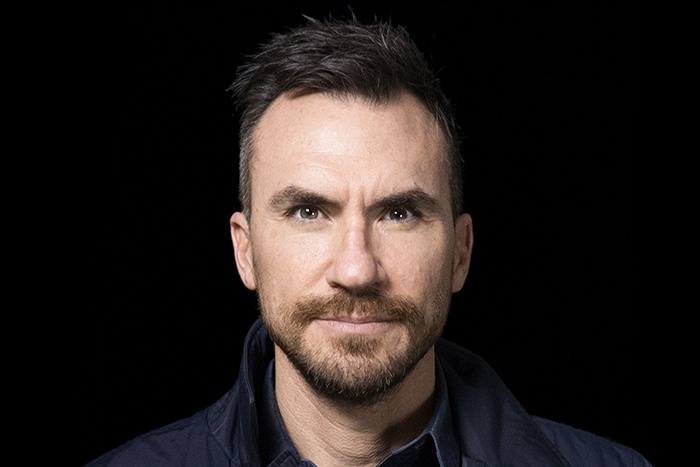
By 2025, the agency had taken its audience questions into a study with Radius Insights. Completed in June and announced in October, the Geography of Brand Connection research surveyed nearly 1,000 Americans. It described two mindsets: Pragmatists, approximately 52 percent of the adult population, and Experientialists, approximately 48 percent. The former emphasized practical value and reliability; the latter had stronger emotional connections with brands and greater interest in identity and cultural trends.
Two ways of looking at a brand
Pragmatists
Practical value
Reliability
Experientialists
Emotional connection
Identity and trends
In discussing the findings, Andersen traced the question to a brand assessment for WoodmenLife, whose activity centered on family, community and country. He used a laptop bag to illustrate the difference: one buyer might be drawn to the brand, another to durability and value over time. The labels were not simple political teams; 56 percent of Pragmatists identified as moderate or liberal.
For an agency, the implication is uncomfortable in a productive way. The enthusiasm of the people making the campaign cannot stand in for the preferences of everyone receiving it. A useful idea has to make contact with an actual need. That leaves room for creativity, while giving it a job more precise than being admired in the meeting.
Room for other people
Andersen has described the pleasure of being a practitioner again at an independent agency. In 2023, he combined the CEO role with leading strategy. He talked about working closely with creative teams and treating research as an input into thinking, with later research helping diagnose the work. His stated aim with creatives was direct: “I want to give them inspiration.”
“I’ve never bragged about a deck”
Greg Andersen, on the difference between a presentation and the work it helps produce
His management comments carry a related idea. In 2021, he described leaders as a source of confidence who should give talented people room to work. Employees need support and trust, with leadership available when it is needed. That approach asks a chief executive to judge when involvement helps and when it simply adds another person to the process.
In May 2025, Bailey Lauerman promoted Aaron Jarosh to Head of Integrated Strategy. Jarosh had joined in 2017 after working at Havas New York. The new role brought broader responsibility for collaboration across disciplines, with social and public relations involved earlier in strategy and AI capabilities integrated into the agency’s work. Andersen highlighted Jarosh’s combination of analytical and intuitive thinking.
There is also a literal investment in who gets to enter the industry. At the University of Nebraska-Lincoln’s October 2022 scholarship brunch, Andersen spoke about opportunity and diversity. Bailey Lauerman supported a student scholarship, a design challenge and travel for the student advertising competition team. The Fund for Student Opportunity paired $5,000 in support with an internship offer. Andersen appeared alongside recipient Dulce Garcia.
In June 2025, the agency named Michelle Montenegro its fifth annual scholarship winner. A junior studying advertising and public relations, she wanted to make work that reflected Latin and immigrant communities. Andersen praised her volunteerism and commitment to people who had been underserved. The award included the scholarship and an internship of her choice at the agency. Understanding more people begins, in part, with inviting more people into the work.
Bring people to the table
In September 2026, Andersen extended his argument into restaurant marketing. His essay considered shared experiences around the World Cup and America’s 250th anniversary, urging brands to participate in occasions people already cared about. Food offered a practical setting for connection. A meal promotion designed for people to eat together could give an idea about unity an everyday form.
The thread reaches back to the geography bet. Advertising asks for attention, money and sometimes affection. Andersen’s career keeps returning to the work required before making that request: understand the setting, respect the customer’s reasons, and make something that belongs in their life. After years on both coasts, he found a place to pursue those questions at home. Nebraska, at least, was never a blank on his map.