Rick Chiorando was offended by a license plate. In September 2019, New York’s proposed redesign gave the Austin Williams CEO something to argue with: a crowded little rectangle, a familiar collection of symbols, and an opportunity he thought had been squandered. Most drivers had more pressing concerns. Chiorando saw a creative brief traveling at highway speed.
His complaint was specific. The plate combined elements of earlier designs without finding a convincing new direction. Other states, he argued, had recognizable personalities on their plates. New York had Madison Avenue and a substantial advertising tradition. Surely it could make better use of a surface that millions of people would carry around for years.
There was a personal irritation, too. He had paid to change his own plate to the yellow-and-blue version. Another redesign arrived about a year later. Taste and the household budget had briefly formed a coalition. His verdict included this small, unmistakable declaration: “THAT’S BORING!”
The designer keeps his seat
Chiorando’s route to the executive desk began with making things. He studied at Buffalo State, graduating with a B.S. in 1977, and later completed a workshop certificate at Pratt. His working life took him through Long Island agencies Millennium and Garvan Communications before Austin Williams.
He describes the progression plainly: designer, art director, creative director, CEO. The sequence matters because each move brings a wider responsibility. A designer can attend to the thing in front of him. An art director must consider how several contributions fit together. A chief executive inherits the people, budgets and decisions that make the work possible.
The agency’s current roster places him alongside president Eva LaMere and managing partner Andrew Catalano. Those are distinct jobs within the same business. Chiorando’s public voice retains the designer’s tendency to question what everybody else has learned to overlook. He can be looking at an advertisement, a web page or a government-issued piece of metal. His patience with a weak idea appears similarly limited.
“Let your content drive the VR experience.”
Rick Chiorando, January 2018
A cute dog is an unreliable business plan
In 2015, Chiorando described a recurring problem with television commercials. Viewers could remember the dog, recognize a house that resembled their childhood home, or feel warmly toward an actress. Ask them to identify the advertiser, however, and the answers could wander into the wrong industry.
For a creative person, this is an awkward result. The work has attracted attention. People have enjoyed it. Someone may even have congratulated the agency. Yet the company paying for the advertisement has slipped out of the picture. Chiorando’s test was whether the work made a business difference, with the agency accepting responsibility for that result.
His criticism has room for admiration. In an earlier essay, from 2012, he took advertising agencies to task for unoriginal work, including a Subway pitch on AMC’s The Pitch. He also praised a DirecTV campaign for being memorable, entertaining and clear about the product. His willingness to envy a rival’s good idea gives the complaint some credibility. He wants the work to be better, including work he did not make.
What the campus photograph leaves out
Austin Williams’ 2015 campaign for Metropolitan College of New York shows how that judgment can shape an assignment. The agency conducted research with current and prospective students. Its creative direction emphasized graduates’ concrete contributions to communities and neighborhoods.
A college can show a lawn, a building and a student looking hopefully into the middle distance. The MCNY campaign chose experience-based learning and applied scholarship as its distinguishing territory. The question became what people could accomplish with their education. Chiorando, then identified as a principal and chief creative officer, described the work in terms of the social outcomes graduates produced.
A year later, St. Joseph’s College selected the agency after a regional search. The assignment encompassed Brooklyn, Patchogue and online study, as well as the institution’s centennial. Chiorando pointed to preliminary research with students and alumni as the basis for a compelling brand story. Before deciding how a school should sound, his team had gone to hear from the people connected to it.
Three-year growth in gross income less ad-placement costs, reported with Agency Post’s ranking.
Telly Awards received by the agency that year.
CUNA Brand Identity award for the Hudson Valley Federal Credit Union campaign.
Agency results at specific dates. Awards and growth belong to the team; these figures measure different things.
The napkin before the machinery
Chiorando prefers starting an idea on a napkin and resolving the concept before execution. A napkin has useful limitations. It offers little room for decoration and no opportunity to impress a client with a loading animation. A thought has to survive on its own.
Chiorando carried that concern into his 2018 discussion of virtual reality in college recruitment. He had expected the technology to change the field more quickly. He acknowledged that expectation had been wrong, then questioned the experiences colleges were building. An immersive tour might reproduce a campus while giving prospective students little meaningful understanding of its brand.
He proposed using the medium to explore a student’s possible career or introduce accomplished alumni. The technology could make a story engaging, provided there was a story worth entering. Coming from someone interested in new tools, the admission is useful. Enthusiasm can survive a disappointed prediction if the person making it is willing to revise the assignment.
His 2016 writing about vertical video took a more practical angle. People held their smartphones upright. Video production could accommodate that habit, though staging, lighting and blocking would require different decisions. He was interested in the format because of how an audience behaved, with the production consequences included in the discussion.
The price of asking first
Website estimates brought out the same instinct. In a January 2017 essay, Chiorando used two vases to illustrate the difficulty of pricing objects that appear to serve the same purpose. The appearance gives you only part of the explanation. A website’s cost depends on what it must do and the work required to make it do that.
He walked through questions about commerce, databases, content and connections to other systems. Who would create the copy? Who would manage the build? What would success look like? His recommendation was to pay for discovery before relying on a quote. The resulting document could guide a request for proposals even if another firm eventually built the site.
That advice also distributes responsibility. The client has to define a useful outcome. The agency has to understand the problem before promising a solution. A cheaper estimate can be expensive if both parties have quietly imagined different projects. In Chiorando’s telling, the questions are part of the work.
- AskWhat must the work accomplish?
- ListenWhat matters to the audience?
- MakeGive the idea a useful form.
- CheckDid people take the intended action?
An editorial reading of his essays on websites, college campaigns and advertising.
His 2010 website advice had already emphasized visitors’ needs, understandable language and research. It urged teams to use performance information to keep improving a site. The vocabulary of web development has changed considerably since then. The underlying demand is still recognizable: a visitor should be able to find a reason to trust the organization and a way to act.
Even in the old argument between direct mail and email, he declined to pick a universal winner. His 2011 comparison considered the physical presence of mail alongside the speed, cost and measurement advantages of email. The choice depended on the job. Loyalty to a format would be a poor substitute for understanding the situation.
A floor plan is part of the work
In 2018, Chiorando wrote about the agency moving from separate offices clustered around a conference room to a bright, colorful open plan. He described colleagues working more closely and understanding how their tasks affected one another. A change in the surroundings had become a change in the conversations.
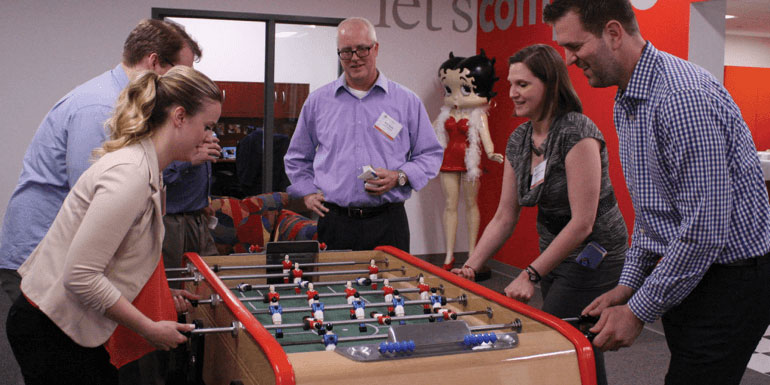
His account acknowledged the administrative side of agency life: invoices, bookkeeping and paperwork. Those obligations helped support the people doing the creative work. He could enjoy the campaigns and still accept the machinery required to keep a business running. The open floor plan was another investment in that machinery, one whose effects he could see in everyday contact.
The agency had been willing to tease its boss long before the move. In a 2010 account, colleague Jay Eckert recalled Chiorando returning from St. Maarten to find a snowman pressed against his office window. Its features were improvised from office materials; agency softball shirts supplied a scarf. Eckert closed the blinds and left the reveal for Chiorando’s return. Even the prank had art direction.
Room for the next designer
His relationship with education extends beyond client campaigns. He serves on Farmingdale State College’s visual communications advisory committee, appearing in its 2025-2026 membership. Through the agency’s scholarship at Molloy University, he emphasizes opportunities for talented people who may otherwise have fewer chances to succeed.
These connections place the working creative inside the region’s educational life. Colleges are clients, but they also prepare people who will enter professions like his. An advisory committee and a scholarship connect the business of making campaigns with the conditions that allow someone to begin a career.
Chiorando’s published reflections on branding make the customer’s full experience central: the company’s behavior, reputation and accumulated encounters all contribute. A logo occupies only one part of that relationship. The argument gives his design criticism a broader consequence. Every visible choice can affect what people expect from an organization.
The license plate fits comfortably into that view. It is a small object with a public life, carrying an idea about a place whether its designers have thought carefully about that idea or not. Chiorando notices. Then he says something. Somewhere between the sketch and the CEO’s desk, he has kept the habit of looking twice.