Grace Leong keeps thank-you notes. In a business that produces presentations, campaign reports and enough correspondence to give an inbox a second career, she saves these particular pieces of paper. She has described taking them out again to remember what her job is: making a place where other people can do their work with confidence. It is an unexpectedly modest filing system for the chief executive of a communications agency. It also helps explain how she got there.
Leong leads HUNTER in New York, a firm whose name reaches back to her first boss, Barbara Hunter. Her career has grown alongside the agency for almost four decades. There have been changes of ownership, new services, larger teams and offices across the Atlantic. Yet the most revealing details tend to be small: an assignment explained to a junior employee, a student’s expenses considered, a former colleague invited back.
Public relations is a profession concerned with attention. Leong’s story invites a look at where the person directing that attention chooses to spend her own.
The person in the textbook
At the University of Delaware, Leong encountered Barbara Hunter in an introductory public relations textbook. Hunter and her sister Jean Schoonover had bought the established agency Dudley-Anderson-Yutzy. Here was a woman running the kind of business a student could scarcely yet imagine entering. Leong wanted to work for her.
After graduating in 1988, she joined Hunter’s team at D-A-Y/Ogilvy. Her recollection of the first day includes a formidable desk and a formidable boss. Then Hunter came to her cubicle, explained an assignment herself and thanked her for joining. The distance between the executive in the textbook and the young employee had suddenly become walkable.
A year later, Leong followed Hunter into the new agency that bore her name. TABASCO went with them. The decision placed her close to someone she wanted to learn from, even as it meant leaving an established operation for a smaller one.
The useful part of this origin is its specificity. Leong had found a model, sought a job and accepted the next uncertain step. Her ambition had a person attached to it. A textbook had supplied an introduction; the work supplied everything that followed.
Joins Barbara Hunter’s team
Helps start HUNTER
Takes over with colleagues
Continues after MDC investment
Learning to own the place
Agency ownership arrived through a decision shared with colleagues. As Hunter prepared to retire, Leong and fellow executives considered the firm’s future and ultimately bought it. By 1999, she was leading the business she had entered at its beginning. Staying had brought her to a different set of responsibilities.
She also earned an MBA at Rutgers. In her own writing about leadership, she recalled originally imagining a future as a marketing manager. Business school introduced her to Peter Drucker’s thinking about management, and heading an agency gave those ideas somewhere to be tested.
Her account of the job expands beyond assigning tasks. A leader needs to give work a purpose, supply resources and help people make connections. Those obligations become especially tangible in an agency, where an organization’s promise to a client eventually depends on a person doing an assignment well.
In 2014, MDC Partners acquired a majority interest in HUNTER. Leong continued leading it alongside partners Jon Lyon and Jason Winocour. Contemporary reporting put the staff at about 100. The transaction changed the ownership arrangement and provided a route to additional resources. It also meant carrying an existing culture into a larger network.
Succession and acquisition can make a business look different on paper. For the employees and clients involved, the more immediate question is what changes on Monday morning. Leong’s long tenure puts that practical question at the center of the story.
The classroom inside the agency
Hunter Community College sounds like a place where the evening course might involve both a press release and a decent sandwich. It is the name Leong gave HUNTER’s internal education initiative. She wanted stronger ideas and a way for employees to keep improving their craft.
The premise has a certain plainness. A communications business sells thinking. People need time, instruction and fresh experience to improve that thinking. A full calendar alone cannot provide them.
HUNTER has also described a mini-MBA program taught by leaders with business or legal qualifications. Its subjects include financial reporting, strategic planning, operations, supply chains and negotiation. The aim is to give younger communicators a working understanding of the businesses they advise.
That matters when a conversation moves beyond whether a story is interesting. What is the company trying to accomplish? What constrains it? How does a recommendation affect the rest of the operation? Those questions require curiosity about the client’s business as well as skill with words.
Leong’s education at Rutgers and her agency’s business training belong to the same practical concern: the communicator should be able to follow the conversation when the budget appears. An idea has more room to survive when someone understands both its appeal and the conditions under which it must work.
“I have a stack of thank-you notes; I keep every single one.”
Grace Leong, 2019
The people who come back
Leong has described asking employees why they stay at HUNTER. Training, development and access to senior leaders feature in the answers she reports. The question is useful because it arrives while there is still time to do something with the response.
She has also told a story about a former employee who had been away for nearly 17 years. The woman called to ask for a reference for another job. Leong declined, then explained that she wanted her to return to HUNTER instead. The former employee did.
It is a recruiting conversation with a pleasingly short detour. The request for help becomes an invitation. There is room for affection in the story, and for the commercial good sense of recognizing someone whose work you already know.
Returning employees appeared in HUNTER’s 2022 figures, too: eight joined a staff that had grown to 248. A return is a particular kind of decision. The person has seen another workplace and elects to try this one again. It does not settle every question about a company, but it gives an employer something worth understanding.
The thank-you notes fit here. They preserve individual experiences that an aggregate staff count cannot describe. Leong’s habit suggests that she wants to remember the people within the numbers, including the ones whose careers take them elsewhere for a while.
Hot sauce, bigger assignments
TABASCO was HUNTER’s founding client in 1989 and remained a client when Leong discussed the business in 2025. For a communications agency, that relationship provides a tangible measure of continuity. The brand has stayed while the channels available to tell its story have multiplied.
HUNTER’s work has expanded from its consumer PR roots into an integrated communications offering. By late 2021, it had reorganized leadership to bring social, digital and influencer services into its practice areas. The change made those capabilities part of the client teams’ work.
The following year, global revenue reached $51.2 million, a reported increase of 21 percent. U.S. revenue reached $50.2 million. These are historical figures, a snapshot of a particular stage of the agency’s growth.
Leong called the period “Absolutely bananas growth.” The phrase has considerably more flavor than the usual executive description of a revenue chart.
HUNTER global revenue
A campaign from that period shows the breadth of the assignments: HUNTER helped introduce Amazon and Rivian’s electric delivery vehicles through a launch event, interviews, tours and social content. The agency brought different audiences into the same story. The work offers a concrete example of the expanded communications business Leong was helping run.
A door with the expenses considered
Leong’s connection to Delaware continued after graduation. In 2014, she created the Barbara W. Hunter Internship, offering a selected university student a stipend to help offset the cost of living in New York. She connected the initiative to the internship experience that had helped her get started.
The expense is an unromantic detail, which makes it valuable. A student can be eager, capable and ready to work while still needing to pay for a place to sleep. An opportunity becomes easier to accept when its design takes that into account.
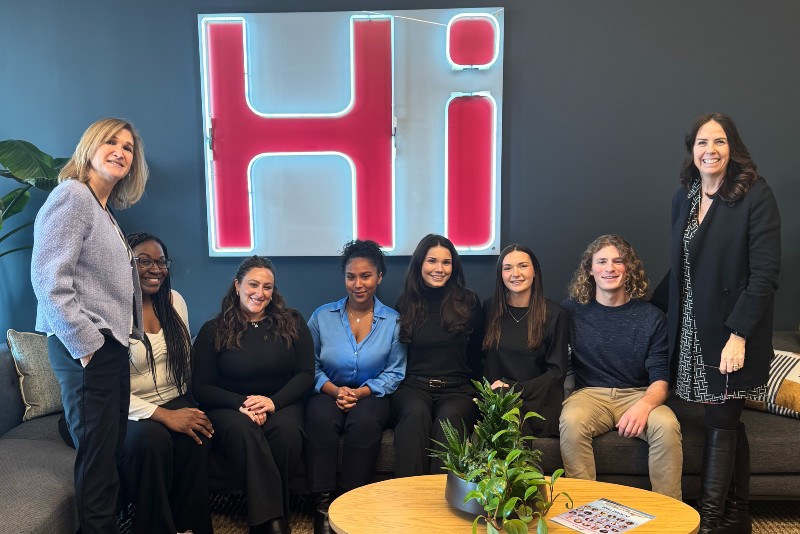
She and Heddy DeMaria, her former college roommate and a HUNTER colleague, have also advised Delaware’s Bateman competition teams. Students research, plan and carry out a campaign for a real client. The relationship brings them into contact with professionals who can help them see how classroom decisions hold up in practice.
Two former roommates returning as mentors is a detail a career diagram would struggle to accommodate. It makes the professional network feel less abstract. People meet, keep working, and sometimes find themselves helping students make the same crossing they once made.
The fan in the executive chair
Outside agency work, Leong talks readily about sports. She follows the Yankees and USC football. In a 2025 interview, she described wanting to take her family to a Rutgers-Oregon football game for her birthday. Her staff had also arranged a recorded greeting from Yankees manager Aaron Boone to mark an award.
The personal details bring a welcome change of scale. An executive can spend the week thinking about clients and colleagues, then want a Saturday organized around a football fixture. A gift works because someone has noticed what she actually enjoys.
Formal recognition has continued. Leong received PRSA’s Gold Anvil in October 2025, followed by a place in Ragan’s 2026 Top Women in Communications Hall of Fame and a SABRE Award for Outstanding Individual Achievement that May.
When accepting the Gold Anvil, she drew on Lou Gehrig and described feeling lucky. The phrasing suited a career she repeatedly connects to other people: the boss she sought, the colleagues who helped run the firm, and the students she now makes time for.
There is a lovely economy to the idea of keeping thank-you notes. A career spent helping organizations tell their stories also leaves a quieter record of what happened to the people involved. Leong can open that record whenever she needs a reminder. The next assignment, the next student, the next conversation will still need someone to show up.