Climate has had more costume changes than a touring company. Cleantech became climate tech. Corporate responsibility learned to answer to ESG, then stopped answering when the initials became politically inconvenient. Decarbonization, energy transition, efficiency and resilience took turns on the marquee. Keith Zakheim has watched this semantic repertory for two decades, and he has reached the conclusion one expects from a communications executive who is tired of watching the thesaurus do strategy's job: pick a case and make it.
His preferred case is not shy about money. Climate investment can lower costs, steady supply chains, reduce risk, improve operations and protect long-term enterprise value. These are not euphemisms to smuggle virtue into a board meeting. They are the reasons a board meeting exists. Zakheim's recent argument is that the sector should say so plainly.
“I am certain that the problem isn't language. It's courage and conviction.”Keith Zakheim, on climate communications
This position is the latest expression of a career built between public purpose and commercial persuasion. Zakheim is the CEO of Antenna Group, the integrated agency whose work sits across climate and energy, mobility, real estate and infrastructure. He also hosts the Age of Adoption podcast, a long-running interview show about the point where a good technology must become an ordinary fact of life. If innovation is the laboratory, adoption is the zoning hearing, the procurement meeting, the customer decision and the investor call. It is where a better machine meets a skeptical human.
Before the signal, there was Avalanche
Zakheim did not arrive at that view by way of a tidy marketing ladder. His earlier work included journalism, political counsel and public affairs. He served as executive director of the Jewish Community Relations Council of Central New Jersey and completed a term as a councilman in Paramus. He later held a senior public-affairs role at Rosica Strategic Public Relations, then founded Avalanche Strategic Communications.
One old public-hearing transcript catches the civic version of his temperament. Zakheim had been waiting since eight in the morning to testify on a proposed Newark arena. When told that his subject would be heard another day, he objected, read the notice back to the committee and pointed out that nonprofessional politicians could not keep abandoning work to return to Trenton. Another senator intervened: let him testify. It is a small scene, but a useful one. Long before he ran an international agency, Zakheim understood the practical cost of asking the public to participate badly.
In 2010, Zakheim became chief executive of Beckerman. That same year, the firm acquired The Antenna Group, a San Francisco specialist in clean energy and emerging technology. More acquisitions and disciplines followed. Eco Branding joined in 2017, a year in which the wider business reported 21 percent growth. By 2019, Beckerman, Antenna, Eco Branding and Chicago Digital were folded into one Antenna Group. The name of the specialist became the name above the door.
Zakheim described that arc in 2025: a one-person PR shop in Hackensack had become a global agency with 140 people across five international offices. The neat numbers conceal the untidy management problem. A public-relations firm had to absorb digital, creative, performance marketing and public affairs without becoming a drawer full of unrelated cables. His answer was integration around sectors where communications have consequences beyond a launch-day headline.
The awkward middle between invention and life
The agency's climate specialty gave Zakheim a close view of an industry graduating from prototypes to deployment. Solar panels and electric vehicles no longer needed to be explained as science projects. They needed financing, permits, customers, supply chains and communities willing to host infrastructure. In his formulation, the Age of Innovation was giving way to the Age of Adoption.
It is a less glamorous age. Adoption is repetitive. It requires the same argument in a hundred different rooms. The engineer's confidence that a product works does not settle whether a regulator approves it, a fleet operator buys it or a household trusts it. Zakheim's podcast lives in that gap. He interviews founders, investors, corporate sustainability officers and policy thinkers, usually starting with the path that brought them to the work and then pressing on the machinery that lets the work spread.
The host is serious without embalming the conversation. Welcoming Autodesk sustainability chief Joe Speicher in 2026, he noted that the previous guest had been a Stanley Cup-winning goaltender. No pressure, then. Speicher replied that he would try to punch above his weight. The exchange is light, but the method matters: biography first, abstraction second. People generally care how another person came to believe something before they care about the framework built around it.
Zakheim's own curiosity wanders productively. He has written that his more original ideas often begin in fields outside marketing: anthropology, sociology, history, biology, philosophy and behavioral psychology. One came during what he called an “interminable” commute to Manhattan. A podcast discussion of tainted altruism - the tendency to discount a good act when the actor also benefits - gave him a way to think about climate claims. If a company saves money while cutting emissions, pretending the profit motive is shameful can make the action look less credible. Mixed motives are normal. The better story can hold both.
No more apologizing for the spreadsheet
That insight helps explain his present impatience with climate's renaming habit. A fresh term may briefly avoid old political baggage, but it also discards accumulated understanding. Every rebrand, he argues, opens a window of confusion and gives reluctant institutions permission to delay. The sector begins to sound as though it is communicating in code, anxiously trying to say the same thing without alarming anyone who disliked the previous noun.
Zakheim is not arguing that human consequences should disappear. In another 2026 essay, he endorsed direct, personal messages about family and future generations as more persuasive than abstract ideology. He is arguing for a fuller account of motivation. Cleaner energy can protect a child's future and reduce exposure to volatile fuel prices. A resilient building can lower emissions and remain usable through a disruption. A stronger grid can serve a public good and enable valuable commerce. Moral and economic value are not rival claimants to the same sentence.
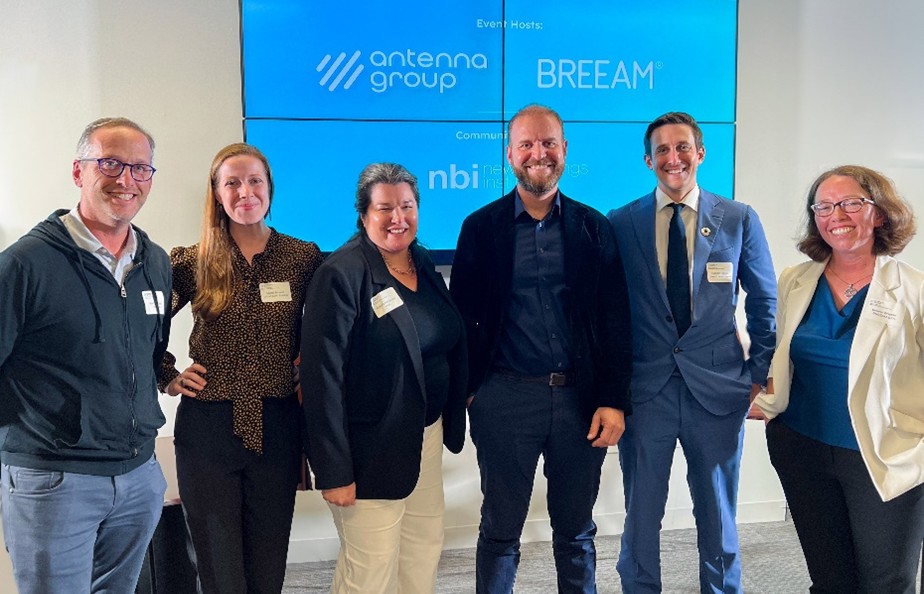
His event work puts that proposition in public. At Climate Week gatherings, Reset Connect and CERAWeek, Zakheim has moderated conversations among journalists, corporate leaders and sustainability executives. The subjects are where abstractions acquire addresses: buildings, grids, data centers, mobility systems. These projects consume land, power, water and political attention. Their owners cannot communicate their way around a bad decision, but neither can they build a durable good decision in silence.
The distinction matters for a PR chief. Storytelling is easily caricatured as a glossy layer applied after the serious people finish. Zakheim's career makes a narrower and more defensible claim. A narrative cannot repair a technology that fails. It can help a useful one become intelligible to the people whose money, permission or behavior it needs. Communication is not the turbine. It is part of the connective tissue that lets the turbine be financed, sited and trusted.
A wider map, the same argument
Antenna's expansion follows the geography of that connective work. The agency opened in London in 2023 because its clients' problems already crossed borders. Climate capital, regulation and technology do not stay politely in one market. Zakheim said the challenge required partners able to help companies scale across continents. The phrase is corporate, but the logic is plain: a global transition produces local conversations everywhere.
That is why his biography feels less like a pivot into climate than a convergence. Journalism taught him to look for the story. Politics and civic service exposed the friction between institutions and the people they affect. Agency building turned persuasion into an operating business. The podcast lets him keep asking how other people crossed from intention to practice. Climate supplied a field large enough to require all four.
The aspiration now is not another label. It is a communications culture confident enough to speak in complete sentences: this project costs less over time; this system is more reliable; this choice protects people; this investment creates value; this tradeoff is real. The candor is strategic because the audience is not foolish. People can hear the rustle of euphemism.
Zakheim has spent much of his career helping clients find a signal in noisy markets. His current message to his own industry is bracingly economical. Stop changing the frequency. Say what the work does, who benefits and why it is worth doing. Then have the courage to leave the name alone long enough for people to remember it.