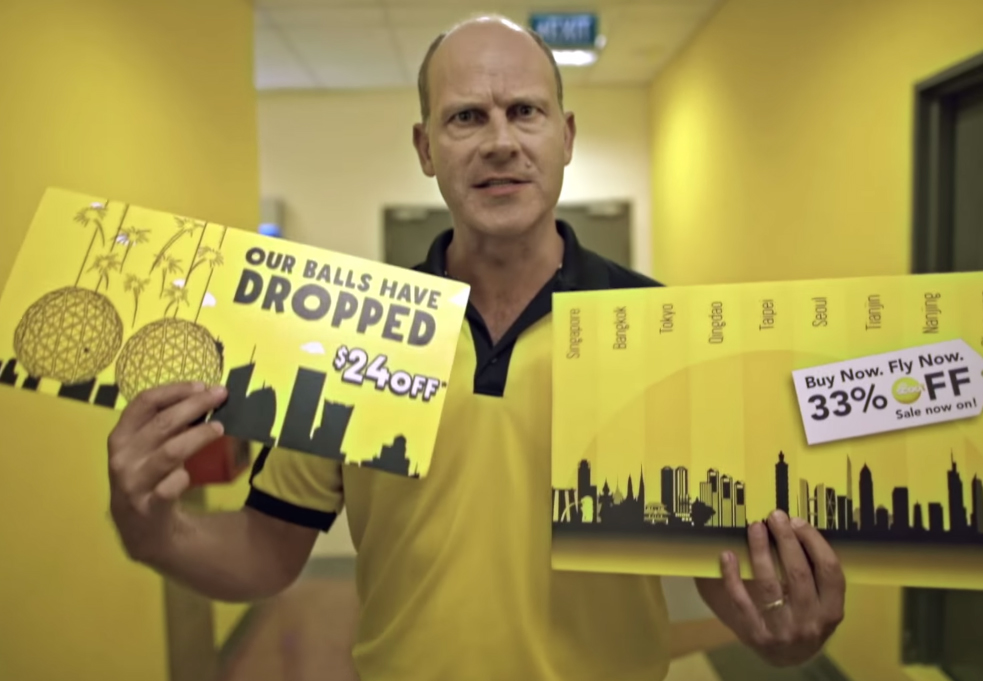
On a certain kind of morning, a corporate communications adviser earns the fee by preventing the client from doing the obvious thing. In 2014, the people at Scoot, the Singaporean low-cost airline, noticed that Spirit Airlines in the United States had unveiled yellow aircraft and advertising that looked remarkably familiar. The colors, typography, illustrations and cheeky tone all appeared close to Scoot's. The obvious move was to call a lawyer. Instead, Scoot's agencies decided to be helpful.
They assembled a kit for Spirit: a toy Scoot airplane painted in the correct colors; a pocket brand guide; advertisements printed on tracing paper; instructions for making a Scoot ad in five minutes; and a letter bearing the glorious title “DON'T Cease and Desist.” Scoot's chief executive sent it to Spirit's chief executive. Copies found their way to reporters. A grievance became a prop, and the prop became a story.
A consultancy hiding inside an editorial room
SweeneyVesty, founded by Jane Vesty and Brian Sweeney in New Zealand in 1987, is not primarily a stunt shop. Its list of services reads like the complicated middle of corporate life: transformation, investor relations, executive counsel, employee communication, litigation communication, reputation and crisis management. It works for corporations, public bodies, government organizations, consumer brands and senior leaders. Much of that work is necessarily discreet; the company offers its client list in a new-business conversation, not as a public trophy cabinet.
The interesting distinction is how the firm connects boardroom judgment with the making of things. It writes speeches, plans stakeholder programs, builds media strategies, produces film and web work, manages events and develops brands. SweeneyVesty calls writers and editors its “forward pack,” a rugby metaphor that assigns prose the bruising work up front. Its consultants, the company says, have studied everything from political science and law to accountancy, literature and music. The desired employee is less a channel specialist than a person who can think, write, talk, plan and execute.
“A brand story is not a logo or a tagline, but an idea that has multiple adaptations and connections.”SweeneyVesty on its “Organizing Idea”
That sentence is the company's product philosophy. One central thought should survive translation into a CEO speech, a media pitch, a video, an employee meeting and a social post. Distribution is designed alongside the idea. The agency's geographic claim works the same way: New York and New Zealand are operating bases, while projects have extended, by its count, across more than 100 cities in 50 countries during a ten-year period. The business is private, independent and relationship-led. It sells bespoke counsel and implementation, sometimes for an urgent moment and sometimes over years.
The famous case / by the numbers
Earned media value is an industry estimate, not revenue in the bank. The more durable evidence is the coverage, search lift and awards record.
The first thing to fail was the conventional frame
The problem looked legal: somebody had imitated the brand. But legal action would have forced Scoot into a contest about ownership, with a much larger American company on the other side. It also would have made an irreverent airline sound injured and bureaucratic. The shift was to ask a communications question instead: what response would make Scoot more recognizably Scoot?
That changed the economics. According to a creative leader who worked on the campaign, the budget was about US$36,000. SweeneyVesty described the award category more conservatively as under $50,000. The firm reported more than $40 million in earned media value, coverage from over 100 outlets and a 32 to 33 percent lift in Google searches. A Facebook video exceeded the airline's previous peak by 43 percent. These figures came from the campaign team, but the outside recognition is plain: a Silver Lion at Cannes in 2015, PR Daily's grand prize, honors at Spikes Asia, Clios, AD STARS and Mobius, followed by two Gold Pencils at The One Show in 2016.
How the joke learned to travel
The campaign was collaborative. Saatchi & Saatchi Singapore led the creative work, Publicis Singapore handled digital duties, and SweeneyVesty developed and executed the worldwide media strategy with people in Singapore, Wellington, Auckland and New York. This matters because PR case studies tend to award the entire magic trick to the person holding the wand. Here, the mechanism required several hands: the joke, the physical kit, the client willing to sign it, the media plan and fast coordination across time zones.

What a communications buyer is actually buying
SweeneyVesty sits between a management consultancy and a creative agency. A client can bring it a transaction, a product launch, a hostile news cycle, a new chief executive, a culture problem or a market it does not yet understand. The output may be counsel, a narrative, a speech, a film, a stakeholder program or an entire campaign. The common purchase is judgment: deciding what the problem really is, then building the smallest coherent system that can change how people perceive it.
That positioning is useful for organizations whose problems ignore departmental borders. An investor-relations issue may become an employee issue by lunch and a consumer story by evening. SweeneyVesty's breadth means the same organizing thought can continue through each audience instead of being retranslated by a chain of vendors. The tradeoff is the natural one for a senior-led independent: it is a fit for bespoke, consequential work, not necessarily for buyers who chiefly need enormous paid-media purchasing power, hundreds of local offices or a standardized self-service product.
The part worth stealing
The Scoot campaign tempts imitators toward surface details: be funny, make a box, tease a competitor. Its useful lesson is more disciplined. First, find the action that demonstrates the message. Scoot did not announce that it was the original, mischievous brand; it behaved as though imitation were flattering. Second, give the story a physical or visual object. A claim about similar branding is abstract. A toy plane and tracing paper can sit in a photograph. Third, write the headline into the event. “Airline sends rival instructions for copying it” is already a publishable sentence. Finally, plan distribution before production. A lovely object that reaches nobody is office decor.
There are conditions. Humor works when the facts are legible, the voice is authentic and the joke points upward or sideways. It is a poor instrument when safety, grief, legal jeopardy or a genuine power imbalance is involved. A challenger can tease a larger rival; a dominant company teasing a small one may look cruel. And earned attention cannot be promised. The Scoot story carried because the resemblance was instantly visible, the response was surprising, and the brand had permission to be cheeky. Remove any one of those and a “DON'T Cease and Desist” letter may become merely a cease-and-desist letter with worse punctuation.
The broader company is quieter than its famous yellow campaign. That may be the point. Since 1987, SweeneyVesty has built a business around long relationships and moments in which the client cannot afford disconnected advice. The work ranges from financial reporting to video production, from crisis rooms to keynote stages. Its most memorable case does not summarize all of that work. It reveals the habit beneath it: change the frame, make the idea concrete, and give other people a reason to carry it.
Go further