Christine Turner’s promotion took twenty-five years to become a headline. She joined ChappellRoberts in 1998. In 2023, she became its chief executive officer and partner. The company name on the résumé stayed put while the responsibilities beneath it kept moving. For an advertising executive, whose business involves finding the fresh angle, that is a pleasingly unfashionable career plot.
There is another plot inside it. Turner has spent years learning how an agency works, and she has publicly questioned a familiar piece of advice passed down to people learning the same thing. As a young woman, she heard that she should “pay my dues.” By the time she was president, she was ready to replace that vague instruction with something a person could actually use.
The distance between those two positions gives her story its shape. A long tenure offers an unusually close view of an organization. Becoming its leader offers a chance to decide what the next person should inherit. Turner’s public record contains both: the patient accumulation of responsibility and a willingness to reconsider how responsibility gets taught.
A promotion with a long preface
Turner graduated from the University of South Florida in 1997 and joined the agency the following year. Her subsequent positions included vice president of account services and executive vice president. That sequence matters because account work places a person between the client’s expectations and the team’s capacity to deliver. It is a practical education in the distance between an attractive idea and an agreed result.
Her professional biography lists a bachelor’s degree in mass communications and executive education in digital marketing strategies at Northwestern University. The subjects suit the arc of her work: understanding communication, then continuing to learn as the channels change. The agency credits her with strategy for consumer and business audiences, combining branding decisions with attention to business outcomes.
A small, concrete credit offers a glimpse of the earlier chapters. The team behind ChappellRoberts’ 2015 WebAward-winning entry for DTCC’s 2013 digital annual report included Turner as principal account executive. Charlie Militello handled senior digital art direction; Adam Alvis, web development; Sarah Tildsley, creative direction; and Hunter Taylor, account work. An annual report has to carry information as well as an identity. The credits show the different disciplines brought to that task.
They also put the later CEO title in proportion. The work already depended on several people. Award lists, with their plain names and job descriptions, can be more revealing than a leadership portrait. Here was Turner in the company of the people who designed, built and directed a piece of client work, years before the public announcement of her presidency.
vice president
The handoff was part of the job
In February 2021, Colleen Chappell announced Turner’s promotion to president. The announcement described Turner as the agency’s first executive vice president, appointed nearly three years earlier, and credited her with strategy, branding and new business development. She had managed key departments as well. Her new remit covered day-to-day operations and work with the principals on products and services.
Chappell remained CEO at that stage. The change belonged to a long-term succession plan, with the two leaders continuing to work together. A succession announcement can sound like a ceremonial exchange of stationery. This one named the practical work: operations, growth, developing services and coordinating with other agency principals. The transition had tasks attached.
By 2023, Turner had become CEO and partner. Seen together, the two dates describe a staged transfer of responsibility. They also distinguish her story from a founder’s origin tale. Her task was to take a business she knew deeply into its next chapter. The relationships and expectations were already there. So were colleagues who had known her under earlier titles.
That makes continuity an active responsibility. A leader promoted from within brings knowledge of how decisions have been made, which clients require what, and how different departments work together. The question then becomes what to do with that knowledge. Turner’s comments about younger colleagues offer one answer: examine the rules they are being asked to accept.
The dues, apparently, need itemizing
Asked in 2021 for advice to young women in business, Turner recalled the instruction to pay her dues. She found it confusing and associated it with accepting diminished boundaries and respect. Her replacement was direct: “work hard, define your boundaries, know your worth.” It is advice with verbs, which gives it an advantage over advice with a fog machine.
“work hard, define your boundaries, know your worth.”Christine Turner, 2021
Each part asks something of the person beginning a career. Effort remains essential. Boundaries require judgment. Knowing one’s worth calls for an understanding of the work and the relationship. Taken together, the advice leaves less room for treating discomfort as proof that an apprenticeship is going well. Learning still takes time; the expectations can be clearer while it does.
A colleague’s account adds evidence of Turner’s influence. In a PRSA Tampa Bay spotlight, Katy Parsons named Turner and Colleen Chappell as her most important career mentors. Parsons described how they helped her see failure as a chance to learn and become more creative. She also associated them with an energetic, enjoyable working environment.
That testimony brings the story down from the executive title to the experience of being taught. Failure can become a verdict or a lesson, depending partly on how the people around it respond. Parsons’ description suggests that Turner’s mentoring helped make it a lesson. It is a specific account from someone who worked alongside her, rather than a value displayed on an office wall.
The business case for a decent working day
In a February 2024 conversation about running an agency, Turner connected the working environment to the quality of creative output: “People that are happy will produce creative, great work.” The sentence is brief enough to be useful in a meeting. It also puts a commercial responsibility behind the matter of how people experience their jobs.
An agency depends on people producing ideas together, then carrying those ideas through research, execution and client decisions. A leader’s interest in the working day therefore reaches into the product. Turner’s argument makes employee experience part of the way the business earns its living, with consequences for the work customers receive.
She has also publicly celebrated ChappellRoberts’ workplace recognition from Florida Trend, linking her pride to the team she works with. The recognition and her comment provide a modest, verifiable counterpart to the interview’s principle. Culture is easy to announce. A colleague’s description, a workplace acknowledgment and a leader’s stated priorities offer different views of the same subject.
They do not tell every story inside an agency. They do show what Turner chooses to discuss when asked about leadership: the business, the people producing its work and the conditions in which they can develop. Her career began among those people. Her present job includes responsibility for them.
Tampa keeps appearing in the credits
The city runs through her record well beyond the agency. Turner’s connection with Leadership Tampa and its alumni organization dates to 2007, according to the Tampa Bay Chamber’s 2022 annual report. That report also records her presenting the Deanne Dewey Roberts Emerging Leader Award to Wyatt Krapf. Recognition of another person’s development sits comfortably beside the mentoring chapter of her own career.
Her civic service has included the Tampa Downtown Partnership. In September 2024, the agency shared that Turner and Katy had attended its annual meeting and that Turner would extend her board membership into 2025. These are ordinary calendar commitments, which is part of their significance. A connection to a place becomes more tangible when it involves meetings and continued service.
The Tampa Bay Economic Development Council’s FY2025 committee document lists her as chair of its Marketing and Communications Committee. Its remit includes talent attraction, business recruitment and expansion, and campaigns introducing Tampa and Hillsborough County to prospective businesses and influential audiences. Here her professional discipline meets a regional assignment: help a place explain why people and businesses should consider it.
The work is broader than promoting a single client. The committee guides marketing plans and helps connect staff with people who can carry the region’s story further. It is a useful example of how an advertising executive’s skills can have a civic application. Research, audience, message and relationships become questions about a community’s future.
The university chapter stays open
USF announced Turner’s appointment to its Foundation Board of Directors in June 2025. By then she had chaired the Alumni Association board and was serving on the advisory council of the Zimmerman School of Advertising and Mass Communications. The university that appears near the beginning of her career remained an institution to which she contributed time and judgment.
There is an agency connection, too. ChappellRoberts has funded a USF scholarship in memory of founder Deanne Dewey Roberts since 2012. Turner’s 2020 agency post introduced recipient Eleni Kashis and explained the firm’s interest in supporting the next generation of communicators. The story put a student, and the practical help of a scholarship, at its center.
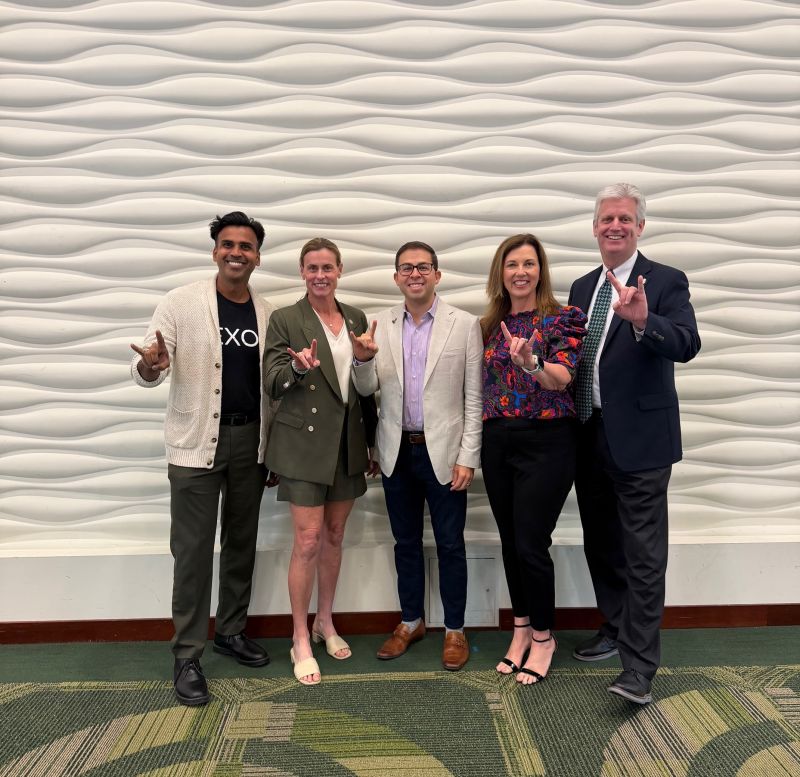
In April 2026, Turner marked her final meeting of her Alumni Association board term with a photograph of colleagues. She named Sally Dee, Balaji Ramadoss, Juan Carlos Soltero and Bill McCausland, and reflected on serving as a member, chair and immediate past chair. It is a group picture rather than a solitary executive image. The chapter closes in company.
A little room for the next idea
When an intern interviewed her in 2024, Turner chose “Judicious” as her one-word description. She emphasized honesty in relationships and described her interest in the agency’s future through the talent it could bring together and what those people would make. Her enthusiasm arrived in a compact phrase: “Outcomes are cool.”
The pleasure is in the finished work. That is a fitting place to leave a career built through account service, strategy, operations and leadership. The titles establish who carries responsibility. The result explains why the responsibility matters. After years inside one agency, Turner still describes the future in terms of people making something worth seeing.