Before Marc Paulenich had a theory about brand advocacy, he benefited from a rather ordinary example of it. A neighbor liked an agency. She suggested he talk to the people there. He needed summer work while pursuing an MBA in Toledo; the agency was Hart. A recommendation crossed a fence, figuratively speaking, and an introduction became a career. Advertising can buy an audience. A person who believes in something can send you through the right door.
That small beginning gives a pleasing shape to the work Paulenich is doing now. In January 2026, he became Hart’s chief executive officer. This October, his book Brand Mover: How to Lead Audiences from Apathy to Advocacy is scheduled to appear. Between the summer opportunity and those two developments lie agency jobs, an excursion into education-sector research, a return to Toledo agency life, and the gradual handover of a business that predates his arrival by decades.
A summer job with a long afterlife
His education had already put two useful subjects beside one another. Paulenich graduated from Hiram College in 2001 with degrees in economics and communications, earning summa cum laude honors and membership in Phi Beta Kappa. Economics asks how people make choices under constraints. Communications asks how meaning moves between people. A brand strategist can spend a working lifetime in the conversation between those questions.
He moved to Toledo after graduation to be closer to his wife and pursued graduate study at the University of Toledo. Hart entered the picture through the neighbor’s suggestion. The summer opportunity became full-time work while his graduate education continued part time. He joined the agency in 2002 and earned his MBA in 2005. There is something reassuringly unceremonious about that route: no grand announcement, just a useful introduction followed by work.
His later alumni biography records that he became Hart’s youngest vice president at 27. Years afterward, Warren City Schools inducted him into its Distinguished Alumni Hall of Fame. He had graduated from Warren G. Harding High School in 1997. The honors punctuate the story, but the early sequence is more revealing: college, a move, graduate school, an opening at an agency. Opportunity arrived at a practical moment.
The detour through consumer insights
Paulenich’s relationship with Hart includes a departure. In 2008, he joined Teach For America as a managing director, working in consumer insights. The change put audience research in a different setting. An education organization seeking recruits has to understand decisions that involve commitment, identity and a prospective person’s idea of a future. The subject may change; the need to understand the person making the choice remains.
A former member of his insights team, Jocelyn Noya Quintana, later described a manager who offered room to run projects independently and made time for questions and constructive feedback. That account adds a specific human detail to an otherwise title-heavy career. A manager’s confidence can be expressed through the amount of responsibility somebody is allowed to carry. Research teams, like their subjects, contain people whose participation has to be earned.
He returned to Hart in 2011 as chief operating officer. The return joined two kinds of responsibility: running the organization and continuing to practice strategy with clients. It is an instructive pairing. Advice about an organization’s future becomes more demanding when the adviser also has to help organize tomorrow. Staffing, resources and priorities give strategic language a timetable. A promising idea eventually needs somebody to decide who will do the work.
A succession measured in years
Hart was founded in 1965 by Tom Hart. His son Mike became president and CEO in 1993. Paulenich’s appointment therefore sits within a company history much longer than the usual announcement of a new executive. Mike moved to executive chairman when Paulenich became CEO, continuing to support culture, client relationships and long-term strategy. The change gave the agency a new chief executive while keeping its longtime leader involved.
The transition had an earlier milestone. Paulenich became president in 2021, a promotion also recorded by his university’s alumni publication. By the time the CEO title arrived, he had spent nearly five years in that role and had already served as COO and senior vice president of strategy. The succession reads as an accumulation of responsibilities. The job at the end of the sequence had several jobs inside it.
During his senior leadership tenure, Hart more than doubled its revenue and expanded from one office to four. Its industry association profile describes growth from 40 to nearly 100 employees. Those figures belong to a period of organizational development involving many people; they also show the scale of the business Paulenich now leads. Keeping disciplines connected becomes a larger task as the agency adds colleagues, capabilities and locations.
The map now includes Toledo, Columbus, Detroit and Washington, D.C. Four addresses are easy to print beneath a logo. The more interesting management problem is how the people at those addresses share decisions. An independent agency’s growth has to be experienced by employees and clients as something useful. Otherwise, expansion risks becoming a longer list of places to send a meeting invitation.
Detroit at the other end of the hallway
In January 2025, Hart acquired Detroit-based Rebuild Group. Paulenich’s explanation of the move focused on a combination of capabilities: Hart’s established services alongside Rebuild’s digital and performance-media experience. He also discussed recruiting and the value of local operations for people who wanted to work closer to home. The rationale gave growth an everyday dimension. A new office can change a commute as well as a company’s market.
He described the connection between Detroit and Toledo through the image of a long hallway along I-75. It is a useful piece of agency geography. A hallway implies that the people at either end can still belong to the same working organization. The challenge is preserving that feeling when the corridor is a highway and collaboration depends on habits, shared priorities and the willingness to involve a colleague elsewhere.
There is a recognizable continuity between that argument and his broader brand thinking. Capabilities matter through the experience they make possible. A digital team, a strategist and a creative team need enough common direction for the client to encounter coherent work. An acquisition offers the ingredients. Management supplies the arrangements under which the ingredients can become dinner. The menu, by itself, remains an optimistic document.
The four steps between indifference and a recommendation
Paulenich’s forthcoming book gives his argument a compact structure. The Brand Movement Model describes four stages: apathy, awareness, alignment and advocacy. The progression begins with an audience that has little reason to care and ends with people who actively support the brand. Awareness sits between those points, a necessary recognition that still leaves considerable work to do. A familiar name can remain emotionally distant.
THE BRAND MOVEMENT MODEL
- 01ApathyIndifference
- 02AwarenessRecognition
- 03AlignmentConnection
- 04AdvocacyActive support
The distinction is easy to recognize in ordinary life. We remember plenty of businesses without recommending them to anybody. Knowing the name supplies a point of reference; having an experience worth recounting supplies a reason to speak. A recommendation asks the speaker to put a little of their own credibility behind the subject. That makes advocacy an interesting destination for someone who began his agency career with a neighbor’s recommendation.
“Why would they come with us?”Marc Paulenich, on the question behind Brand Mover
The publisher lists Brand Mover as a 208-page book scheduled for October 27, 2026. Its intended readers include marketing directors, chief marketing officers and business leaders. Paulenich’s personal website also describes an Emotional Movement Index, a diagnostic tool planned for the book’s launch. The measurement ambition fits his consumer-insights background: a relationship may involve emotion, but a leader still needs a way to ask where it stands.
The book’s premise does not require every customer interaction to become a love story. Its interest lies in movement: whether the organization is giving people reasons to develop a different relationship with it. A brand can earn recognition through repetition. Earning somebody’s support asks for more encounters that hold together. The difference becomes visible when a customer has the chance to tell another person what the business is like.
A brand has to go to work
Early in 2026, Paulenich appeared on a Washington, D.C. panel about organizational values and employee experience. His fellow panelists included leaders from Cisco, Hyatt and Peraton. A brand strategist on an HR stage makes sense once the subject becomes the experience a company actually delivers. The employees encounter the organization from the inside. Customers encounter the consequences of how that organization works.
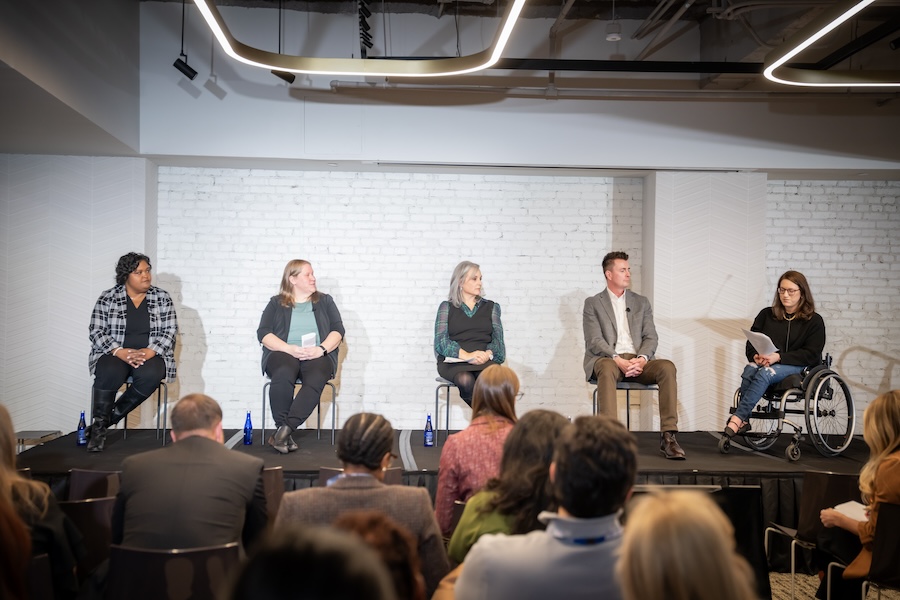
In his reflections afterward, Paulenich emphasized the gap between stated values and everyday behavior. Employees see what gets rewarded, what is tolerated and how decisions are made. His account of technological change, including AI, put participation and confidence alongside the introduction of tools. Giving people a role in a change is a practical expression of the values an organization says it holds.
“People can handle change better than confusion.”Marc Paulenich, on employee experience
The panel discussion also brought the question down to available time. Learning a new technology requires room to learn it. A company can announce its commitment to innovation; a manager’s calendar helps determine what that commitment means. Paulenich’s argument places those operational choices inside the brand conversation. The promise travels through ordinary decisions before it reaches anybody outside the organization.
The classroom, the council, the next question
Paulenich has kept several routes open between practice and education. He has taught marketing coursework at the University of Toledo and serves on its business college’s marketing and international business advisory board. He contributes through Forbes Agency Council and joined the 4As Central Region board in January 2026. His public roles include classrooms, industry conversations and client work, settings that ask different things of the same strategist.
His 2021 writing on marketing budgets considered performance marketing, longer-term brand building and social listening together. The combination anticipates the concerns of Brand Mover: how to keep immediate activity connected to the relationships a business hopes to develop. A budget makes that question concrete. Money has to go somewhere, and the allocation reveals which future the organization is willing to support.
As of October 6, 2026, the book’s publication is still ahead, as is his listed appearance at the October 14 Mid-Atlantic MarCom Summit in Washington. Hart’s CEO role is already underway. The career that began with somebody recommending a place to work has reached a point where Paulenich is asking organizations to earn that same kind of voluntary support. The neighbor had no media plan. She had a reason to recommend Hart. He has spent much of his working life studying what creates one.