When a machine stopped in Leon Lim’s cryptocurrency-mining operation, the bill had more than one column. There was the repair. There was the time lost. And there was the revenue that would never arrive. A short interruption could consume a day’s profit. The equipment was supposed to work continuously; the business depended on it. A machine taking an unscheduled afternoon off was exercising a freedom its owner could scarcely afford.
That experience supplied the problem behind Groundup.ai. Lim had been an entrepreneur before he became its founder and CEO, and had already learned that a promising business could be brought to a halt by an uncooperative physical object. Crypto might trade on screens, but mining required actual machines. Those machines could overheat. They could fail. Their indifference to the business plan was expensive.
Lim also brought another kind of training to the problem. He played the French horn and piano. A musician learns to notice small departures: a note that fails to settle, a change in tone, an instrument behaving differently from the one heard a moment earlier. In his account of Groundup.ai’s beginnings, that habit of listening became a way to think about equipment. A machine’s changing sound could carry information before a breakdown made the message obvious.
The attraction of this origin is its modesty. There is no need for a sudden revelation about the future of humanity. Lim had equipment that kept letting him down and a reason to pay closer attention. The question he carried into his next business was practical: could a company pick up those early changes, interpret them, and give someone time to act?
A horn player’s second repertoire
Lim’s musical background has credentials behind it. He holds a diploma in French horn performance, with distinction, from the University of West London, alongside Grade 8 qualifications in piano and music theory from ABRSM. He served as principal horn of the Singapore National Youth Orchestra and as principal of National Youth Winds. He also taught music. Listening was something he had practised, performed and passed on.
Those details give a different texture to a founder profile. Music demands preparation that the audience will ideally never notice. A listener hears the performance; the player knows the rehearsal behind it. Maintenance has a comparable problem of recognition. When equipment continues working, the intervention that helped it do so can disappear into the ordinary running of the day. Prevention rarely gets a curtain call.
Groundup.ai’s own introduction to its founders described Lim returning to music after work. The horn and piano were part of his life beyond company strategy. That matters because it keeps the connection from becoming a convenient branding trick. The instruments were there before the industrial AI pitch. The vocabulary of listening had somewhere real to come from.
His ventures also crossed back into music. A 2021 white paper identified him as the founder of NFTMUSIC.AI and described his earlier performance and teaching experience. Groundup.ai became the industrial expression of a recurring interest: what might technology do for a field he understood personally? The careers do not form a perfectly straight line. They share a founder willing to carry lessons from one room into another.
“It is and will always be about people.”
Leon Lim · 2023 seed announcement
Two founders, one table
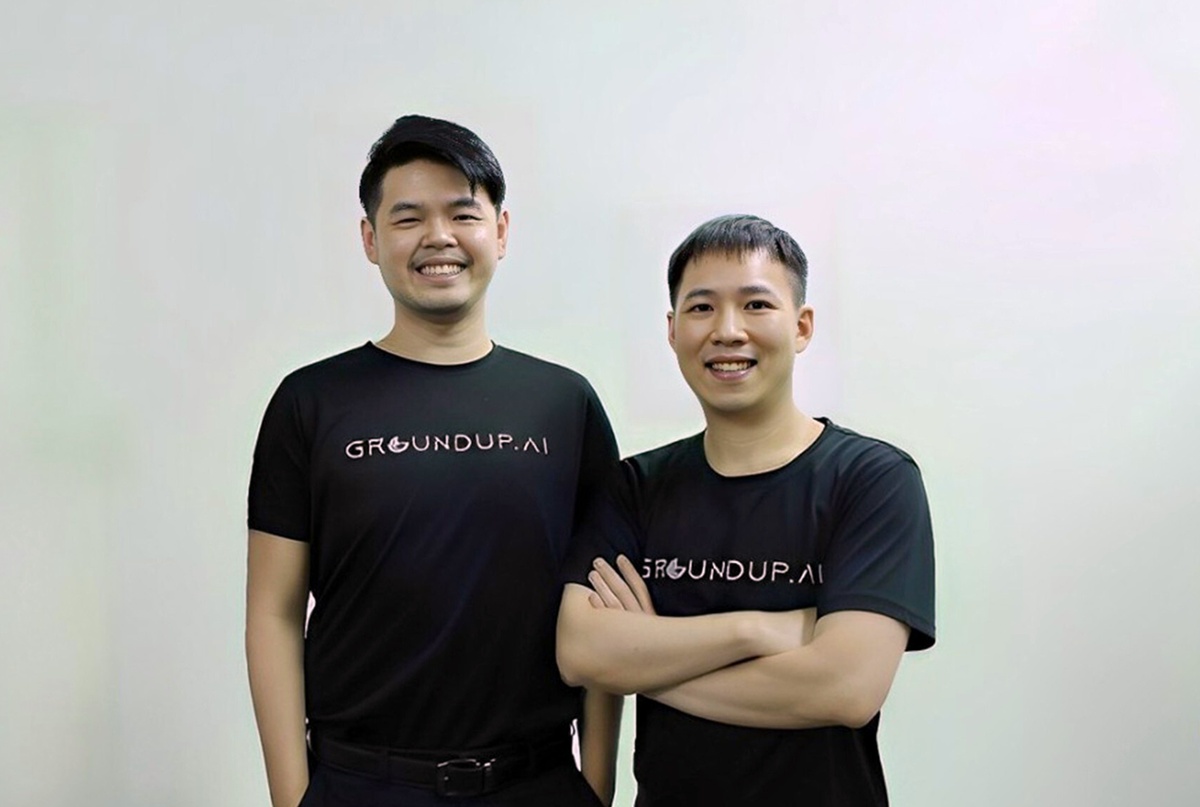
Groundup.ai’s story includes a coffee-shop conversation between Lim and Alex Wong. The pair later returned to that beginning for a founders’ video. The setting is pleasingly ordinary for a business dealing with ships, factories and critical infrastructure. A table is a perfectly serviceable place to start arguing about machinery; it has the additional advantage of arriving with coffee.
The partnership gave the company two distinct responsibilities. Lim charted direction and strategy. Wong, the co-founder and COO, brought management consulting, project implementation and operations experience. Their early team introduction put Wong in charge of business development and keeping operations running smoothly. One could explain where the business should go; the other had to help get it there.
The company’s 2023 funding announcement dates its founding to 2021 and describes Lim as a serial technology entrepreneur with two exits. Groundup.ai therefore entered the market with a founder who had already built and left businesses, alongside a partner versed in execution. The mining experience offered a customer’s view of failure. The partnership supplied a way to turn that frustration into a company.
By the time of the founders’ spotlight, the coffee-shop idea had become a 24-member team serving clients across Southeast Asia and the Middle East. That is a snapshot of growth, rather than a permanent headcount. More revealing is the distance between the first conversation and the work that followed: recruiting people, installing hardware and persuading industrial customers to trust a recommendation about a machine they depended on.
The alarm must come with an answer
Groundup.ai’s equipment collects sound, vibration and temperature signals. Its AI engine, GINA, works with an asset library to identify abnormal behaviour and help interpret what it means. The company calls the resulting approach Cognitive Maintenance. In ordinary terms, it wants to give the person responsible for the machine a useful next step.
An alert creates work for someone. They must decide whether it matters, what caused it and how urgently to respond. A stream of alerts can leave an engineer with a full screen and an unchanged problem. Lim’s argument is that industrial AI has to carry more of that interpretive burden. Detection becomes valuable when it helps a team decide what to do.
In a March 2026 podcast appearance, he described the idea as having “a senior engineer in your pocket.” The phrase works because it names the experience he hopes to reproduce: access to judgment, context and advice at the moment a question arises. It also keeps a person at the centre of the picture. Someone still has to prioritise work across the facility.
The industrial settings are specific. Lim’s public interviews describe deployments involving the Republic of Singapore Navy, Hamad International Airport and Doha Metro. Tatler’s profile also names CBM Qatar and Atlantic Maritime Group among clients and partners. These are settings where machinery supports a larger service. Keeping an asset running means preserving the work around it, whether that is a vessel’s operation or the movement of passengers.
This helps explain his insistence on practical outcomes. A maintenance team cannot spend a shift admiring the sophistication of an AI model. It needs a recommendation that makes sense in its environment. Lim’s business is tested where software meets equipment, and where an elegant explanation must eventually survive a very inelegant mechanical fault.
- 01 / ListenSound, vibration & temperature
- 02 / InterpretGINA + the asset library
- 03 / RecommendCause, action & timing
Capital, with a maintenance schedule
In March 2023, Groundup.ai announced a US$1.8 million seed round led by Wavemaker Partners, with SEEDS Capital and angel investors participating. The planned uses were concrete: grow the internal AI and software capability and pursue international markets. Lim’s explanation put people ahead of the machinery. “It is and will always be about people,” he said.
April 2025 brought a US$4.25 million Series A led by Tin Men Capital, with existing investors participating. The company planned further product development, broader AI capabilities and expansion. The two rounds mark separate stages of financing. Neither amount is a measure of Lim’s personal wealth, and neither tells a reader how reliably a particular machine will run.
His own announcement had a lighter register than the customary funding bulletin. He joked about machines having fewer tantrums and thanked clients, investors and colleagues. He also offered to answer questions about the fundraising process. The humour is useful evidence of how he speaks publicly: the technology is serious, but a celebratory post need not sound like the instructions for a pressure vessel.
In 2025, he appeared on the maritime authority’s Smart Port Challenge launch programme, on a panel about startup scaling, strategic capital and global growth. Tatler included him in its 2025 Gen.T Leaders of Tomorrow selection in Singapore. The invitations and recognition place him in the wider founder community. They accompany the operating business, which still has to earn its place with customers.
What Korea taught him to promise
Groundup.ai took part in the 2025 K-Startup Grand Challenge and reached its 40-company second phase. For Lim, the Korean expansion experience included an adjustment in how to talk about the product. Advice from mentors and industry contacts pushed the team toward reliability, predictability and measurable results. Technical ambition needed to be expressed in terms an industrial buyer could trust.
The distinction is revealing. Entering a new market required more than translating a sales deck. The team worked through the practical questions of establishing an entity, hiring, procurement and compliance. In his January 2026 interview, Lim treated the programme’s contribution as preparation for expansion. He was careful about the stage reached: readiness had improved, while revenue impact was still too early to measure.
That restraint belongs in the story alongside the ambition. Lim wants the company to help industries avoid unplanned downtime internationally. A founder can hold that goal and still acknowledge that a new market begins with learning its requirements. Korea added a lesson in how to make the promise: start with what the buyer needs to rely on, then explain the technology that supports it.
The next audience is the engineer
On 30 January 2026, Groundup.ai launched Groundup Academy, a free educational programme for industrial professionals. Its two tracks divided the task between engineers working with machine signals and leaders deciding how maintenance investments should pay off. Training became another part of the company’s effort to make equipment data useful.
SGInnovate subsequently welcomed the academy as a learning and talent partner. Lim described the gap between advanced sensors and a workforce’s ability to turn their information into results. This brings his earlier teaching experience into the present without requiring a neat career prophecy. He has taught musicians; the business he now leads is providing instruction for people working with industrial AI.
Then, in August 2026, Groundup.ai announced a contract worth S$3,995,473 with PUB, Singapore’s national water agency. The open tender attracted 15 respondents, and Groundup.ai was the sole awarded provider. Its task is to implement and maintain a predictive maintenance and reliability system for critical rotating equipment. The announcement describes planned work and its aims, rather than completed savings.
The destination gives Lim’s original problem a different scale. A failing machine in a mining operation meant lost earnings. Pumps and other rotating equipment in water infrastructure support an essential public service. His ambition now reaches equipment whose continued operation most people take for granted. That is an unforgiving audience: people tend to notice infrastructure precisely when it ceases to behave.
There is a certain appropriateness to a horn player pursuing this kind of business. The desired result is continuity. Engineers get time to intervene. Machines keep doing their jobs. A founder who began by counting the cost of interruptions is trying to make those interruptions less frequent. The successful performance, in this case, is the one that allows everybody else to get on with the day.