The hack that became a platform
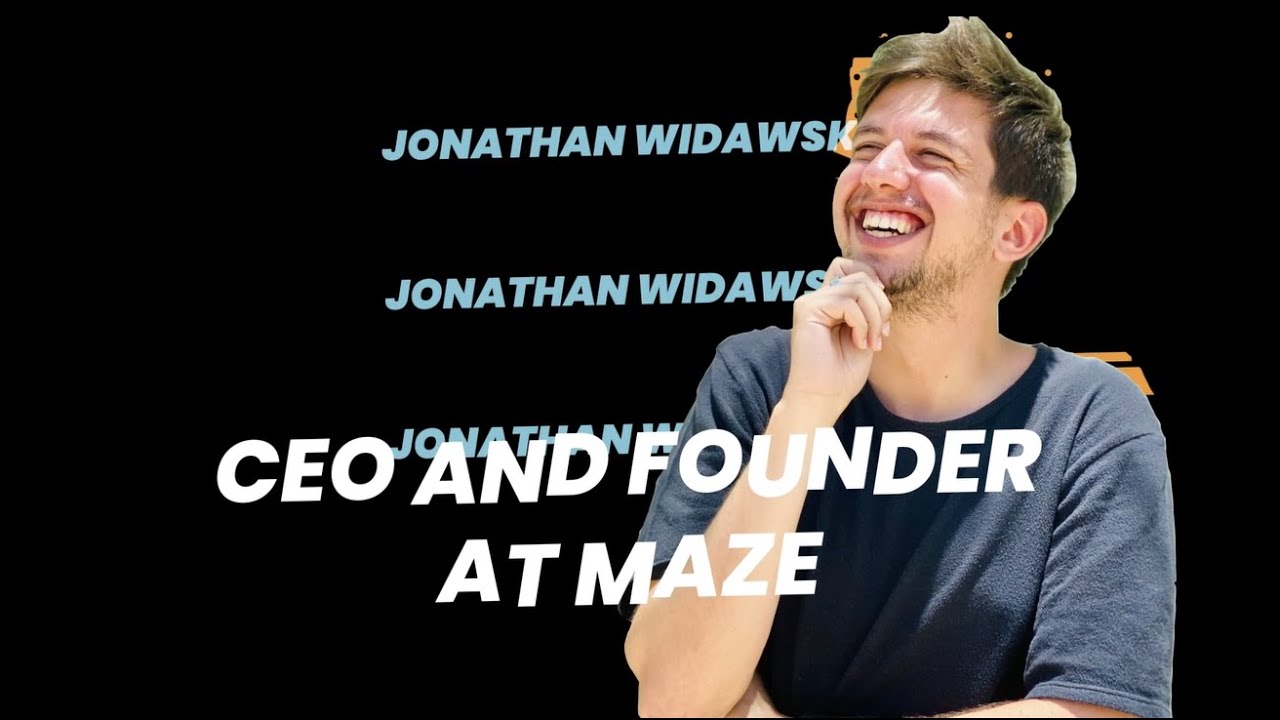
Jo Widawski graduated from two French institutions - EMLV and IIM - with a background in entrepreneurship and digital media. He spent his early career in Paris teaching UX, running design workshops, and consulting for agencies. His clients included McKinsey, Rocket Internet, and PSG. He was good at this. Good enough to see the same problem everywhere he went: product teams making expensive guesses, shipping features nobody wanted, and finding out too late.
"The way companies build products is fundamentally broken."
- Jonathan Widawski, Maze.coBefore Maze, he founded two companies. Viceversa came first. Then Pin.gg - a privacy-focused messaging service for gamers. It was at Pin.gg where the idea for Maze crystallized. Running a gaming startup meant Widawski was constantly testing assumptions against thousands of beta users. Existing research tools were slow, expensive, and built for specialized researchers - not a scrappy team trying to ship a product at startup speed. So he built an internal prototype testing tool. Simple. Fast. Attached directly to the design process. That tool was Maze.
In 2018, Widawski co-founded Maze with Thomas Mary. The original pitch was clear: product teams should have easy access to user data during the design phase - not after the launch, not after the rework, and definitely not after spending 100x more to fix a decision that could have been validated in a day.
The timing turned out to be accidental genius. When COVID-19 hit in 2020 and the world went remote, demand for unmoderated, asynchronous user research exploded. Maze grew 6x. Teams that had relied on in-person usability labs suddenly needed a remote alternative - and Maze was already there. By the time the world reopened, research teams had developed new habits. Maze had 4,000+ customers and was growing.
Twelve months after their Series A, Widawski announced a $40M Series B in June 2022. The round was led by Felicis Ventures' Victoria Treyger, with participation from Emergence Capital, Amplify, Partech, and Seedcamp. What made the round notable wasn't just the size - it was who else joined: Atlassian Ventures, Zoom Ventures, and HubSpot Ventures. Three company-backed VC arms, each representing a product that lives inside the daily workflow of design teams. They weren't writing checks to be polite. They were writing checks because Maze fits into a world where those tools are table stakes.
"In a world where everyone can build, how fast you push something to market doesn't matter anymore. It's what you build that matters."
- Jonathan WidawskiThe $40M announcement marked four years since the company had been a team of four in uncertain early days. By 2022, it was 130+ people distributed across 35 countries. By the time of the Series B, Maze had over 60,000 brands on the platform - Hertz, Sony, Fidelity Investments, BNY Mellon, Nubank among them.
Widawski's framework for understanding the business is unusually candid. He splits Maze customers into two buckets: "cultural adopters" - teams that embed research into every stage of product development - and "transactional users" who show up once for a specific study, then disappear. He doesn't pretend both are equally valuable. "We win when testing and research is seen as cultural shift," he's said. "We lose when it's transactional." The distinction shapes everything from Maze's pricing model to how the company measures churn.
The educator never fully left. Widawski has taught at General Assembly, contributed columns to Fast Company, and hosts Disco Conf - Maze's annual community gathering that draws thousands of UX researchers and product designers. The conference name alone says something about how he thinks about company culture: serious about research, not serious about being serious.
In 2024, Widawski delivered the opening keynote at Disco Conf, laying out his view on where AI intersects with research. His position is more nuanced than the typical AI-maximalism you hear from SaaS CEOs trying to ride a trend. He sees AI as capable of automating the scaffolding around research - transcripts, scheduling, report generation, screening - while the actual insight, the human judgment about what matters, remains irreplaceable. "User insight is the one thing that can't be automated in the process," he's argued. For a company building AI-powered research tools, that's a careful line to walk.