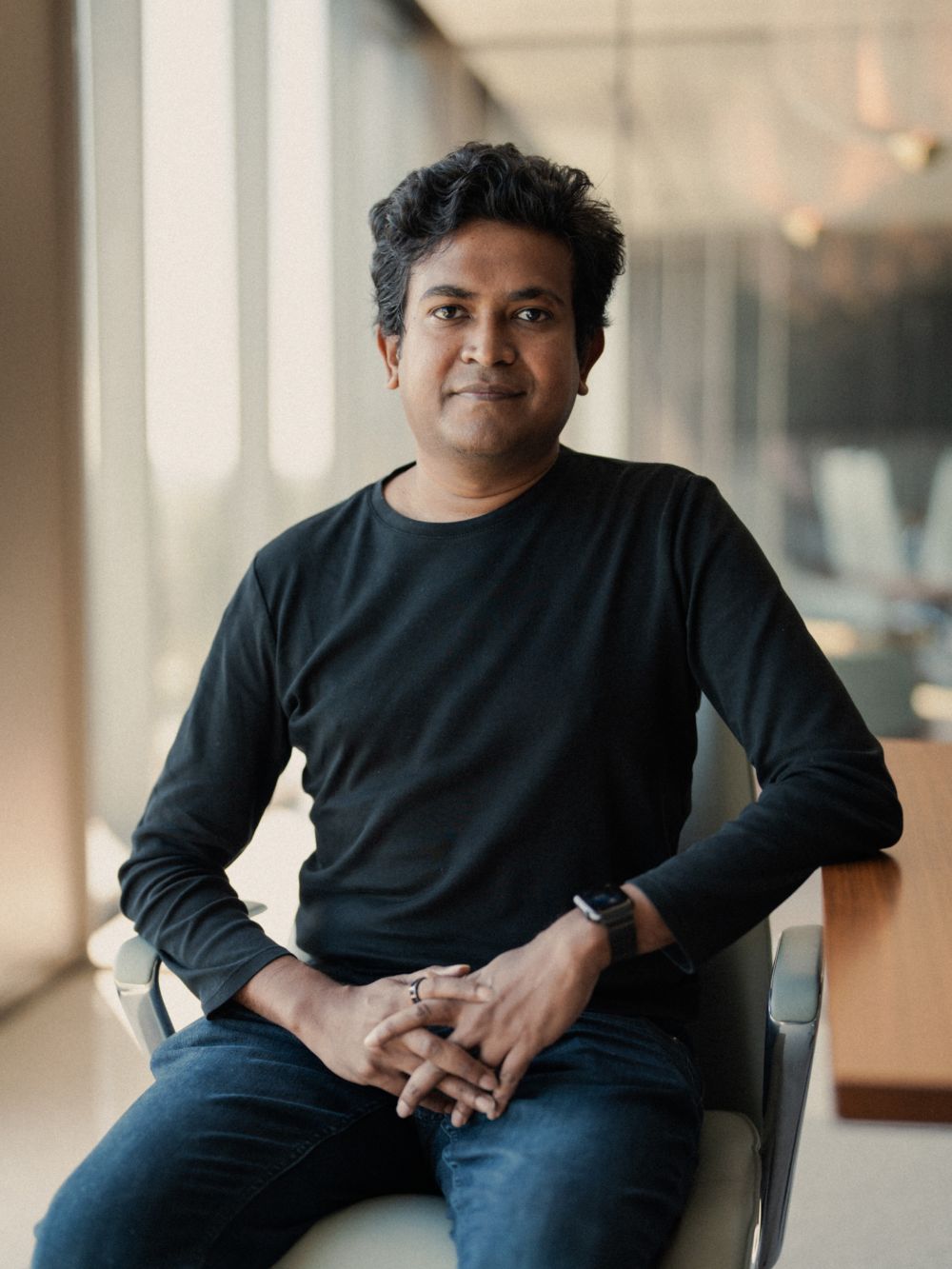
Before there was a billion-dollar company, before the Stanford degree, before the buzzwords and the board decks - there was a teenage boy in India, staying up late, writing neural network code to steer a simulated Formula 1 car. Nobody asked him to. No course required it. Jonathan Siddharth just wanted to see if a machine could learn to drive. That question has never left him.
Today, Siddharth runs Turing, a San Francisco-based company that sits at one of the most strategically important intersections in technology: between the AI labs building frontier models and the enterprises trying to deploy them. Turing has raised $334 million, reached a $2.2 billion valuation, generated $167 million in annualized revenue, and assembled a talent cloud of over 2 million engineers worldwide. The company employs 2,600 people. But none of those numbers fully capture what Siddharth is actually building.
What Turing actually does is harder to compress into a sound bite. It sources, vets, matches, and manages elite software engineers for global enterprises. It trains foundation models - including providing the coding data that powered early ChatGPT. It builds AI agents and enterprise deployments for Fortune 500 companies in banking, insurance, retail, and advanced technology. And increasingly, it functions as a piece of critical AGI infrastructure - the scaffolding that helps the world's most ambitious AI systems learn how to do things people pay for.
The Long Road From Chennai to Stanford to Silicon Valley
Siddharth grew up fascinated by artificial intelligence long before it was fashionable. As a student at Anna University in Chennai, he graduated first in his class in the Computer Science Department, collecting merit awards and publishing his first IEEE paper - on neural networks for self-driving cars - while still a sophomore. The paper was presented at an IEEE Conference on AI in Singapore. He was studying, but he was also already building.
At Stanford, where he arrived in 2005 to pursue his Master's in Computer Science, the research deepened. His thesis applied machine learning to web search - an area that would become enormously commercially important. He graduated with distinction and took home the Christopher Stephenson Memorial Award for Best Master's Research in the CS Department. Not bad for someone who was simultaneously coding up side projects and exploring what machine learning could do next.
In 2006, while still at Stanford, he interned at Yahoo's Search Relevance group, where he built a query classifier that delivered meaningful relevance gains across multiple markets. He was learning how to translate research into impact at scale. He was also meeting people who would become central to his story - including Vijay Krishnan, the co-founder he would build two companies with.
Act One: Rover
After Stanford, the first company was Rover - an AI-powered content discovery app that reached number one on the Apple App Store for content recommendations. Rover drew early acquisition interest from Google and Twitter. It eventually sold to Revcontent for approximately $30 million in 2017, with Siddharth moving over as Senior VP of Technology post-acquisition.
From the outside, that looks like a clean success story. Siddharth describes it differently. He says he felt "an unfinished quest." The exit was real. The itch was still there. What could he build that would be genuinely large? What problem hadn't been properly solved?
Act Two: Turing
In 2018, he launched Turing with Vijay Krishnan. The founding thesis was specific: the global engineering talent market was fundamentally broken. Great developers existed everywhere in the world. Companies hiring them lived primarily in a handful of expensive cities. The matching mechanism between them was inefficient, slow, and full of gatekeeping. An AI system could fix that.
Turing built exactly that system - end-to-end, from sourcing candidates to testing their skills to matching them with the right projects to managing them through deployment. The platform went from zero to two million developers and 900-plus enterprise clients in under seven years. It became a unicorn in 2021. It hit a $4 billion peak valuation in 2022. It came back down and climbed again, reaching $2.2 billion after its March 2025 Series E.
The OpenAI Chapter
Few people outside the AI industry know this part of the story. When OpenAI was developing GPT-3 and needed the model to learn how to code and use developer tools, they came to Turing. Siddharth's team provided the coding training data. ChatGPT launched months later. The coding capabilities that made the product a cultural phenomenon were, in part, built on what Turing supplied.
This is not a marginal footnote. It is central to what Turing has become: not just a talent marketplace, but a company that partners with frontier AI labs on the hardest problems in model capability. Turing now works with multiple leading AI companies on reinforcement learning from human feedback (RLHF), supervised fine-tuning, AI model evaluation, and safety protocols. The developer talent cloud and the AGI infrastructure work are not separate businesses - they are the same bet, placed twice.
The CEO Who Doesn't Take Vacations
Siddharth is not a founder who has learned to delegate and disappear. He has taken two weeks of vacation in seven years running Turing. When he does take time off, he goes to F1 races or concerts - high-stimulus environments that, perhaps not coincidentally, involve exactly the kind of human-machine feedback dynamics he finds intellectually compelling. The Kindle he carries everywhere has earned, in his estimation, the highest "joy-per-dollar" return of any purchase he's made at around $300.
The minimalism is deliberate. He lives simply, owns less, optimizes for cognitive bandwidth. He can't live without ChatGPT. He was an early and genuine Apple Vision Pro enthusiast, one of a small cohort that actually uses the device regularly. He plays racing games on his PlayStation 5. He tracks his recovery with an Oura ring. The personal technology stack of someone who thinks about human-machine interfaces professionally is, predictably, thorough.
What drives Siddharth is not, by his own account, the metrics. It is the unfinished quest. "Our mission at Turing is to unleash the world's untapped human potential," he has said. The developer talent platform is one expression of that. The AGI infrastructure work is another. Both rest on the same foundational belief: that the gap between what humans can do and what the systems supporting them enable is still enormous - and closeable.
Series E and What Comes Next
The March 2025 Series E - $111 million at a $2.2 billion valuation, led by Malaysia's sovereign wealth fund Khazanah Nasional Berhad - was not primarily about surviving. Turing had $167 million in ARR. It was about what Siddharth called "the next wave of AGI." The funding announcement was explicit: Turing is accelerating superintelligence research and deployment in Coding, Enterprise, and Science.
That is a very large statement. It is also, for someone who programmed a neural network to drive a car before self-driving vehicles became an industry, a characteristic one. Siddharth has been ahead of the same curve for over twenty years. The question he is currently working on - how do you build infrastructure for AGI that actually helps enterprises do things they couldn't do before? - is the same question that animated every project before it. Bigger stage. Same obsession.
The teenager in Chennai who wanted to see if a machine could learn to drive is, in some meaningful sense, still running the show. The company has grown. The models have grown. The bet has grown. The instinct has not changed at all.