The first headquarters of The Loyal Subjects was a West Hollywood bungalow. Inventory had the garage. Shipping occupied the living room. Jonathan Cathey had written a $500 personal check to get moving, and his girlfriend at the time helped pack boxes. There was no inherited playbook, no shelf reserved at a national retailer, no grand mythology waiting to be repeated on a conference stage. There was a creative person making small objects and learning what happened next.
Cathey had already tried on several lives. He studied theater at California State University, Northridge. He painted and drew. He recorded records, toured as a drummer and absorbed the do-it-yourself grammar of bands, surf labels and skate brands. His early characters, a rocker-hillbilly troupe called Mullet Heads, made it into animation development at MTV. A trip to China and an encounter with a factory turned those characters into toys. The route was crooked, which may be why it proved useful.
By 2009, the pieces had become a company. Cathey named it The Loyal Subjects, conspicuously leaving “toys” out of the title. The name allowed the idea to roam. It could hold figures, stories, television, art or whatever came after the next turn. Seventeen years on, the company makes action figures, fashion dolls, plush and collectibles. The founder still speaks about it less like a portfolio than a setlist.
A drummer enters the toy aisle
Music gave Cathey more than a biography. It supplied an operating system. He compares assembling a team to taking a band on tour: talent matters, but everyone also has to survive the van. A beautiful solo cannot rescue a group that refuses to listen. Manufacturing has its own tempo, licensing its own key changes, retail its own ruthless curfew.
Cathey learned those parts by playing nearly all of them. He describes his job as a Swiss army knife spanning design, development, production, licensing, procurement, fulfillment, sales, marketing, financing and contracts. He adds the office chores too: stocking the refrigerator, cleaning bathrooms, taking out the trash. The list punctures the polished title of chief executive. It also explains why his products carry such a visible point of view. The person sketching the feeling has spent years watching that feeling move through a purchase order.
“Creating and connecting.”Jonathan Cathey on the rush of making toys
The Loyal Subjects began with designer toys, then moved toward counterculture collectibles and licensed characters. Transformers and G.I. Joe widened the audience. Action Vinyls gave familiar heroes and villains a shared scale, articulation and interchangeable accessories. The proposition was cheerfully unruly: characters from separate fictional universes could meet on the same carpet and borrow one another's gear. Canon could wait outside while imagination got the good seat.
The difference between memory and play
Nostalgia is an efficient doorbell. Ring it with Rainbow Brite, Teenage Mutant Ninja Turtles, M.A.S.K. or My Pet Monster and a grown customer may answer carrying a vivid memory of a bedroom floor. But Cathey does not consider recognition enough. He has criticized a collectibles market too willing to reheat the past without changing the meal. His preferred vocabulary is construction, function, paint detail and “toyetic experience” - the reasons an object invites a hand rather than merely a dust cloth.
That attitude sharpens into one small question: “Are we having fun?” Cathey rejects the notion that adulthood should end play. A collector can care about faithful details and still invent scenes, cross worlds, pose characters and make ridiculous collisions. His example has the logic of a child's room and the wit of a backstage pass: why shouldn't an anime hero jam with Gene Simmons?
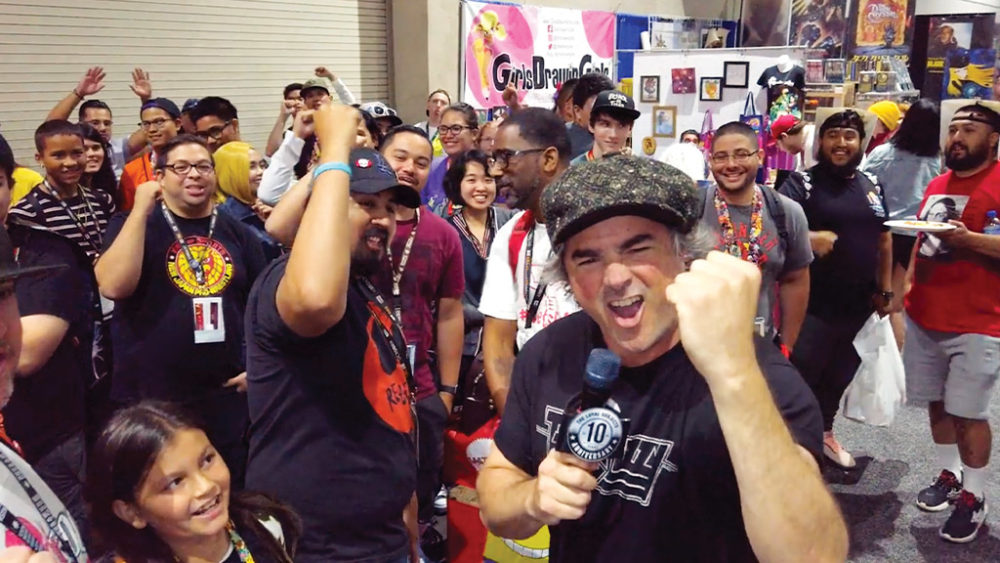
This play-first instinct helped The Loyal Subjects expand beyond its original small vinyl figures. BST AXN brought more detailed action figures. For Keeps ventured into fashion dolls. Superama built miniature scenes. Licensed work reached from eighties touchstones to anime, musicians and film characters. The company formed a strategic distribution partnership with Bandai America in 2019, part of a long progression from limited designer editions to Walmart, Target, GameStop, Hot Topic and specialty shelves.
A product begins with an emotional reason to exist, not a format looking for a license.
Design gets stronger when the designer understands tools, factories, price and delivery.
A team has to cooperate under pressure long after the exciting first rehearsal.
Fidelity can honor a character without turning imagination into a rulebook.
Small company, narrow shelf
The romance of the bungalow ends at the retailer's planogram. Cathey is blunt about the current toy business. Dedicated toy chains have vanished. Big-box stores allocate limited space. Entertainment companies consolidate licenses among a small circle of established partners. Labor, raw materials and decoration cost more. Tariffs add uncertainty to a business built on long lead times and international production.
In 2025, he took that argument beyond trade chatter and wrote publicly to the White House. He presented himself as a California small-business owner shaped by a working-class family and global trade. His case was practical: toy companies support domestic jobs in design, marketing, logistics and retail even when production happens abroad. Tariffs, in his view, would punish the small operators least equipped to absorb a sudden margin shock.
By 2026, his prescription for the competitive shelf sounded like advice from a coach with paint under his nails: stay nimble, arrive prepared, keep some swagger and make the product good. The Loyal Subjects was pushing new M.A.S.K. vehicles, My Pet Monster and Popples while developing programs tied to Angry Birds, Palworld and Hunger Games. At the same time, the company was returning attention to owned brands - its own characters, motifs and stories.
“We want to be toymakers, creatives, and good storytellers.”Jonathan Cathey, 2026
The distinction matters. Licensed work asks a maker to care for someone else's memory. Owned work asks whether the maker can create the memory in the first place. Cathey has spent years proving he can translate. The next test is authorship.
The studio after sundown
Cathey's second act has been hiding inside the first all along. He calls his workspace an art and music studio with a computer, a description that makes corporate departments seem rather dull. He cites Joaquin Sorolla, John Singer Sargent, Helen Frankenthaler and Diego Rivera alongside Elvin Jones, John Coltrane, Miles Davis and John Bonham. Color, rhythm and story share the room.
In June 2026, Corey Helford Gallery in downtown Los Angeles opened Cathey's solo presentation of 16 oils, gouaches and graphite studies. He spoke of the fine-art career as something beginning to bloom and listed what he wanted next: more paintings, workshops, openings, studies and observations. The ambition sits beside a very full toy calendar, not behind it.
There is an appealing symmetry here. Toys took Cathey from drawings into factories, licenses and mass retail. Painting returns him to the quiet end of the process, where one surface, one hand and one set of decisions are enough. The two practices solve different problems. One coordinates a chorus of specialists and rights holders. The other can begin before anyone approves a purchase order.
His habits contain their own small folklore. The best ideas come in the shower. The beach provides immediate renewal. Two owls in the backyard are, at least jokingly, what keep him awake. Asked about legacy, he has said it should be written by the people who knew him best. Asked what would have changed everything, he supplied the cleaner answer: not trying.
Keep the rough edges
Founders are often advised to remove themselves from every process they can. Cathey's story suggests a more interesting calibration. Learn enough of the system to know where your taste matters. Build a team that can carry the song without flattening it. Step back where expertise improves the work, but stay close to the points where an idea can lose its pulse.
The Loyal Subjects is no longer a living-room operation. Still, Cathey's public voice retains the informality of someone calling from the loading dock: candid, funny, competitive, occasionally profane, allergic to corporate starch. His definition of innovation is equally unadorned - a solution that improves another person's life. In toys, improvement may look modest. A figure bends properly. A familiar character feels newly alive. A child and a parent recognize the same face for different reasons and invent a story together.
The useful object lesson is not that every drummer should book a factory tour. It is that experience rarely arrives pre-sorted. Theater can teach character. Music can teach timing and teams. Painting can teach attention. Shipping boxes can teach what an idea weighs. If you keep the rough edges, those lessons may form a style instead of a résumé.
Cathey still wants to “capture that flag” with The Loyal Subjects. He also wants more mornings at the easel, more observations, more work. Competition and curiosity appear to share custody of the calendar. Somewhere between a M.A.S.K. vehicle and an oil panel, the old $500 wager continues: make the thing, follow it farther than seems sensible, and see who wants to play.