At a Hollywood party, Harvey Karp told a woman that he took care of children. She thought he was a nanny. It was an understandable mistake. He had long hair, cloth shoes, and apparently none of the conversational urgency of a person determined to announce his qualifications before someone reached the drinks table.
The woman was Nina Montée. Karp was a pediatrician. In his later telling, saying so had not seemed a particularly promising introduction in Hollywood. The misunderstanding became part of the couple’s shared history. They married, made educational videos together, and built Happiest Baby, the company behind the SNOO bassinet. A modest answer at a party eventually required a much longer explanation.
Karp is now the public face of a business that has moved through several forms: books, demonstrations, digital media, and furniture with software inside it. His name provides continuity. The work has changed considerably. An author needs a publisher. A hardware founder also needs factories, engineers, customer support, and someone to work out what happens when a large box comes back.
The appealing complication in his story is that he did not describe himself as someone who had always wanted to build a startup. By the time SNOO launched in 2016, he had already spent decades working, teaching, and writing. Retirement was available as a perfectly respectable plot. He and Nina chose a product-development schedule instead.

His father’s hours, his own long route
Born in New York in 1951, Harvey Neil Karp grew up with an engineer for a father. What appealed to him about his father’s working life was independence. His father worked for himself; the prospect of arranging one’s own hours looked attractive. Karp liked science, although engineering itself did not much interest him. Biology offered another route.
He earned a biology degree at SUNY Buffalo in 1972 and an MD from Albert Einstein College of Medicine in 1976. Training brought him to Los Angeles, with a residency at Children’s Hospital Los Angeles and fellowships at UCLA. He established his professional life in Southern California and taught at UCLA and USC alongside his practice.
The freedom he had imagined proved more complicated in daily life. Working for yourself can mean answering to a great many people. Karp has laughed about discovering that he had effectively acquired thousands of bosses. It is a useful early detail for understanding the later founder: he wanted autonomy, then repeatedly chose work organized around other people’s demands.
Teaching suited him. He has said that he loves mentoring, and his public manner contains plenty of demonstration and joking. He likes an explanation people can carry away. This became a practical advantage when his audience grew beyond the people he could meet in person. The challenge was to preserve something of the demonstration when the demonstrator was absent.
A book with a second life
The Happiest Baby on the Block appeared in 2002. The Happiest Toddler on the Block followed in 2004. The titles have the reassuring geography of a neighborhood: someone nearby seems to know what to do. They also made Karp’s name familiar to readers who would never visit his office or hear him speak.
A book can explain a sequence, but movement and timing are awkward passengers on a printed page. Nina, who directed documentaries, saw the case for filming him. She wanted people to see the demonstrations. That observation gave the enterprise another medium and gave Karp’s presentation a way to travel without a speaking invitation.
The couple’s educational videos became part of Happiest Baby’s identity. Nina was making an editorial decision as well as a production decision: the useful unit was the visible action, rather than another paragraph describing it. A viewer could replay a moment. The explanation acquired hands, a voice, and a tempo.
The books and videos reached readers and viewers in more than 20 languages. Educators also taught Karp’s material internationally. There was now an audience much larger than one person could address directly. That success introduced an interesting question about format. How much of a demonstration could be carried by something other than a person or a screen?
- 2002The pageThe Happiest Baby on the Block
- 2011The sketchThe initial SNOO concept
- 2016The objectSNOO launches
- 2018The benefitEmployer program launches
Milestones, rather than a straight line: each new form required another kind of work.
Five years to make one button
Happiest Baby dates Karp’s initial SNOO sketch to 2011. In the company’s account, he drew it on a napkin while having dinner with Nina. The napkin is a familiar supporting character in invention stories. Its contribution is usually brief. The difficult part begins when the idea needs materials, tolerances, components, and people willing to keep revising it.
Karp worked with industrial designer Yves Béhar and engineers, including MIT-trained collaborators. Béhar brought his own experience as a father of four. The collaboration joined knowledge of family routines with the disciplines of making a physical product. A desired behavior had to become a mechanism, and that mechanism had to fit into a home.
SNOO emerged with wood, mesh, and hairpin legs. Its machinery was concealed beneath the mattress. The result speaks the visual language of furniture, even though microphones, sensors, and software belong to its construction. A person looking across a bedroom sees a bassinet before encountering the engineering inside it.
Béhar has described a process in which design and technology developed together over years. The team could not simply dress a finished mechanism in a pleasant exterior. Engineering affected the form; design decisions affected what the engineers had to solve. The apparently simple object was the result of repeated negotiation between those jobs.
The launch came in 2016. SNOO responded with motion and sound, bringing part of Karp’s teaching into hardware. It also entered the design world, appearing in the Design Museum’s Beazley Designs of the Year exhibition. For Karp, the change of medium was considerable: an explanation now had legs, wiring, and a shipping carton.
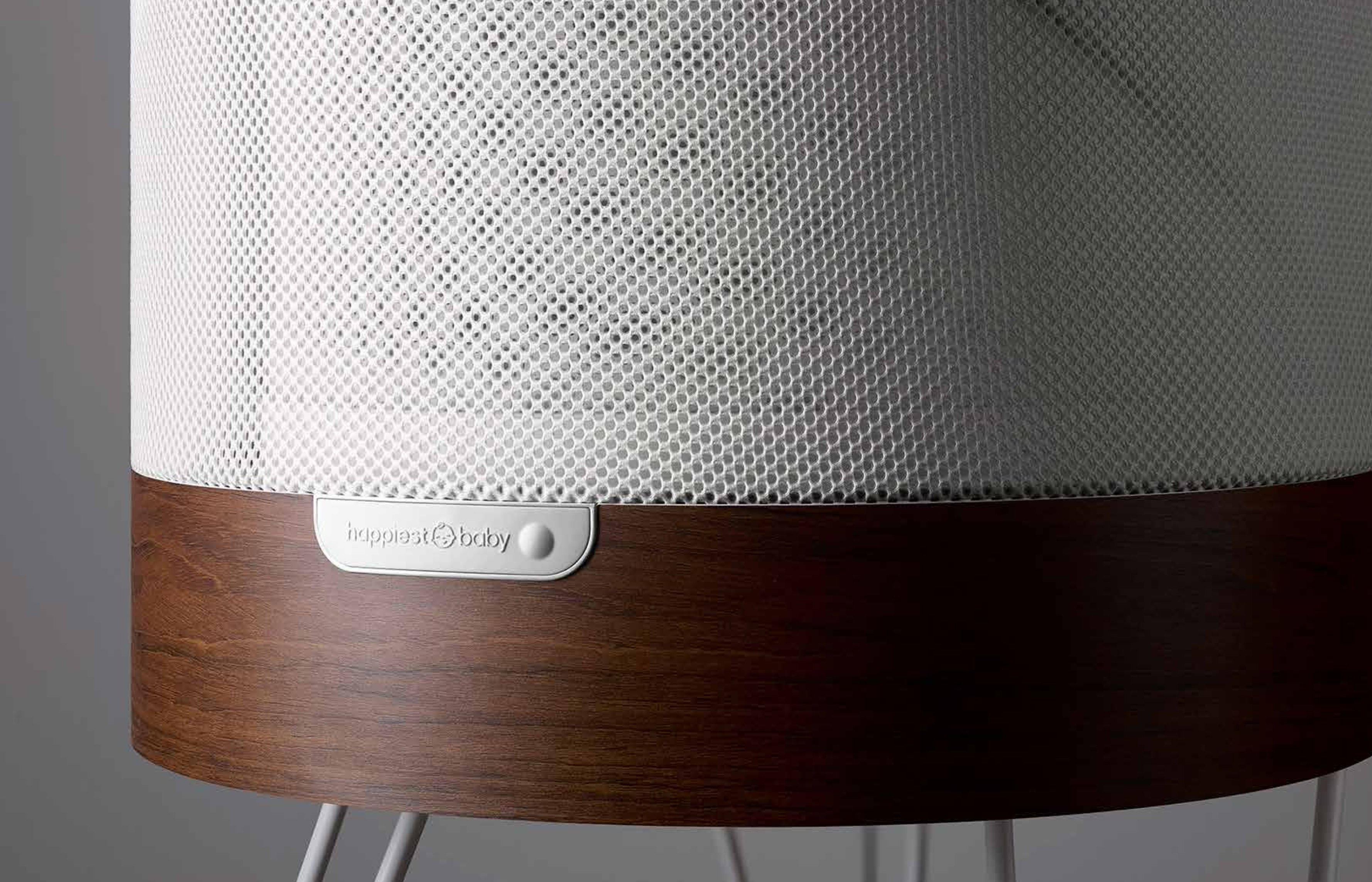
A collaboration map, not a division of credit. The disciplines overlapped throughout development.
The family behind the familiar name
It is easy for a business associated with an author to shrink, in public imagination, to the face on the cover. Karp’s account of Nina’s contribution makes that picture hard to sustain. He credits her with raising funds, hiring the executive team, finding factories in China and India, and helping establish the company’s offices.
“I really have an expertise in the science and she has an expertise in everything,” he said. It is a husband’s joke with a fairly substantial operating report concealed inside it. Funding, hiring, and manufacturing are the activities that turn a promising object into something customers can actually receive. They also consume a remarkable amount of a working week.
Their partnership had experience behind it before the hardware arrived. They had already made films and worked together on other projects. Nina described them in 2020 as accustomed to building a business together seven days a week. Her account of Harvey was affectionate and specific: kind, supportive, and encouraging of the people around him.
The family connection extends to Lexi Montée Busch, who has worked in Happiest Baby’s marketing and communications and joined the couple in interviews. The public conversation can consequently sound like a family remembering its own history, with one person adding the detail another has passed over. There is a recognizable household rhythm beneath the business vocabulary.
“I take care of the kids.”
Harvey Karp, recalling his introduction to Nina
The second household
A bassinet presents an unusual commercial question because a family’s need for it is brief. The object may have a much longer working life. Happiest Baby offers rentals as well as purchases, and the company launched an employer benefit program in 2018. Some employers provide SNOO rentals to new parents. The customer, user, and payer can therefore be different people.
For Karp, wider access has become a recurring ambition. Rental changes the size and timing of the transaction. Employer programs introduce another route into the household. These arrangements also require a business to keep working after the first delivery: objects return, need preparation, and go out again. The next family becomes part of the original product’s story.
The shift also changes what counts as a finished sale. A book leaves the publisher’s warehouse and can spend decades on a shelf. A rented bassinet comes back into the company’s hands. Its condition, packaging, and preparation matter to a customer who has never met the previous user. Karp’s interest in reaching more people now has a logistical expression. The explanation that once traveled through a translation or a video has to travel in a box, arrive on time, and return through a system someone has built.
Connected hardware adds another relationship that a conventional piece of furniture rarely requires. The software can change after the purchase. In July 2024, Happiest Baby introduced a premium app subscription for some users, including people with secondhand units. The shift drew customer criticism. A product passed between households was also carrying a changing commercial agreement.
That episode belongs in Karp’s story alongside the books and design work. A familiar author can introduce a company to customers, but their expectations extend to pricing, ongoing features, and ownership. The founder has to answer for those decisions too. The intimacy of the product makes the relationship unusually personal; it sits inside the home, during a memorable chapter of family life.
Karp’s route into entrepreneurship began with an ability to explain things. It now includes questions about distribution, reuse, and who should pay. Nina’s operating work and Béhar’s design work helped bring the idea into physical form. Every subsequent household gives the company another set of obligations. The napkin sketch was small enough to fold away. The business it started has proved considerably harder to put down.
More of Karp, in his own company
Follow the work, watch a conversation, or explore the design.