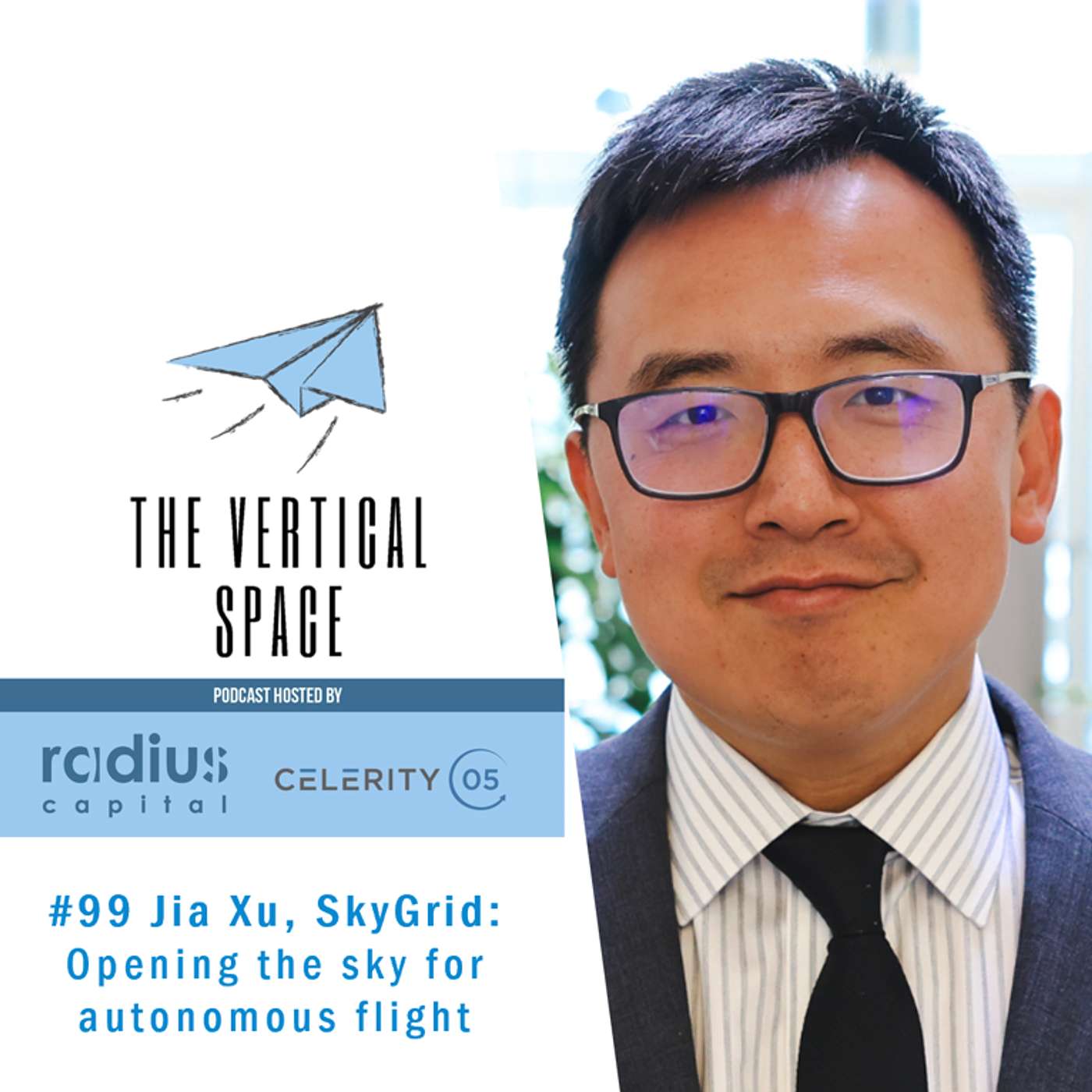
Who He Is
The Architect of the Autonomous Sky
Most people building the future of aviation want to build the plane. Jia Xu wants to build the airspace. Not the sexy part - the scaffolding, the data feeds, the deconfliction logic, the invisible infrastructure that has to exist before a single autonomous air taxi can legally carry a single passenger. He calls it, with characteristic bluntness, "the plumbing."
As CEO of SkyGrid - an Austin, Texas company that began as a Boeing-SparkCognition joint venture in 2018 and is now a subsidiary of Wisk Aero - Xu leads the team building exactly that. SkyGrid's Strata software creates a real-time digital twin of low-altitude airspace: aggregating weather forecasts, obstacle locations, surveillance data, and traffic conditions into a single operating picture that supports the decisions autonomous aircraft need to make safely and at scale.
Latest News
In June 2025, SkyGrid was acquired by Wisk Aero (a Boeing subsidiary), with Xu continuing as CEO - vertically integrating airspace management software with Wisk's Generation 6 autonomous air taxi program.
Xu was appointed CEO in August 2023, replacing founding CEO Amir Husain. Boeing increased its investment to support Xu's product strategy - a strategic shift that signaled something important. The moonshot phase was over. The execution phase had begun. And Xu, with his unusual combination of aeronautical engineering depth and policy-level strategic thinking, was exactly the kind of CEO that required.
His predecessor built SkyGrid as a bold concept. Xu is building it as a business - and more than that, as an infrastructure company that the entire autonomous aviation industry will depend on.
The future of aviation is autonomous, and SkyGrid will play a vital role in safely integrating unmanned flights into the airspace.
- Jia Xu, on his appointment as CEO, August 2023
Career Path
From Stanford's Aerodynamics Labs to Austin's Airspace Startup
The most telling detail about Jia Xu's background is not his Stanford PhD. It's that alongside his doctorate in aeronautics and astronautics, he holds a master's in international relations from the London School of Economics. In a field where most people speak either engineer or policy, Xu is fluent in both.
That bilingualism runs through everything he does. His first major industry role - designing unmanned aircraft systems at General Atomics - grounded him in the hard engineering. His years at the RAND Corporation, driving its portfolio in AI, machine learning, and autonomous systems, gave him the analytical and policy-level view that most aerospace engineers never develop. Then Airbus, where as Chief Architect for UAM systems he built operational architectures and data-driven business cases for urban air mobility vehicles and networks.
Early Career
UAS Design at General Atomics
Policy + Tech
RAND Corporation: AI, ML & Autonomy
Urban Air Mobility
Chief Architect, UAM Systems at Airbus
2020 - 2023
CTO, UAS & UAM at Honeywell Aerospace
From Honeywell - where he served as CTO for unmanned aerial systems and urban air mobility from 2020 to 2023 - Xu arrived at SkyGrid with something rare: he had seen the autonomous aviation problem from the inside of the aircraft industry's largest players, and he understood exactly where the gaps were. Not in the aircraft themselves. In the airspace.
He also taught aerodynamics as an adjunct lecturer at Stanford along the way. It is the kind of thing that signals someone who finds a field genuinely interesting, not just professionally convenient.
Full Career Timeline
Early Career
UAS design engineering
General Atomics
Stanford
Adjunct lecturer in aerodynamics, alongside PhD research
Stanford University
Mid Career
Advanced technology leadership in AI/ML, UAS, and autonomy
RAND Corporation
Pre-2020
Chief Architect for UAM Systems - built operational architectures and business cases for urban air mobility
Airbus
2020 - 2023
Chief Technology Officer, Unmanned Aerial Systems and Urban Air Mobility
Honeywell Aerospace
Aug 2023
Appointed CEO, succeeding founder Amir Husain. Boeing increased investment to support new product strategy.
SkyGrid (a Boeing Company)
Jun 2025
Led SkyGrid into acquisition by Wisk Aero, accelerating vertical integration of airspace software with autonomous eVTOL operations
SkyGrid / Wisk Aero
The Mission
Building the Plumbing Nobody Else Wanted to Build
Xu has a phrase he returns to repeatedly: "the elephant in the room." He's referring to a specific problem nobody in the advanced air mobility industry wanted to talk about. Every eVTOL aircraft maker, every drone services company, every autonomous logistics startup had assumed that the airspace infrastructure they needed would exist by the time they were ready to use it. Someone else would build the air traffic management stack. Someone else would create the data feeds. Someone else would figure out the deconfliction logic.
Nobody built it. And nobody wanted to - because it's not glamorous, it doesn't generate venture capital headlines, and it doesn't fit neatly into "aircraft company" or "software company." It lives in between.
Key Insight
"The Elephant in the Room"
Every aircraft developer in advanced air mobility was quietly building their own airspace management stack - creating massive duplication, fragmentation, and risk. Xu saw this as SkyGrid's founding opportunity: become the shared, trusted infrastructure layer that the whole industry depends on, rather than another proprietary silo.
SkyGrid, under Xu's leadership, positioned itself deliberately in that gap. The company's Strata platform aggregates aeronautical and environmental data, provides surveillance feeds, enables flight planning and deconfliction, and produces the situational awareness that autonomous aircraft need to share airspace safely. It's not the aircraft. It's not the pilot. It's the operating system the sky runs on.
Xu describes SkyGrid's approach as "a bit peculiar" compared to others - deliberately building for third-party service provision rather than captive proprietary use, working to regulatory standards like Part 146 ADSP that most companies haven't even started thinking about, and treating the policy landscape as part of the product rather than an obstacle to it.
Surveillance Data
High-fidelity real-time feeds on aircraft positions with integrity guarantees
Airspace Deconfliction
Machine-to-machine coordination to prevent conflicts before they become hazards
Environmental Data
Weather and obstacle intelligence at fidelity levels that autonomous operations require
Decision Support
Operator tools that augment human judgment rather than replacing it
Digital Twin
Real-time mirror of low-altitude airspace for planning, monitoring, and analysis
Regulatory Alignment
Compliance with emerging frameworks like Part 146 ADSP built into the platform
Philosophy
The Frozen AI Argument (and Why It Matters)
Most technology executives evangelizing AI in their industry talk about systems that learn, adapt, and improve in real time. Xu's position on this is almost heretical: in air traffic management, he argues, that's exactly the wrong approach.
His reasoning is rooted in how aviation certifies software. A system that learns continuously is a system whose behavior cannot be fully validated - because it will behave differently tomorrow than it did today. Safety certification in aviation requires knowing precisely what a system will do in every condition. A neural network that updates its weights during operation makes that certification essentially impossible.
Air traffic control software doesn't need to be capable of learning all the time.
- Jia Xu, on AI certification in aviation
So Xu advocates for a specific approach: AI systems that learn offline, then get "frozen" for deployment. The learning happens in the lab. The certified, validated, frozen version goes into the operational system. Updates go through the same certification process as any other software change. It's slower. It's less exciting. It's also how you get aviation authorities to approve your product.
The broader philosophy: Xu is deeply skeptical of the idea that autonomous aviation can skip the incremental steps. He talks about building credibility through segregated airspace operations before scaling to shared environments. He talks about proving safety data before asking regulators to change frameworks. He talks about "human machine teaming" as the necessary middle state between today's manually-controlled airspace and tomorrow's fully autonomous one.
There's something both pragmatic and principled about this stance. Xu has seen enough of the industry - from RAND policy analysis to Airbus operational architectures to Honeywell systems engineering - to know that aviation's conservatism around safety isn't bureaucratic inertia. It's why flying is the safest form of transport ever invented. You don't disrupt that. You build inside it.
The only way to do that is through responsible, safe addition of human machine teaming and automation.
- Jia Xu, on scaling autonomous operations
In His Own Words
What Jia Xu Actually Says
"The high-level strategy is that we need to build the plumbing first."
On SkyGrid's phased approach to AAM infrastructure
"We cannot and will not act alone."
On collaborative airspace ecosystem development
"Autonomy really extends beyond the aircraft - they have to integrate into the national airspace."
On the systemic nature of autonomous aviation
"SkyGrid is a bit peculiar in its approach when compared with others."
On SkyGrid's third-party services model
"We feel that it's very important to lay out a systemic view of AAM."
On SkyGrid's ConOps publication
"By deploying our airspace integration capabilities with Wisk's autonomous eVTOL technology, we are paving a path to safe, efficient, and increasingly autonomous operations for all."
On the Wisk acquisition, June 2025
SkyGrid - By The Numbers
✈️
2018
Founded as Boeing-SparkCognition JV
🛰️
2025
Acquired by Wisk Aero
Education
Three Institutions. Three Continents. One Purpose.
Xu's academic path is unusually diverse for an aerospace CEO. A PhD in aeronautics and astronautics from Stanford is the expected credential. An MSc in aeronautics from Imperial College London and an MSc in international relations from the London School of Economics are less predictable - and more revealing.
The LSE degree in particular stands out. International relations trains you to think about systems, about power, about the gap between technical possibility and political reality. In a field where regulatory approval is as important as engineering validation - where the FAA and EASA and ICAO set the actual constraints - that kind of thinking is not optional. It's essential.
Stanford University
PhD, Aeronautics and Astronautics
Imperial College London
M.S., Aeronautics
London School of Economics
M.S., International Relations
He also taught aerodynamics as an adjunct lecturer at Stanford - the same university where he got his doctorate. It's the kind of thing that signals someone who found the material genuinely interesting enough to go back and teach it.
Looking Forward
What the Wisk Deal Actually Means
When Wisk acquired SkyGrid in June 2025, the coverage mostly focused on the deal terms. The more interesting story is what the deal reveals about where autonomous aviation is actually headed.
Wisk is building a Generation 6 autonomous air taxi - a vehicle with no remote pilot, designed for urban commutes, currently seeking FAA type certification. That certification process requires Wisk to demonstrate not just that the aircraft is safe, but that the airspace system the aircraft operates within is safe. You can't certify an autonomous aircraft in isolation from the airspace management infrastructure it depends on.
By integrating SkyGrid's airspace software directly into Wisk's operation, Boeing is making a strategic bet: that the airspace infrastructure layer is as important as the aircraft itself, and that owning both gives Wisk a structural advantage in the race to get autonomous aircraft certified and commercially operational.
For Xu, the deal represents validation of the thesis he's been prosecuting since he arrived at SkyGrid: that airspace infrastructure is not a supporting role. It's the main event. The aircraft are only half the system. The other half is the intelligent, certified, high-assurance environment they fly in - and SkyGrid, now inside Wisk, is building that environment.
This alignment with Wisk marks an important step in the advancement of autonomous aviation.
- Jia Xu, on the Wisk acquisition, June 2025
SkyGrid continues to offer its services to external customers - it's not becoming a purely captive operation. But the integration with Wisk's Type Certification program gives the company a forcing function that few software companies in aerospace ever get: a real operational deployment with real regulatory stakes, in the real national airspace, on a real timeline.
Xu's aspiration is stated plainly: to build the world's most trusted airspace and operational integration platform. The Wisk deal is the first major test of whether that ambition is achievable. If it works - if SkyGrid's infrastructure helps get Wisk's autonomous air taxis certified and operational - it will be the proof point that changes everything. The plumbing, it turns out, is the product.
Watch & Listen
Jia Xu in Conversation
▶️
The Vertical Space · Podcast #99 · YouTube
Jia Xu, SkyGrid: Opening the Sky for Autonomous Flight
An in-depth conversation on autonomy, airspace integration, and the future of aviation infrastructure