Jessica Steier’s father was a professional gambler. When she went with him to casinos and racetracks, the outing came with a particular way of looking at the world: outcomes had odds. Numbers could tell you something about what might happen next. Years later, she would recognize a family resemblance between those early excursions and her own work with data. A racetrack is an unusual place to begin a story about a science communicator. Steier’s career has made room for unusual beginnings.
She liked mathematics, statistics and calculus. The quantitative part of a problem held her attention. Her eventual public role would require another skill altogether: explaining complicated things to people who had good reasons to be busy, distracted or unconvinced. That combination now runs through Unbiased Science, the organization she founded and leads. The numbers matter. So does the person trying to make sense of them.
A childhood with odds attached
Her route into the work took a few turns. She took the LSAT, applied to law school and got in, then decided against going. Acceptance, apparently, did not settle the argument. It is a useful detail in a career that can look inevitable when reduced to a biography: founder, scientist, host. Living it involved more reconsideration.
At Stony Brook University, she earned a bachelor’s degree in 2008 and a master’s in 2010. A doctorate at the CUNY Graduate Center followed in September 2015. Her training centered on evaluating evidence, designing research and working with statistics. Before she had a public audience, she had the habits of someone expected to ask how a conclusion had been reached.
Those habits give her later work a recognizable starting point. An explanation has to survive examination before it can become a graphic or a conversation. But a technical education supplies no automatic instructions for keeping a stranger interested. Steier would spend the next part of her career bringing those two demands into the same room.
The professor becomes a partner
One connection outlasted graduate school. William T. Gallo, her dissertation advisor, became her business partner. In 2017, they started Vital Statistics Consulting. The relationship moved from the university into the less orderly world of running a company, where a promising idea also needs clients, colleagues and enough structure to become dependable work.
Steier had already taught statistics and research design at Hofstra University and worked on an advanced analytics team at The Lewin Group. She wanted more control over the culture surrounding the work. Autonomy, positive reinforcement, partnership and time for family were part of her account of why she chose self-employment. The business decision had a domestic dimension as well as a professional one.
“I fell in love with data science,” she said. The attraction involved turning a collection of numbers into something another person could use. Her consultancy asked clients what information they possessed and what questions they wanted answered, then worked through the analysis and interpretation.
There is a communication problem hidden inside that description. An organization can possess an expensive quantity of data and still need help deciding what it means. The last stage of the work requires judgment about an audience: what does this person need to understand before they can act? That question would accompany Steier beyond consulting.
An audience beyond the family circle
Unbiased Science began in 2020. Her original collaborator, Andrea Love, was a friend from their undergraduate years. They brought different scientific backgrounds to a shared microphone. Their familiarity gave the project a relationship to build around before it had the machinery of an established publication.
Steier has joked that she thought her mother and her friends would follow along. Strangers began arriving, too. The family circle proved to be an opening audience rather than a permanent boundary. A project that began close to home needed a public home of its own.
By 2024, the venture had accumulated more than a million podcast episode downloads, alongside its social presence. A download is a modest unit of measurement: one file requested, one possible listener, one opportunity to hold someone’s attention. Repeated often enough, those small acts of choosing to listen give a weekly project a life beyond its founders.
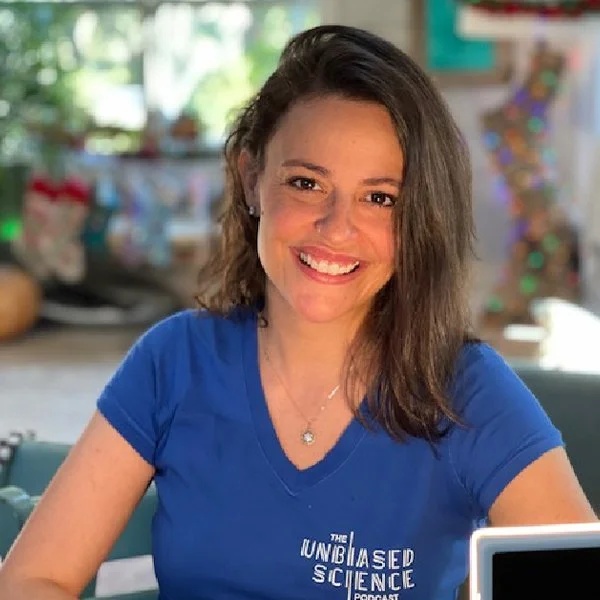
Recognition followed from several directions. Stony Brook named her to its 2021 40 Under Forty class and recognized her with its Norman Edelman Alumni Achievement Award. In 2023, Steier and Love shared the American Medical Writers Association’s John P. McGovern Award. The communication itself had become a substantial part of her professional identity.
There was room for mischief in that identity. The association’s coverage singled out the podcast’s taste for puns, including an episode title built around the phrase “We Shih Tzu Not.” The wordplay is an invitation to enter a serious subject without first adopting a serious expression. A title can offer a small courtesy to the reader: you are allowed to enjoy this.
One idea, several entrances
The publication now works across audio, illustrated social posts and longer writing. Its newsletter offers extended explanations, while its social channels make room for graphics and shorter encounters. Sarah Scheinman is identified as a podcast co-host and newsletter contributor. The project has developed a network of contributors rather than depending on a single person to supply every kind of expertise.
That variety matters to the shape of Steier’s working life. A podcast conversation unfolds in time. An infographic has to establish relationships on a screen. An essay can slow down and make space for qualifications. Each asks its maker to think about how much an audience already knows and how long it is willing to stay.
Three formats used by Unbiased Science. Different ways into a complicated idea.
The team reflects that range of work. Michelle Bridenbaker serves as chief operating officer. The wider roster includes writers, designers and specialists in data visualization, alongside scientists. Jarrod Breithaupt’s work includes production and distribution. Those are practical jobs behind a public voice: making the episode available, making the graphic legible, getting the work into a form somebody can encounter.
Steier also holds a public relations certificate from Cornell. Beside the research degrees, it reads like a deliberate addition to the toolkit. Finding an answer and helping it travel are different tasks. Her qualifications now acknowledge both.
The person who disagrees is still listening
Collaboration has widened beyond the publication. Steier co-founded The Evidence Collective with Katelyn Jetelina. The network brings independent communicators together, giving people with their own audiences a structure for working alongside one another. Individual voices remain part of the arrangement; so does the possibility of sharing expertise.
In February 2026, the collaboration meant a trip to New Haven for a retreat with fellow communicators. Writing before the journey, Steier described coffee, the road and the prospect of being away from her children for longer than she had been before. She also asked readers to complete an audience survey. Even the travel update contained a request to listen in the other direction: tell us something about yourselves. For a publication built around explanations, asking its audience questions is a practical way to keep the relationship from becoming a monologue.
In April 2026, she joined Liz Marnik and Yasmin Mohseni for a conference panel on communicating science. The discussion ranged from uncertainty to disagreement and the limits of trying to persuade everybody. Steier described a modest measure of progress: a person who disagrees might still see a video, engage with it and encounter more of that material later.
That is a patient interpretation of an online encounter. A comment does not have to end in a conversion story to matter. Someone has stopped, watched and considered a thought outside their usual stream. The exchange can be unfinished without being empty.
“Getting it right takes creativity and imagination.”
Jessica Steier, July 2026
Her professional commitments continued to expand that summer, when she joined the American Council on Science and Health’s Board of Scientific Advisors. Yet the recurring craft question remains quite small and specific: how do you introduce an idea so another person can stay with it? An appointment can broaden the setting. It cannot answer that question on the communicator’s behalf.
A place on the sofa
There are ordinary pleasures around the work. In a personal essay about her mother’s visit from Florida, Steier described trips to the lake with her children, board games and long conversations. A visit to the Hotel Northampton included Brandy Alexanders, a family tradition passed along through her mother. The details give the public voice a setting beyond the recording schedule.
Her ambition for a future collaboration is similarly conversational. Asked in August 2026 whom she would like to work with, she chose Amy Poehler. She admired Poehler’s humor and warmth, and the easy conversation of her podcast, Good Hang. The imagined meeting would bring Steier’s scientific interests into a setting where people had come to spend time with someone they liked.
It is a revealing aspiration for someone whose early enthusiasms were numbers and odds. A sofa and a friendly conversation now belong in her picture of how ideas might travel. She has also asked what causes people to change their minds, a question that leaves plenty of room for the listener’s experience.
That question is a fitting place to leave her. Steier has built a company, a publication and professional partnerships, but she keeps returning to the encounter between an explanation and a person. Her father’s racetrack offered outcomes to calculate. The microphone offers a different uncertainty: somewhere beyond it, someone is deciding whether to keep listening.
Keep the conversation going
Unbiased Science · Newsletter · Watch on YouTube
Jessica on LinkedIn · Instagram · X · Bluesky
The August 2026 conversation with April English
Read about the 2026 communication panel
AMWA on the podcast’s approach