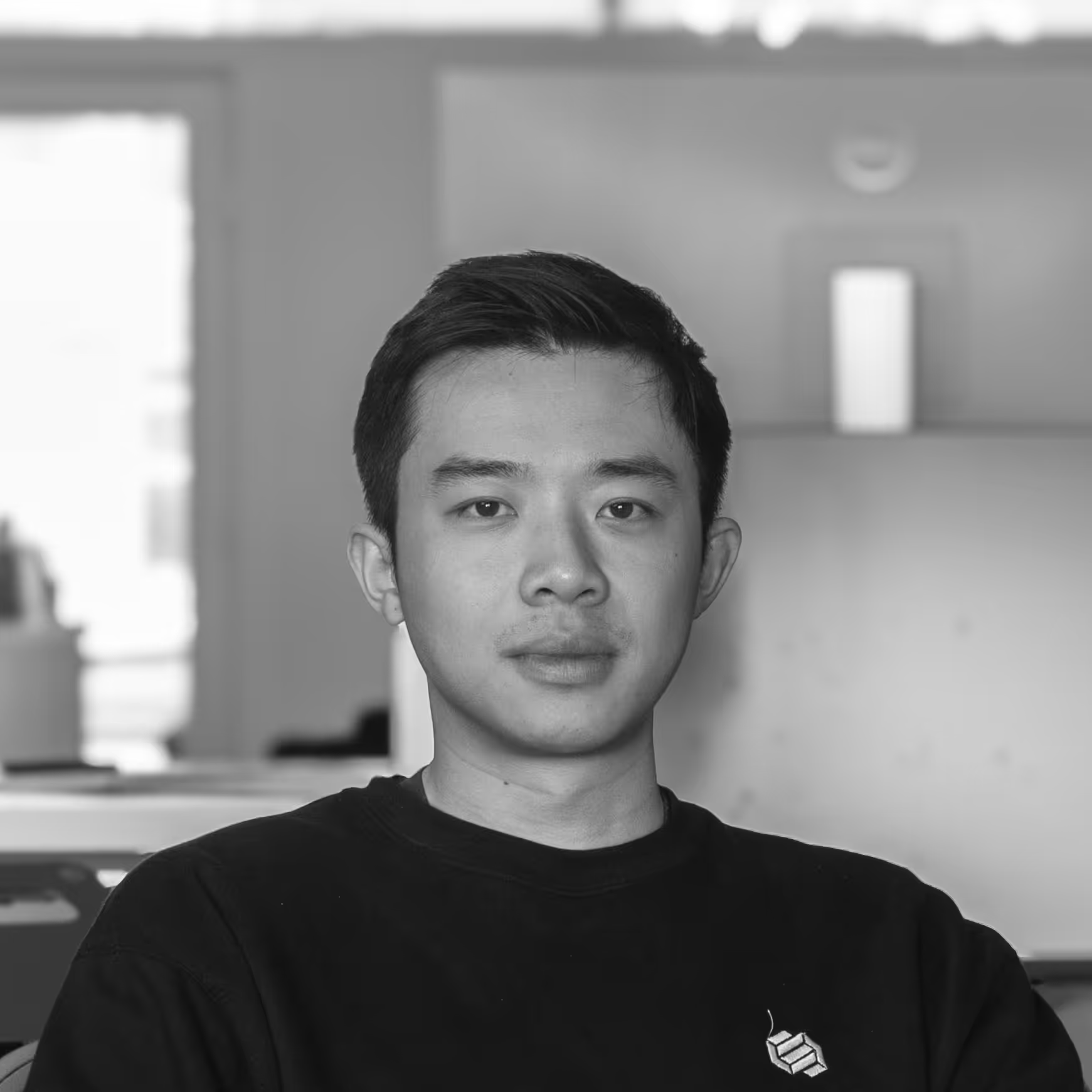
At 15, Jesse Zhang cracked open his PlayStation - not to fix it, but to understand it. That distinction matters. Fixing things is a job. Understanding them is a calling. The kid from Boulder, Colorado was already asking the question that would define his career: not "does it work?" but "why does it work - and how could it work differently?"
Flash forward a decade. It's early 2023. Zhang is sitting inside Niantic - the company that made Pokemon Go - doing solid work on the Social team after they acquired his first startup. Then GPT-4 drops. He doesn't schedule a meeting to discuss implications. He doesn't write a strategy memo. He quits.
"In my twenties I really need to use this time to take big swings," he would later say. That line sounds like a motivational poster. Coming from Zhang, it was a precise calculation: he saw a narrow window between the emergence of capable large language models and the moment incumbents would figure out what to do with them. He intended to be through that window before it closed.
The Counterintuitive Path to a Unicorn
Zhang co-founded Decagon in 2023 with Ashwin Sreenivas, who would serve as CTO and President. They had a hypothesis - that AI could genuinely transform customer service - but they made an unusual choice: they did not start building. Instead, they spent months conducting customer discovery interviews with large enterprises. They lined up conversations, listened, and let the actual use cases emerge.
"We didn't go in with a fixed idea," Zhang explained. "We lined up a ton of conversations with large companies and let the use cases emerge from those." In a startup culture that prizes shipping fast, this felt almost contrarian. But it reflected a hard lesson learned from Lowkey, his first company: conviction without customer validation is just expensive guessing.
By the time Decagon actually started building, they already knew what enterprises needed. The result was a platform for autonomous AI agents that handle customer service - not by following rigid scripts, but by learning from real conversations, ingesting company data, and operating through what Decagon calls AOPs: Agent Operating Procedures. Business teams write these instructions in plain English. The AI agent follows them with the consistency of a trained employee and the speed of software.
The numbers that followed were not gradual. Decagon reached $50 million in ARR within 15 months of founding. Their Series C had five times more investor demand than available capacity. Clients signed on: Notion, Duolingo, Hertz, Webflow, Eventbrite, Avis Budget Group, Block, Deutsche Telekom. Ticket deflection rates hit 70 to 80 percent. Customer satisfaction tripled.
From Stealth to $4.5 Billion in Under Three Years
In January 2026, Decagon announced a $250 million Series D led by Coatue Management and Index Ventures, tripling the company's valuation to $4.5 billion. The round included participation from a16z, Accel, Bain Capital Ventures, Elad Gil, and Ribbit Capital - practically a who's-who of Silicon Valley's top funds. Total funding now stands at $481 million across six rounds.
In March 2026, Decagon completed its first tender offer, allowing more than 300 employees to sell a portion of their vested shares at the $4.5 billion valuation. Zhang had grown the team from twelve people to over three hundred in eighteen months - a pace that makes most VC-backed scaling stories look leisurely.
Zhang's thesis for Decagon runs deeper than "automate the help desk." He argues that customer support is undergoing a strategic inversion. Historically a cost center - something to minimize and offshore - support becomes, with AI, a potential revenue driver and competitive differentiator. The companies that figure this out first, he says, will use their customer relationships as a moat. "It starts becoming competitive advantage... it can be a revenue driver."
The Apprenticeship Nobody Talks About
Before Decagon, there was Lowkey. Zhang founded the gaming social platform in 2019, fresh out of Harvard (where he'd completed a four-year CS degree in three years, squeezing in internships at Google, Citadel, Hudson River Trading, and Kensho along the way). Lowkey let gamers capture and share gameplay clips. a16z backed it. Y Combinator backed it. Niantic acquired it in late 2021.
What's notable about how Zhang talks about Lowkey is the absence of spin. He describes it as "not necessarily super enjoyable the whole time." He calls the consumer startup experience "very intuition heavy." He learned, the hard way, that following other founders' playbooks is "deeply distracting." The first venture taught him what the second venture needed: customer discovery as the backbone, not an afterthought.
After the acquisition, Zhang spent 18 months at Niantic. He wasn't biding time. He was watching how software operates at massive scale, understanding what breaks, and building the contextual knowledge that would inform Decagon's enterprise approach. When GPT-4 arrived and he recognized the moment, he had both the scar tissue from failure and the structural knowledge from scale.
The Portfolio Builder and the Grandmaster
Zhang's attention doesn't stay inside Decagon. He's an angel investor in more than twenty startups - Pika, Cursor, Cognition, Visual Electric, Moment, Motion among them. He's part of the Sequoia Scouts program. He builds side projects: PapersGPT, 3D city-building demos. He writes competition math problems for the AMC 8 and AMC 10, the same national competitions he excelled at as a teenager in Boulder.
Then there's Teamfight Tactics. Zhang reached Grandmaster rank - the top 0.02 percent of all players globally - in the complex, probabilistic strategy game. This is not a trivial achievement. Grandmaster in TFT requires rapid probabilistic reasoning under time pressure, long-term resource planning, adaptability when conditions change, and the discipline to optimize every decision even when exhausted. It's a reasonable proxy for how Zhang runs his company.
His public presence is deliberately low-key for someone running a $4.5 billion company. He focuses on substance over personal branding, posts thoughtfully rather than frequently, and talks more about customers than about himself. The contrast with the founder-celebrity archetype is intentional. "Block out the noise, block out what people are telling you, especially what investors are telling you," he advises. "Ground truth is always making sure you're doing what customers actually care about."
Customer support has traditionally been the department companies tolerate. Zhang is building the case that it's the department that defines them. At 28, he has a $4.5 billion company, a Forbes 30 Under 30 recognition, a Grandmaster gaming credential, and math competition problems bearing his name. The PlayStation he hacked at fifteen is somewhere gathering dust in Boulder. The question it prompted has not stopped.