Jason Bunge has spent a career learning that attention changes its costume. At Microsoft, it looked like a software subscription asking families to rent what they once bought in a box. At Trulia, it arrived as the nervous thrill of looking for a home. At Electronic Arts and Riot Games, it became something louder and more tribal: players turning games into identities, sports and stories. At Hasbro, attention can be a child opening Play-Doh, an adult shuffling a Magic deck, a family negotiating the rules of Monopoly, or a Transformers collector making room on a shelf that plainly ran out of room years ago.
The products are different. The durable question is the same: what does a person value enough to return to? Bunge's answer begins with an image more architectural than promotional. A franchise needs a core, a center of gravity. Around it, a company can build concentric circles of games, stories, products and partnerships. But the middle must hold. Otherwise, expansion becomes a cheerful form of dilution.
It is a useful theory for a company full of nouns that double as childhood memories. Hasbro does not merely manage inventory. It tends rules, characters, rituals and arguments over who gets to be the race car. Bunge's work is to help those properties travel into new formats without losing the peculiar thing that made anyone care in the first place.
truth
The chameleon learns the room
Bunge once described himself as a military brat and a chameleon. Moving repeatedly taught him to read a new room, adjust and continue. It is easy to see the line from that childhood to a résumé that refuses to stay in one category. He began in advertising at Saatchi & Saatchi in New York. The agency taught him the discipline of the craft. Then came roughly a decade at Microsoft, where his product-marketing work included Office 365, a launch that asked consumers to accept a new relationship with familiar software.
He earned a BS at Boston College and an MBA from Harvard Business School. The latter was useful beyond the credential. Bunge has said business school helped him gain confidence, a modest admission from someone whose later jobs would require him to defend a profession that everyone believes they understand. Marketing suffers from its own visibility. Everybody encounters it, so everybody arrives at the meeting with a theory.
“Marketing is one of those interesting disciplines where one of its unique attributes is that everyone else in the company thinks they know marketing better than you do.”Jason Bunge
His solution is not to protect marketing with velvet ropes. It is to bring a perspective the rest of the room cannot supply. If a chief marketing officer merely takes orders for campaigns, the title has outrun the work. Bunge argues that marketers should define their strategic role, show how customer behavior meets business economics, and offer a different lens before someone else reduces the function to ads and adjectives.
The path was not an immaculate sequence of winning bets. He has discussed Skype and Trulia as risks that did not unfold as expected. That detail matters because executive biographies tend to turn careers into airport moving walkways: step on, face forward, arrive at leadership. Bunge's version contains switches, partial bets and an acceptance that change is not a special event. It is closer to the weather.
A player, not an eyeball
At Electronic Arts, Bunge moved deeper into games. He eventually led brand management and marketing across more than 20 global properties spanning console, PC, mobile and live services. His work touched Apex Legends, The Sims and games made with Lucasfilm's Star Wars universe. These were not products that politely ended after purchase. They lived through updates, conversation, competition and the judgment of fans who could detect a corporate tourist at remarkable speed.
Riot Games hired him in 2020 as its first chief marketing officer. The company was stretching beyond the enormous shadow of League of Legends into a multi-game publisher. Bunge oversaw game marketing, product publishing and global channel strategy. His language there centered on celebrating the player, not acquiring a pair of eyeballs. Passion mattered more than making an audience indiscriminately larger.
The personal footnotes make the corporate appointment less polished and more legible. Riot introduced him as a League player who could be found using Riven or Pyke. It also offered three literary passwords: Erik Larson, Tana French and Daniel Silva. History, crime and espionage sit comfortably beside a game famous for five-person teams attempting to destroy one another's base. A marketer should probably enjoy several kinds of plot.
The toy box has several doors
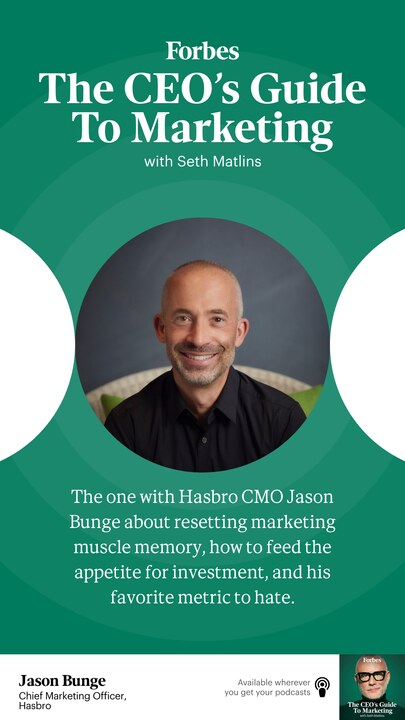
Hasbro appointed Bunge chief marketing officer in May 2023. He arrived with more than 20 years of experience and an unusually apt combination of technology, games and brand management. In 2024 his remit expanded across Wizards of the Coast and digital gaming marketing, with a seat on the executive leadership team. His current professional listing is EVP, Chief Marketing and Communications Officer.
The job resists one tidy playbook. A toy business, a tabletop business and a digital-games business operate at different speeds and ask marketing to do different things. Toys can be seasonal, physical and dependent on retail conversion. Magic: The Gathering and Dungeons & Dragons are systems with devoted communities. Digital games need sustained participation. Bunge finds the variety intellectually fun. The operating question is how to honor those differences while sharing enough talent, data and capability to avoid rebuilding the same machine three times.
“We have to be both bespoke, but then we also have to scale.”Jason Bunge
The answer increasingly lives in partnerships and communities. A Magic collaboration with Final Fantasy can join two fan cultures without asking either to abandon its accent. Disney and Netflix partnerships can open other doors. Smaller creators with one or two thousand committed followers may be more useful than a giant account with shallow attention, because they already understand the jokes, etiquette and enthusiasms of the room.
This is a change from the comforting geometry of broadcast marketing. There is no single Hasbro audience waiting in a large hall. There are Monopoly people, Transformers people, Magic people, video-game people and parents attempting to locate the toy their child saw for eleven seconds on YouTube. Communities are becoming smaller and more specific even as the company's need for scale remains.
Cardboard after the screen
Bunge has noticed an appealing inversion in how generations play. Children travel naturally toward digital experiences. Millennials, and some of Gen Z, are moving back toward tactile ones. They want cards, collectibles, figures and games that require a table. After a day conducted through glass, cardboard begins to feel almost luxurious.
For Hasbro, the movement creates an opportunity to think in lifetimes instead of age brackets. A person can meet a brand as a toy, rediscover it as a game, watch it as entertainment and display it later as a collectible. The sequence will not be identical for everyone. The art is to make each doorway feel intentional rather than like a licensing department discovered another surface.
That restraint is hidden inside Bunge's center-of-gravity idea. Before building the ecosystem, decide what generates the value. Before chasing a new format, understand the promise being carried into it. Before buying reach, know which community might welcome you. It is patient advice inside an industry trained to announce the next big thing before lunch.
His ambition at Hasbro also turns inward. The company launched MarketingXP, a year-long development program designed as a game for its own marketers. Bunge's line is direct: great brands are built by great marketers. The program treats marketing as a craft that can be practiced, taught and improved, rather than a mysterious instinct handed to whoever has the strongest opinion about the color blue.
Across the résumé, the products keep changing form. Software becomes a service. A game becomes a sport and a television series. A toy becomes a digital world; a digital native buys a physical deck. Bunge's contribution is not a slogan that resolves every contradiction. It is a method for staying useful inside them: adapt to the room, defend the craft, locate the center, and listen closely enough to the people already playing.