The modern résumé has acquired an awkward new talent: it can sound remarkably competent before its owner has done anything at all. A prompt, a few keywords, a brisk polishing pass, and the page arrives dressed for the interview. Jam Khan’s current job begins with the problem this creates. As chief marketing officer of Criteria Corp, he is helping explain why employers need evidence richer than a beautifully behaved document.
The assignment suits him because Khan has spent a career moving between claims and proof. He studied computer science at UCLA. He started in engineering, shifted into technical sales, moved through product management and professional services, then built a life in product marketing. His résumé, ironically enough, is persuasive because the transitions form a pattern: learn how a complicated machine works, learn how customers encounter it, and then find language that lets the rest of the market see what matters.
Khan calls himself a “career generalist.” It is a modest phrase for a deliberate accumulation of vantage points. Specialists know their square of the board. Generalists learn why the pieces keep colliding.
The machine before the message
Khan’s early software years were spent close to the machinery. He worked at McAfee and Rainbow Technologies, then joined SafeNet in 2004 when it merged with Rainbow. The territory was security, licensing, entitlements, and software monetization. These are not products that explain themselves over cocktails. They sit in the plumbing of a business, deciding who may use software, how a company charges for it, and what happens when hardware makers begin earning recurring revenue from code.
At Gemalto and later Thales, Khan’s work ranged across product, professional services, and global marketing. He spoke with customers around the world and appeared at industry events from semiconductor forums to a Tokyo press conference on device monetization. The business lesson was concrete: a manufacturer adding connected services is not merely shipping a clever feature. It is changing how value moves through the company.
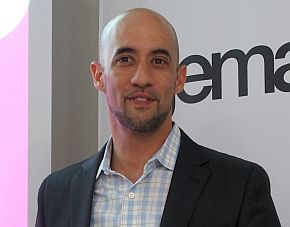
Global work also cured him of the fantasy that one sentence travels everywhere intact. He has pointed to tiny spelling differences between American and British English, legal limits on corporate gifts in Nordic markets, and the difficulty of translating a term such as “entitlement” directly into French. His operating principle is sensible: keep the durable value story consistent, adapt what the local context demands, and make time to listen to regional teams in person.
A portfolio, a launch, seven months
By the 2020s, Khan had carried that technical fluency into the SaaS companies where invisible systems are sold with very visible narratives. He held product marketing leadership roles at Seismic and 6sense, where the product’s subject was buyer intent hidden inside what marketers called the dark funnel. The iceberg became a favorite metaphor: the obvious activity sits above water; much of the consequential behavior remains below it.
At ZoomInfo, he became senior vice president of portfolio marketing, with responsibility spanning product marketing, customer marketing, brand, content, and communications across a $1.3 billion portfolio. He helped lead the launch of ZoomInfo Copilot, an AI-guided go-to-market product. The product reached $150 million in annual recurring revenue in seven months. The number is arresting, but the underlying craft was familiar: bring product, sales, brand, and customer evidence into one legible story.
Khan’s advice to product marketers is rarely glamorous, which is one reason it is useful. Map the deliverables. Name the stakeholders. Establish rules for how product updates reach marketing. Build a structure once the team grows past the intimacy of seven people. Recognize wins, because the function sits between so many teams that its contribution can disappear into everyone else’s success.
He also warns against confusing motion with progress. A product marketing group can be pulled toward every launch, deck, request, enablement session, website rewrite, and competitive emergency in the building. Focus is less a mood than a maintained boundary. His hiring version is even shorter: “Don’t hire in desperation.”
When the document becomes noise
Khan joined Criteria in July 2025. The company had spent nearly two decades building assessments for cognitive ability, personality, emotional intelligence, and skills, then extended into structured interviewing and employee development. Its founding promise was to make high-quality talent assessment available beyond the largest employers. The new pressure came from generative AI, which can produce more applications, more polished answers, and more uncertainty about what any one document reveals.
There is an elegant symmetry here. At 6sense and ZoomInfo, Khan marketed signals intended to help teams recognize genuine buying activity inside a cloud of commercial noise. At Criteria, the question is more human and more consequential: which signals reveal whether a person can do the work?
The language Khan uses is careful. A résumé tells. An assessment or work sample can show. An interview contains possible evidence, but an amiable conversation does not become predictive by wishing. The role must be defined around outcomes. Questions must elicit observable behavior. Candidates must be evaluated against consistent criteria. Structure matters because charm is not a scoring rubric, and gut feel is often merely bias in comfortable shoes.
That final clause carries the weight. Criteria introduced real-time video interviewing and an AI interview agent in June 2026, but its public framing keeps human judgment at the center. The company’s tools can standardize a flow, capture notes, support scoring, and surface patterns. They are meant to make the evidence clearer, not quietly appoint the machine as hiring manager.
Culture is an operating system
Khan speaks about teams with the same systems instinct he brings to products. He has described the pleasure of working somewhere people look forward to Mondays, then made the managerial point hiding beneath the sentiment: leaders own culture, and assembling the right mix of people need not be a coin flip. His record of recommendations from former colleagues repeatedly emphasizes vision, growth, kindness, and the ability to make a team feel lifted rather than merely driven.
At a Criteria executive dinner during SHRM26 in Orlando, a conference dominated by AI in hiring, the hosts invited a local artist to paint a watercolor portrait of each guest. Khan saw the paintings as a better expression of the company than a conventional pitch. The medium was slow, interpretive, visibly human. Dessert, he joked, had competition.
The anecdote would be too tidy if Khan were hostile to AI. He is not. He is pragmatic about what it can summarize, structure, and scale. His concern is preserving judgment and human possibility while the tools become more capable. “The future of work is still human,” he wrote after the dinner.
His public defense of Gen Z follows the same logic. Employers may complain that younger workers are unprepared, but Khan argues that every generation has treated the next as lazy or entitled. Today’s entrants are navigating a workplace altered by a pandemic and a job market where AI competes for tasks while helping flood application systems. He prefers to look for durable skills and says plainly that he likes hiring Gen Z. The point is not sentimental. A hiring process that overvalues familiar career packaging can mistake resemblance for readiness. If the purpose is to find people who can learn, adapt, and perform, then the employer has to test those qualities rather than reward the candidate who best imitates yesterday’s employee.
The generalist’s advantage
There is a useful tension in Khan’s career. He has spent decades specializing in complicated businesses, yet his chosen professional identity is generalist. He values consistent standards, yet insists local nuance matters. He markets AI products, yet keeps returning to the human decision. He wants employers to use better data, yet his most memorable leadership stories are about attention, connection, and watercolor.
Perhaps this is what the zigzag taught him. Engineering asks whether the system works. Product asks whom it serves. Sales asks why anyone will act now. Marketing asks which story can hold the whole thing together. Leadership asks what happens to the people inside it.
At Criteria, all five questions now meet at the interview table. A candidate arrives with a document polished for the moment. The employer arrives with assumptions polished over years. Between them sit assessments, questions, algorithms, and the awkward theater of two strangers trying to predict a future. Khan’s task is to make the signal clearer without sanding away the person. For a career built on translating complex systems, it may be the most fitting brief yet.