Ivan Zhiznevsky had done the part that was supposed to be difficult. In 2016, he had incorporated a company in the Netherlands and obtained its paperwork. Then he tried to open a business bank account. He says a branch manager told him the bank served Dutch citizens. Other approaches produced the same obstacle. The account eventually took four months.
A business can exist on paper while remaining inconveniently absent from the payments system. For a founder trying to trade across borders, that distinction has consequences every time money needs to move. Zhiznevsky’s experience became a reason to build something. In 2018, he co-founded 3S Money with Eugene Dugaev and Andrei Dikouchine, taking an account-opening problem into the company’s founding brief.
The detail that makes the story linger is the sequence. Registration had worked. Banking had stalled. The customer had crossed a national border; the service had become harder to reach. Zhiznevsky would spend his next career addressing that gap, having already spent an earlier one asking questions for a living.
The broadcaster changes the subject
His route to payments began some distance from a product dashboard. He studied sociology at Lomonosov Moscow State University from 2000 to 2005, specialising in mathematical methods. His early career included BBC reporting from 2004, a university lecturing role in 2005 and a move to Business FM as a news anchor in 2006.
Those jobs placed him around explanations: gathering them, testing them, delivering them to an audience. Finance later became the work itself. His career included a directorship at Ascent Europe, followed by a partnership at the financial consultancy and mergers-and-acquisitions boutique 3Sygma. Roles at 3S Capital Partners and property lender Relendex followed.
He has dated his decision to change careers to the financial crisis of 2008. The timing gives the move a certain comic nerve. A financial crisis would send plenty of people looking for another industry; he chose that moment for a fresh start. His later advice to entrepreneurs was more cautious: get help from people who understand the local culture and legislation. Trying to do every job yourself, in his telling, is a common mistake.
Someone who knows the account
At 3S Money, the underlying customer problem extends beyond obtaining an account number. A company might have directors in one country, shareholders in another and suppliers somewhere else. That makes understanding the business part of the service. Zhiznevsky’s approach pairs payment technology with a dedicated relationship manager who can follow those circumstances.
There is a familiar managerial temptation to treat support as an expense that should shrink as software improves. His public argument gives people a substantial role in the product. In 2025, he described onboarding decisions made by humans, with technology helping the application process along. He also described a business designed to work alongside traditional banking structures.
That is a practical choice for the customers he discusses: businesses whose international arrangements require explanation. A dashboard can display a balance. Someone still has to understand the commercial reason for the next transfer, the documents involved and the questions a customer is asking. The service has to hold together through all of it.
“We’re hiring people, not roles.”
Ivan Zhiznevsky, on direct approaches from candidates
The inbox as a front door
His recruiting stories put the same preference for conversation inside the company. In a public post about direct messages, he described forwarding prospective candidates’ CVs to the talent team. People could approach him about an advertised job, or explain why the company should create a position for them.
Ernest Ouwerkerk offered a particularly good example. He first messaged about opening a business account for one of his contacts. By the time Zhiznevsky recounted the exchange, Ouwerkerk had become a senior sales executive and branch director in Luxembourg. The initial enquiry had turned into a working relationship.
Another example was Evangelos Kaldelis, who applied through LinkedIn and came with a strong reference from shared connections. He went on to run the Dubai operation. These are specific pathways into a business, and they reveal something about the founder’s preferred way of meeting people. An unsolicited message can be the beginning of useful information. The inbox, for all its inconveniences, still has a front door.
He has made a related argument about expansion overseas: hire people who know the local market. Customers’ habits, cultural expectations and employment rules all shape how an operation works. Shipping an existing team into a new country can leave those questions unanswered. The advice comes from someone whose own difficulty abroad began with discovering that a familiar business task worked differently in another jurisdiction.
When everybody stops being everybody’s friend
Growth complicates that approachability. Zhiznevsky has spoken about the transition from startup to scale-up in unusually personal terms. A small team can behave like a group of friends. As it expands, accountability needs clearer processes, and friendship cannot carry every operational obligation.
By June 2022, he was describing a team of 80 and the difficulty of maintaining that early closeness while keeping people responsible for their work. The company’s customer policy at the time also made a point of offering human contact instead of chatbots. Keeping the service personal and making the organisation more structured were simultaneous jobs.
That is an awkward assignment for any founder who likes the early atmosphere. The people arrive partly because a small company feels different. Success then requires changing how they work together. A growing payroll offers less room for the assumption that everybody knows what everybody else is doing.
The company has continued expanding. Its current history records a Hong Kong launch in 2025 and Paris in 2026. It reports processing more than €7 billion in client payments during 2025. Those are company figures. For the founder, the organisational question remains close to the one he described when the team was smaller: how to keep the relationships working as more people join them.
A jacket with its own credits
Zhiznevsky’s public persona makes room for subjects other than payment infrastructure. At a Lisbon conference, he appeared on stage in a patterned jacket. In the comments beneath a photograph, he supplied the credits: RÆBURN for the jacket, Tateossian for the bracelets. He also directed readers to his Instagram account, IvanTheCEO, for more fashion tips. Due diligence had briefly moved to the wardrobe.
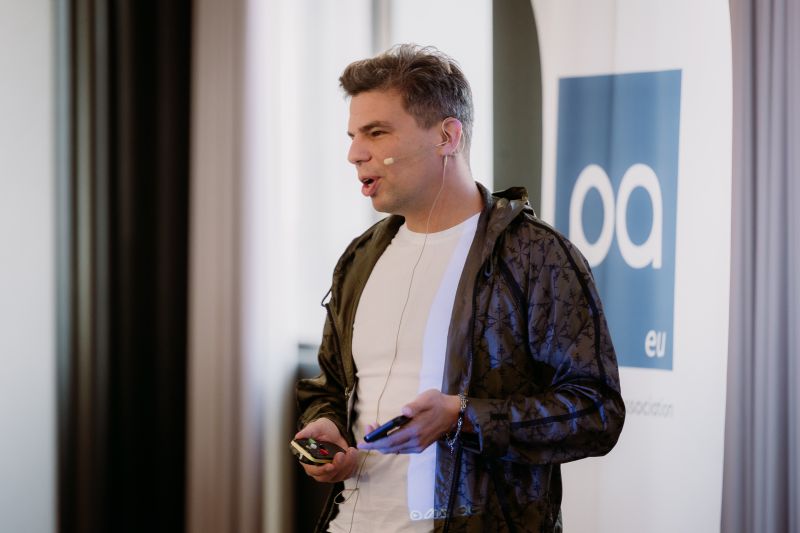
The humour runs through other appearances. After an Amsterdam networking event, he thanked people for coming and added that next time they would bring more food. It is an ordinary host’s afterthought in a feed full of corporate announcements. His Lisbon fashion commentary works similarly: a business event leaves room for a person with tastes, jokes and an Instagram handle.
He has also compared a good office to a five-star hotel, writing about fresh-cut flowers and surroundings that remove everyday friction. The comparison fits his interest in service. An environment expresses its priorities through what people encounter, including the small details they would never put on a company strategy slide.
The stopwatch meets the invoice
The founder who once waited months for an account is understandably interested in speed. But his newer conversations dwell on what happens around the transfer. In a July 2026 discussion with Linas Beliūnas, he separated settlement speed from the compliance work a payment also has to pass through.
Modern infrastructure can move money quickly while checks still take time. For an internationally operating business, uncertainty about that second part matters. He put reliability at the centre of the customer’s experience: a finance team needs confidence that its payment will reach the intended recipient and that somebody understands its progress.
ONE PAYMENT · TWO PIECES OF WORK
The customer needs confidence in the whole journey.
His interest in technology remains practical. In a 2025 interview at Money20/20 Europe, he described personally testing potential suppliers and using LinkedIn to find providers. A founder buying technology has to discover what it does in use. That fits a business whose customers ultimately judge an international transfer by whether it works.
In June 2026, his interests also took him into a separate investment. He and Dugaev invested personally in Express Minds, a licensed virtual-asset service provider in Botswana, to support stablecoin payment infrastructure in Southern Africa. The announcement distinguished their investment from 3S Money’s regulated electronic-money activities. It described support for settlement and access to dollar-denominated liquidity, with the development work still ahead.
He is also discussing agentic AI as a way to handle routine work so colleagues can spend more time on clients. That description places a condition on the technology: it should help extend the experience the company wants people to have. For Zhiznevsky, new tools keep returning to an old service question. After the system has done its part, who is paying attention to the customer?
A little less screen, a little more art
Ask about ambitions beyond the company and the answer becomes less predictable. In 2023, Zhiznevsky described an interest in a business that would make art affordable to more people. He also wanted to bring down the time he spent looking at screens. A founder can apparently help move money around the world and still struggle to put the phone down.
Asked what skill building the company had taught him, he answered: “Patience.” It is a neat ending for a story that began with four months of waiting. Since then, his work has involved accounts, colleagues, customers and suppliers, each requiring attention of a different kind. Even the ambition to spend less time on a screen has to compete with an inbox he has made a point of reading.
KEEP READING & WATCHING ↗