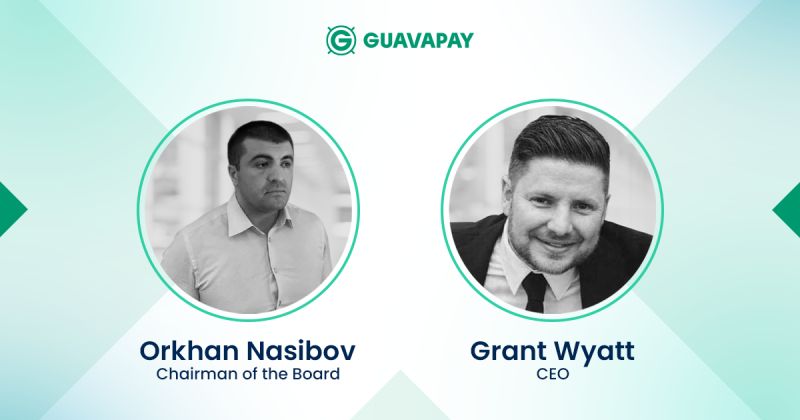
In December 2022, Orkhan Nasibov changed chairs. Guavapay’s founder was handing the chief executive’s job to Grant Wyatt and becoming chairman of the board. The announcement was cheerful, complete with applause and good wishes. Corporate succession rarely arrives dressed for a funeral. Nasibov offered a fairly ordinary explanation: “I decided to step aside as the CEO to focus on other projects.” He would remain involved in developing the business he had founded five years earlier.
It looked like a division of labour. Wyatt would lead the next stage; Nasibov would concentrate on growth and Guavapay’s international profile. The arrangement placed the founder one step further from daily management, while keeping him close to the company’s future. His move from CEO to chairman is a useful place to enter the story, because the relationship between a founder and his company can survive several changes of title.
Nasibov’s story runs through those changes. It also runs through a deceptively modest ambition: make payments easier. Few people wake up hoping for a more intellectually demanding bank transfer. The interesting question was how much machinery Guavapay would need to put that convenience within reach, and what it would take to keep the machinery running.
The years before the button
Guavapay began in London in 2017 as a card processing centre. Its founding date was 6 February; Nasibov became a director that day. The early proposition sat behind the transaction, handling the technology through which a payment becomes possible. Before a financial app can look effortless, somebody has to do rather a lot of effortful work.
The business obtained its small electronic money institution registration in 2019 and developed a wider set of services. Its account of its early years placed an official launch in 2021, after a period spent building products. The progression matters. Nasibov’s company started with processing capabilities and expanded towards services that individuals and businesses could use directly. Its later consumer identity grew out of that earlier technical business.
Nasibov’s public professional identity also had an academic element. His LinkedIn profile lists Saint Petersburg State University of Finance and Economics, with study dates of 2005 to 2009. His contributor biography describes him as holding a PhD in economics. In the writing that followed, he repeatedly considered how new financial technology could fit into an existing banking system.
By April 2025, Guy Noble, then Guavapay’s newly appointed CEO, was describing the early period as five years concentrated on technology. His account made the investment sound patient and substantial. It also set up a second problem: how to package the capabilities into something a customer could understand. Building the components and explaining the product were separate jobs.
Products followed.
A card processing centre became the foundation for consumer and business payment services.
He wanted the banks in the picture
In January 2021, Nasibov published an essay about fintech and bank payment services. The emphasis was cooperation. Banks had established relationships and payment networks; financial technology companies could bring more adaptable software and simpler ways to connect. He described an opportunity to combine those capabilities and reduce the difficulties of moving money internationally.
There was something practical about the argument. A payment company could build technology without expecting the financial world to abandon its existing institutions. It could connect to them. In Nasibov’s account, international transfers, cost and customer access belonged in the same conversation. A service became useful when its various participants could work together.
That perspective helps explain the type of company he was building. The ambition depended on reaching beyond a single interface into the systems that served it. An elegant screen could make a transaction easier to request. The connections behind it had to make the request possible. The screen, as ever, would receive most of the compliments.
His writing later extended to cryptocurrency, including an opinion piece published in July 2021. That broadened the subject matter, but the recurring interest remained the changing means of moving value. He was putting his name to arguments about how financial services might develop while running a business that needed to make its own place among them.
Borrowing reach, building connections
In January 2021, Guavapay announced principal membership of Mastercard. The status allowed it to issue cards directly and for other organisations, and to offer acquiring services to merchants. The announcement presented the company as both a financial services provider and a technology business with its own card processing centre.
Nasibov, speaking as CEO, put the customer at the centre of his explanation: “Our primary focus is customer convenience”. Membership gave that familiar phrase a particular operational meaning. Guavapay was seeking the ability to connect its processing services to cards and merchant payments through an established international network.
In September of the same year, another partnership announcement, with Western Union Business Solutions, addressed international transfers. The planned connection used Western Union’s payment capabilities to widen Guavapay’s access across borders. Nasibov described an ambition for more affordable, reliable transfers and a broader international presence.
The two relationships reveal the work behind a payments company’s expansion. One involved cards and payment acceptance; the other involved cross-border movement. For the founder, growth meant adding connections that could support different uses of the same underlying business. A customer might see a card or a transfer. Guavapay had to assemble the relationships that made each available.
A founder can have more than one seat
The December 2022 handover did not end Nasibov’s involvement. Nor did his first departure from Guavapay Limited’s board, on 1 February 2024, mean that the ownership story had ended. By then, a holding company had become part of the picture.
Nasibov became a director of Tainotech Holding Limited on 20 October 2023. In December, Tainotech replaced him as Guavapay Limited’s registered person with significant control, holding at least 75 percent of shares and voting rights. Nasibov, in turn, is registered as controlling at least 75 percent of Tainotech’s shares and voting rights.
These distinctions can sound like the administrative equivalent of watching paint dry. They become more useful when a founder’s job title changes. Management, directorship and ownership describe different relationships. Someone can leave an operating company’s board while remaining connected through the company above it. Following Nasibov requires keeping those relationships separate.
His international involvement also appears in the November 2024 incorporation of Guavapay Argentina S.A., where he and Kamal Hasanov were named as founding shareholders. The ambition had travelled beyond London. The incorporation gives that expansion a specific place and date, without requiring a grand theory about the founder’s private motivations.
“Our primary focus is customer convenience”
Orkhan Nasibov · Mastercard announcement · January 2021
When the sequence turned
By April 2025, Guavapay’s outward-facing story covered MyGuava for individuals and MyGuava Business for corporate customers. Noble was discussing how to arrange the company’s technology around customer needs. The business Nasibov had founded had acquired several layers: processing, cards, transfers and products with their own users.
Then the UK chapter changed. On 17 September 2025, Guavapay agreed to a voluntary requirement with the FCA restricting its activities. Two days later, on 19 September, Nasibov returned as a director of Guavapay Limited. The timing puts his second spell on the board within the company’s period of restriction.
He resigned on 9 January 2026. Twelve days later, on 21 January, Guavapay Limited entered compulsory liquidation. The winding-up followed a petition from Mastercard, one of its creditors. The network that had appeared in a 2021 announcement about extending payment capabilities now appeared in the story of the UK company’s ending.
- 2017Founds Guavapay in London.
- 2022Moves from CEO to chairman.
- 2025Returns to the UK board on 19 September.
- 2026Leaves on 9 January; UK company enters liquidation on 21 January.
The liquidation concerned Guavapay Limited, the UK legal entity. Its customers’ claims became part of the liquidators’ work. Kristina Kicks and Michael Leeds of Interpath were appointed on 2 February 2026. The practical concerns at that stage were funds, claims and the work of winding up the company.
The promise behind the transaction
Nasibov remains listed as a director of Tainotech. His Guavapay titles belong to earlier chapters. Putting both facts in view produces a more accurate portrait than leaving him permanently in the CEO’s chair or allowing the liquidation to erase the preceding business altogether.
There is a consistent line through his public work: the attraction of making a complicated financial service feel straightforward. His early essays considered cooperation with banks. His partnership comments stressed convenience and international access. Guavapay’s development moved from processing towards products that tried to put several kinds of payment within a customer’s reach.
The UK outcome belongs beside that ambition. A payment service must satisfy the person using it and sustain the organisation providing it. Nasibov’s career brings both demands into focus, from the processing centre to the chairman’s seat and the return to a restricted company’s board. The button can be simple. Everything required to keep it working has a much longer story.