The most honest thing a new university can say is that it is new. International Business University, or IBU, received Ontario's final consent to call itself a university in December 2020 and began teaching in 2021. It cannot point to ivy, Nobel prizes or generations of alumni occupying corner offices. So it points to a different kind of evidence: projects completed, competencies demonstrated, employers brought into the room. This is not modest positioning. It is the only sensible move for a school trying to sell business degrees in Toronto, a city already crowded with familiar names.
IBU is an independent, private not-for-profit institution focused exclusively on business education. Its portfolio now spans Bachelor of Commerce streams, a family of MBA specializations and two Master of Science programs in applied artificial intelligence. The pitch is career relevance without the drift: smaller cohorts, teachers with industry experience, accelerated options and assignments that resemble work. The university says it enrolls more than 2,150 students from over 50 countries. LinkedIn lists roughly 3,000 alumni. Its 2026 convocation included nearly 700 graduates, up from only 11 in 2024.
A university designed backward from the job
The product is not the campus and it is not the parchment. It is a bundle of career options. Undergraduate students choose among business management, digital sales and marketing, or international management and technology. MBA students can pursue a general stream or specializations spanning technology, entrepreneurship, global business, financial analytics, information systems, healthcare management, and digital health and data analytics. In March 2026, Ontario consent began for MSc programs in Applied AI for Industrial Innovation and Data Engineering.
That catalog tells you where IBU sits in the market. It is narrower than a comprehensive public university, more degree-focused than a certificate platform and more flexible than the classic residential business school. Its customers are international students who need structured support, domestic students who want an accessible degree path, college graduates moving through transfer agreements and working professionals fitting an MBA around adult life. What it solves is less a knowledge shortage than a translation problem: students learn things, employers want capabilities, and the transcript between them is usually cryptic.
IBU's answer is a new comprehensive skills record called IBU Signal. Announced in May 2026, it is meant to validate applied abilities such as critical thinking, communication, adaptability and problem-solving. The important word is validate. Plenty of schools promise career readiness. The interesting product decision is to make those fuzzy human skills inspectable beside the credential. If the evidence is rigorous and employers learn to read it, the signal can give a young school a language that does not depend entirely on brand recognition.
What it costs - and what the number hides
A career option still has a price tag. For the 2026-2027 academic year, IBU lists its standard Toronto MBA at CAD $24,160 in tuition and fees for domestic students and CAD $40,860 for international students, before eligible bursaries. The listed international Bachelor of Commerce total is CAD $77,320 before bursaries. International learners also face mandatory health coverage and other living costs. The numbers are reviewed annually, so a prospective student should treat the offer letter, not a screenshot, as the bill.
The degree menu, before bursaries
Listed tuition and mandatory fees. Bursaries may reduce totals; health insurance, housing and some other costs can sit outside them.
That price changes the standard of proof. A capstone is not automatically valuable because a company name appears on the brief. A skills record is not automatically trusted because it has tidy badges. Students should ask who evaluated the work, what employers did with it and how recent graduates fared. IBU publishes headline measures, including a claimed 100 percent graduation rate and a survey result saying 94 percent agree the school gave them skills to succeed. Useful, yes. Sufficient, no. Cohort definitions, response rates and independent outcome data matter when the institution is this young.
The credibility stack
The first thing that failed was the possibility of leaning on inherited reputation. IBU had none to inherit. Early online discussion about the school often collapsed into one nervous question: is it legitimate? The factual answer is that Ontario granted the institution consent to use the university title and offer approved degrees, and IBU became a Designated Learning Institution in 2023. The more demanding answer is that regulatory permission is a floor, not a reputation. Students still need to test whether a particular degree fits an employer, licensing body, transfer plan or immigration goal.
What seems to have changed the school's approach was scale. Eleven graduates can be known individually. Nearly 700 cannot be managed by goodwill and faculty memory alone. As IBU expanded, it added systems around the promise: the Future Talent Research Institute to study workforce demand, the Centre for Sustainable Business to anchor responsible management work, new senior academic leadership, a purpose-built Toronto campus at 655 Bay Street and an Ottawa graduate campus near the capital's technology and government networks.
The employability loop
Partnerships do much of the reputation work. Sheridan and Centennial create routes from college credentials toward degrees. ILAC provides an English-language pathway. CIBC offers student banking and financial-literacy programming. Scotiabank has connected students with workplace learning through Bank Your Future. SpacesShared addresses the less glamorous but decisive problem of housing. UNITAR is working with the Centre for Sustainable Business on training and events connected to the UN Sustainable Development Goals. NORDIK Institute brings applied research and Indigenous entrepreneurship into the network.
None of these names transfers a century of prestige. They do something more practical: each partnership removes a little friction from the student journey or puts another external participant near the curriculum. That is the model's clearest differentiation. IBU behaves less like a miniature traditional university and more like a focused education company assembling a complete route from recruitment to classroom to employer evidence.
The growth chart is also the warning label
Fast growth is evidence of demand, not evidence that every promise survived contact with scale. The student-centered model works when instructors notice an absence, feedback arrives quickly and support feels personal. It works less well if enrollment outruns faculty hiring, advising becomes a queue or “industry aligned” hardens into a marketing phrase. Nor is it the natural choice for a student who wants a vast research library, a global alumni brand built over decades, a guaranteed paid co-op or the breadth of a comprehensive public university.
The competitive set is formidable: Rotman, Schulich, Ted Rogers and a long list of public colleges, private providers and online certificates. IBU cannot win their game by claiming equal history. It can win a specific student's decision by being faster to update, easier to navigate and more explicit about the work that sits behind the credential. The applied-AI degrees are a clean example. Instead of presenting AI as a detached computer-science topic, the programs frame it around industrial innovation and data engineering, using cases and industry datasets. That makes sense for managers and technical translators. It makes less sense for someone seeking deep theoretical computer science or a research doctorate.
The playbook worth stealing
There is a useful company-building lesson buried inside this university. In a trust-heavy market, the new entrant should not imitate the incumbent's furniture. It should identify the missing proof. IBU has treated employability as a product system: listen to employers, shape programs around the demand, make students perform real work, record the capabilities and bring partners back into the loop.
Four moves another operator can copy
- Start narrow. IBU chose business, not a hurried catalog of everything.
- Turn feedback into releases. Research employer needs, then change the actual program.
- Make the invisible visible. Projects and skill records are easier to inspect than “career ready.”
- Partner around friction. Admissions, housing, finance and career access all shape the product.
The conditions are equally important. This playbook fails when the signal is self-awarded, the partners are decorative or growth erodes the personal service used to sell the program. It also fails for buyers who primarily value prestige, research depth or a traditional campus experience. Reputation cannot be growth-hacked forever. Eventually, graduates become the brand.
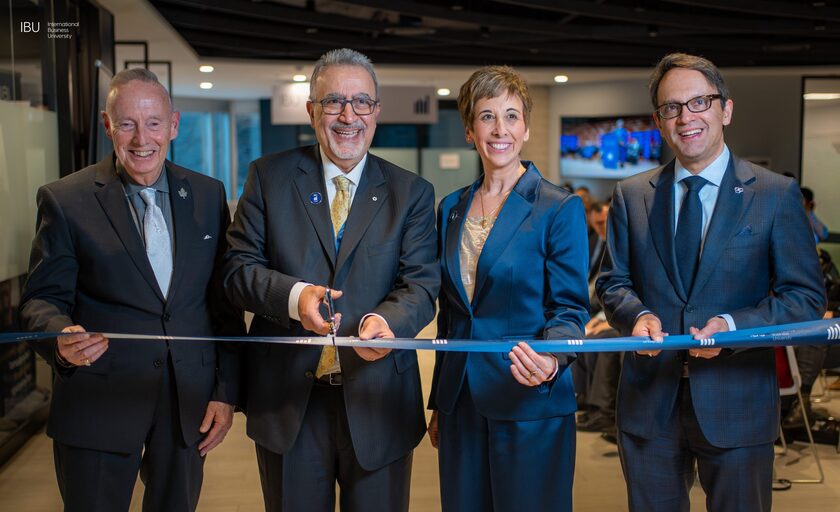
That is why the nearly 700 people who crossed IBU's convocation stage in June matter more than the ribbon cuttings. Their next jobs, projects and promotions will decide whether “next generation” becomes an accurate description or remains an energetic slogan. The university has built the machinery for a faster feedback loop. Now comes the slow part: letting the market see what its graduates can do.
Keep exploring
See the university's current programs and campus details, follow its public updates or watch students describe the experience in their own words.