The most revealing arithmetic at Université Européenne de Tunis is not on a finance exam. It is in the course catalog: 2+1. Two years in Tunis, then one at a partner institution. For a student who wants an international education, that little equation turns a large ambition into a sequence of places, years and decisions.
UET, also branded European World University, sells education with an onward journey attached. Its campus brings business, political studies and hospitality into the same institutional family. The pitch combines French- and English-language study, professional preparation and routes overseas. The interesting question is how those pieces fit together for an actual student.
Founded in 2006 by Abderraouf Tebourbi, the private group has made international connections central to its identity. The interpretation suggested by its catalog is straightforward: Tunis can be the first chapter of an international degree. That is a useful proposition to examine course by course, with the brochure open and a pencil handy.
A timetable for the international ambition
UET’s published international catalog names institutions and attaches subjects to study sequences. It lists 2+1 undergraduate routes and 1+1 master routes with Paris School of Business and HEC Liège, among others. Political studies have their own destinations, including HEIP and ILERI. The numbers do useful work: they describe how a course might be divided between institutions.
These arrangements speak to students who want an overseas component without beginning their entire university life abroad. The staged format also gives families a way to discuss timing. When does the move happen? What must be completed first? Which institution delivers the final part? Those questions turn an attractive destination into an academic plan.
Two years here. One year there.
Illustrative undergraduate sequence; conditions vary by program.
A double diploma, an exchange and an immersion period deserve separate attention. UET describes its double-diploma arrangement as an award from UET plus an award from a partner. Its catalog also explicitly labels some American offerings as immersion programs. Applicants should therefore read the exact route and resulting qualification before treating every overseas option as equivalent.
Three academic doors, different careers
Europe de Com is the group’s business and technology offering. Its national licences include business administration, finance, IT management, business intelligence and marketing. Master subjects include data management, financial engineering and communication and digital marketing. The name sounds like a communications school; the current program list reaches considerably further.
Sciences Po Tunis handles political and legal education through the Faculté Privée des Sciences Politiques et Économiques de Tunis. Its national offering includes political science and public and private law, followed by master subjects such as public-policy management, international relations and business law. The local school’s name should be read precisely: an applicant needs the particular institution and award, not an assumption based on familiar words.
Vatel Tunis supplies the hospitality route, with bachelor and MBA programs in international hotel management. That gives UET a different professional setting from the trading room or legal classroom. A prospective hotel manager is studying an operation built around guests, staff and service. The common thread across the group is preparation for a recognizable field of work, rather than a single disciplinary specialty.
The classroom borrows a working life
UET describes its campus principle in five words: “la pratique valide la théorie.” Practice validates theory. On its campus pages, the idea takes the form of a financial-market simulation room, a mock courtroom, collaborative learning spaces and media-production facilities. These are settings in which a lesson can become an exercise.
The Trading Lab is described as using real or simulated economic data. The Law Hub supports simulated trials and advocacy. Neither activity needs to pretend that students have already become professionals. Its educational purpose is rehearsal: making a decision, defending it and discovering what the classroom explanation left unresolved.
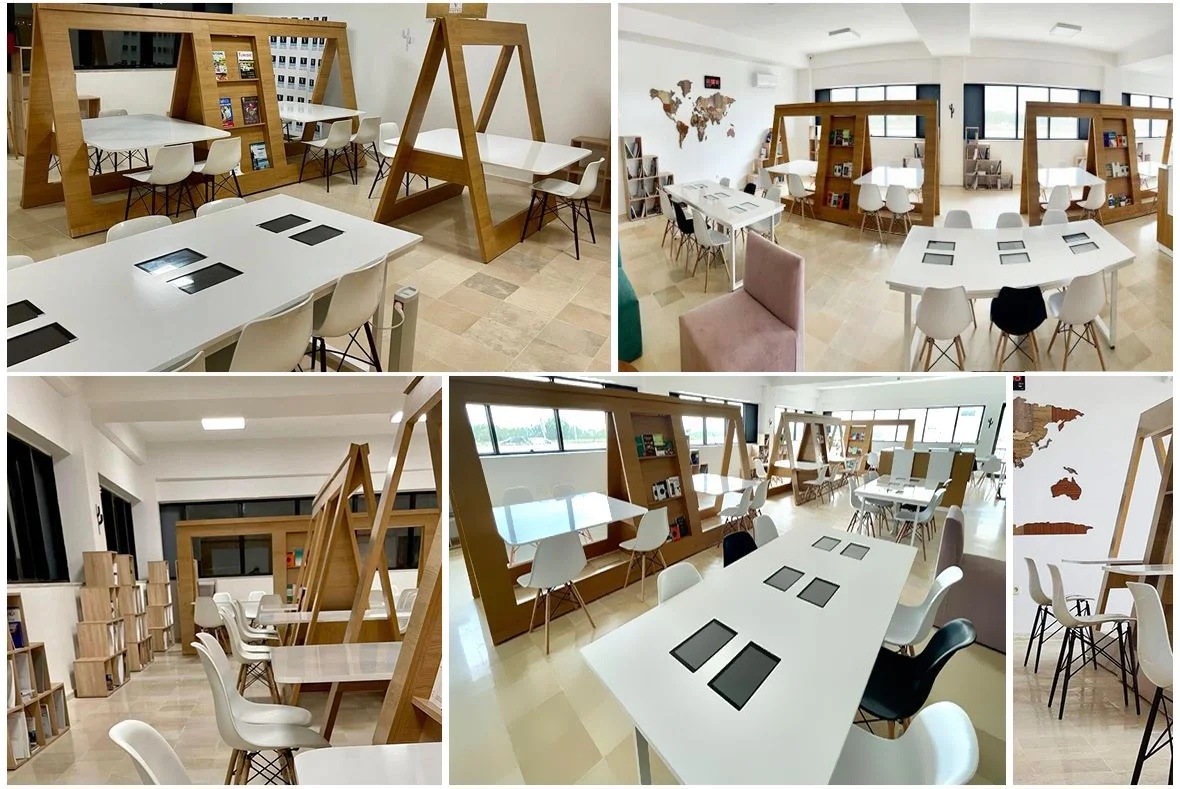
Vatel makes the principle particularly tangible. Its Hotel Lab includes a reception, a guest room, a kitchen and practice lounges. The school also describes a rooftop café run by students under professional supervision. Hospitality has plenty of theory, but a reception desk gives that theory somewhere to stand.
“la pratique valide la théorie”
UET’s campus principle: practice validates theory.
A partnership earns its keep in the details
A January 2017 announcement offers a concrete example of UET’s method. The group said Tebourbi and UQAM political and legal sciences faculty representative Carolle Simard met on January 17 to conclude an agreement. It provided for reciprocal student mobility, allowing Sciences Po Tunis students to spend their third licence year at the Canadian university.
The agreement also included faculty exchanges and research collaboration through CRUET, UET’s research center. Those provisions matter because an international connection can affect teaching in Tunis as well as travel out of it. The historical announcement describes several jobs for one agreement: student movement, visiting teaching and joint academic work.
In June 2023, UET announced Westminster-linked bachelor, master and MBA programs spanning business and related subjects. It presented them as courses between Tunis and London and said applicants would be selected. This is the kind of detail that makes the offer assessable. A named destination, a subject and an admission process tell a prospective student more than a wall of university logos.
The rooftop has homework
The café-restaurant at Vatel Tunis has a name with very little mystery about its location: ROOFEAT. Alongside the Hotel Lab, it puts food service into the campus’s working vocabulary. Vatel also lists internship support and establishments that have accepted its students, including JW Marriott Cannes and the Hôtel de Crillon in Paris.
Its Marco Polo program adds another form of mobility. Students can spend a study year at another participating Vatel school, within the program’s selection and academic arrangements. For hospitality students, changing countries is closely connected to the subject itself: the guest, the colleague and the service expectation may all be unfamiliar.
The school’s recent activity keeps that vocational story grounded. Vatel Tunis held a graduation ceremony on April 30, 2026, for its 2025 and 2026 classes. It is a useful reminder of who all these rooms and agreements serve. The institutional network matters most when a student completes the course and can explain what they have learned to an employer.
The price belongs to a particular course
UET’s business model is private, fee-paying higher education. An archived Vatel-associated euro fee sheet for 2017-18 makes the components visible: annual licence tuition of €5,200, a €600 registration fee and a one-time €480 uniform charge. Master/MBA tuition was listed at €5,600. These are historical charges for that offering, not a current university-wide quotation.
Plus €600 annual registration and €480 for the one-time uniform kit. Historical prices, shown to explain the fee structure.
The separation is instructive. A tuition headline does not describe every educational expense. For a route that moves between countries, the useful comparison is the complete itinerary: the Tunis portion, the partner portion and the cost of living during each. Even a neat 2+1 diagram needs a less glamorous companion spreadsheet.
That is also how to compare UET with alternatives: a domestic university course, another private institution or direct entry overseas. The relevant unit is the specific program a student can enter and finish. A shorter period abroad may suit one family’s plans; another applicant may prefer to settle into the destination institution from the beginning.
More than a departure lounge
UET’s research center, CRUET, gives the institution an academic project alongside the mobility pitch. It describes work across politics, law, economics and management, published through research papers and conference proceedings. Its stated role includes bringing research into teaching and connecting local work with international academic collaboration.
Admissions, meanwhile, is aimed at both school leavers and university students changing direction. UET asks for an academic dossier, examines the candidate’s background and uses an orientation interview. Depending on the field, an evaluation test may be required. The process allows for redirection toward another course as well as admission to the original choice.
That makes fit a practical part of the offering. A student attracted by finance may need to distinguish financial engineering from general management; a student drawn to international affairs must choose between different political and legal paths. The breadth of the group creates options, but those options become useful through a specific decision.
Copy the sequence, then inspect the handoff
The lesson for another education provider is visible in UET’s design: give a large promise a small, understandable sequence. Name the first campus, name the next one and explain what connects them. Build practice around the subject, whether that means a hearing, a market exercise or a hotel reception.
For the student, the same lesson works in reverse. Start with the desired qualification and follow the route backward. Ask about entry to the partner year, teaching language, academic requirements and the full budget. A pathway loses its appeal if the destination course does not match the student’s ambitions or the overseas portion does not fit the plan.
UET’s distinctive proposition is the combination: a Tunis base, subject-specific practice and a published route outward. The rooftop may win the photograph. The decisive part is the handoff between one year and the next.
Explore the courses and campus
UET website ↗ · International course catalog ↗ · Admissions ↗ · Vatel Tunis ↗
LinkedIn ↗ · Instagram ↗ · Facebook ↗ · X ↗ · UET on YouTube ↗