The first useful thing to know about Mitch Gordon is that his career did not begin with a theory of higher education. It began with the ordinary confusion of trying to go somewhere. After growing up in upstate New York, Gordon went to Taiwan, taught English, and stayed in Taipei for five years. He found a second home. He also found a problem: reliable information about schools and jobs abroad was frustratingly hard to locate.
Plenty of travelers complain about a bad search experience and then get on with the trip. Gordon built a company. Reach To Teach helped place teachers in schools across Asia. The work put him on both sides of the journey, first as the person looking for an opportunity and then as the operator trying to make that opportunity legible to somebody else. This distinction would become his professional habitat. Travel supplies the romance; Gordon keeps returning to the machinery that allows the romance to happen.
The problem follows the founder
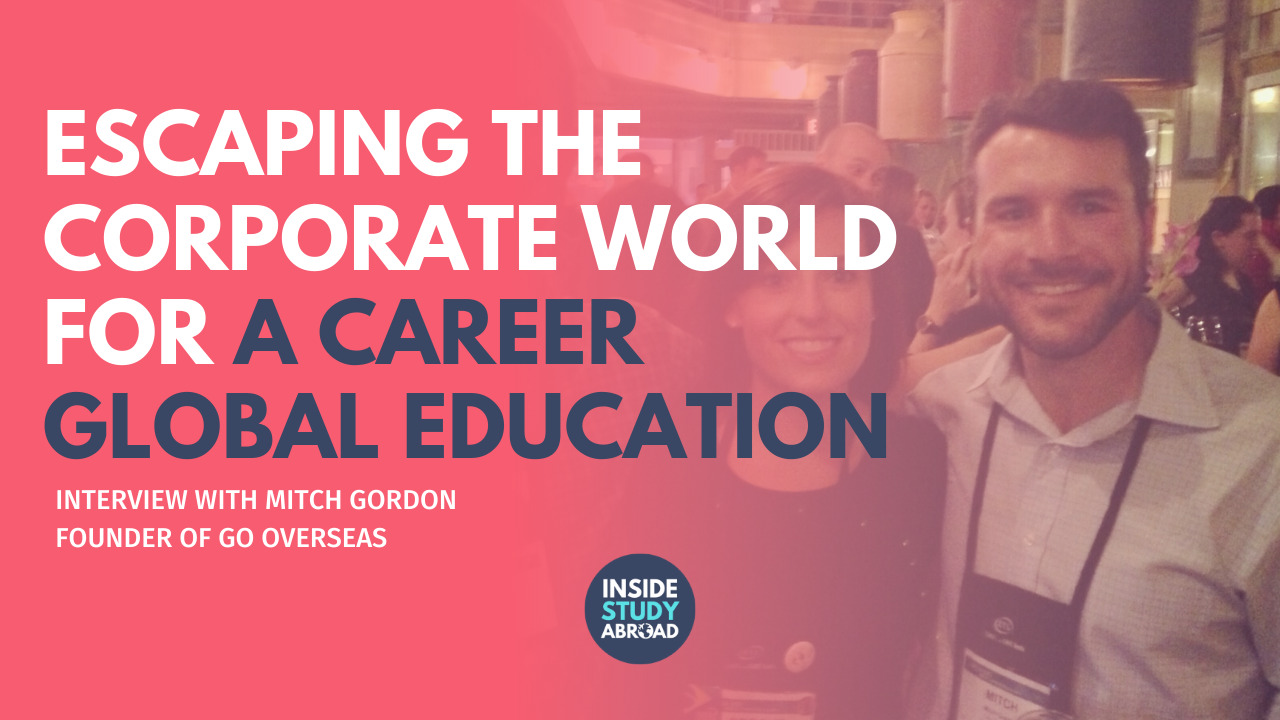
In 2010, Gordon co-founded Go Overseas. The premise was wonderfully unglamorous: people making expensive, consequential choices about studying, teaching, volunteering, or taking a gap year abroad should be able to read candid reviews from people who had already done it. Today, review platforms feel like plumbing. At the time, assembling that information for international programs meant turning a scattered set of brochures and anecdotes into something searchable.
Gordon carried the idea into UC Berkeley's Haas School of Business, where he completed his MBA in 2012. Go Overseas first worked out of an incubator in the basement of the Bancroft Hotel. It later moved into Berkeley's SkyDeck. Gordon supplied the line any editor would have been annoyed not to think of first: they had gone “from the basement to the penthouse.” The joke also captured a serious founder need. A recognizable home gave a young company credibility with customers before it had much history to offer.
My business wouldn't be where it is today without Haas.Mitch Gordon on Go Overseas
After the MBA, he stayed close to the campus as an Entrepreneur in Residence from 2013 to 2015. He helped students and founders around Berkeley's startup community while Go Overseas grew. His public bio lists rugby, running, reading, barbecue, and travel among the preferred uses of an unscheduled hour. It also records more than 40 countries visited. This is less a collection of quirky résumé garnish than a clue: the product category and the person were unusually well matched.
The path to that fit had included what he once jokingly called his “dark years” as an accountant in New York. Accounting and international education make an odd couple until one considers what a founder actually does all day. The traveler in Gordon supplied the appetite. The accountant understood that appetite eventually meets a budget, a deadline, and a form with one missing signature. His later ventures sit comfortably between those instincts. They sell a larger life while respecting the ledger required to reach it.
Move the passport to page one
Go Overseas helped people choose an experience. Verto Education, co-founded by Gordon in 2017, went after a larger structural question. Study abroad usually appears deep into the college catalogue, a possibility for a later semester if credits, money, timing, and degree requirements cooperate. Verto moved it to the front. Students could begin college in an international location, take accredited courses, and continue through a pathway to a partner institution.
The reversal is easy to describe and hard to operate. A teenager may love the thought of Florence, Prague, Seville, London, or Buenos Aires. A family also needs to know who awards the credit, whether it will transfer, what the next application requires, and who will answer the phone when a plan changes. A university needs academic alignment and confidence in the student pathway. The original idea fits on a napkin. The institution around it requires an alarming number of spreadsheets.
It also requires translation between groups that use different clocks. Students think in semesters and departure dates. Families think in tuition bills and graduation plans. Universities think in requirements, enrollment cycles, and institutional standards. A global program lives between them. Gordon's years at Go Overseas had already taught him that enthusiasm is plentiful and trust is painstaking. Verto applies that lesson to a more consequential transaction. A review can help someone choose. A college pathway must keep working long after the choice is made.
Verto's current structure makes the bridge explicit. Courses and transcripts at its locations are delivered through its accredited academic provider, the University of New Haven. Its partner-college directory lists more than 75 institutions and distinguishes between direct-transfer pathways and programs offered through a university's admission process. It is not a casual promise that everything will somehow work out after the flight home. The pathway is the product.
Gordon's language about the student experience tends to wander beyond credits. In an early letter explaining Verto, he named “resiliency, grit, compassion, and gratitude” as the qualities he wanted students to develop. The list can sound like a handsome poster in an advising office. His mechanism is more specific: unfamiliar places, small classes, close contact with faculty, community work, and the repeated minor shocks of discovering that one's normal is merely one normal among many.
It's a privilege to witness so many students developing independence, emotional awareness, and maturation.Mitch Gordon during Verto Family Week
When the world closed
A company built around student mobility met an unforgiving test in March 2020. As the pandemic accelerated, Verto brought students home from programs in Latin America and the South Pacific. Gordon and co-founder Mallory Meiser described a team monitoring events, communicating with families, and making decisions under changing conditions. The episode exposed the responsibility tucked inside the phrase “experiential education.” Once a company places young people around the world, operational judgment is not backstage work. It is the work.
The organization continued, changed its programs, and resumed the international model. By fall 2025, Verto announced more than 1,200 students across five locations. In January 2026 it announced another spring class of more than 400. Those are enrollment counts, not a verdict on the whole approach. They do show that an idea once explained as an alternative to freshman year had become a repeatable route used by substantial cohorts.
There is a tidy founder lesson hiding in this untidy journey. Gordon did not leap from accounting to travel to software to education as unrelated market opportunities. His projects kept circling the same human moment: somebody wants to cross a border to learn, but the path is opaque. Reach To Teach addressed placement. Go Overseas addressed information and trust. Verto addresses the academic bridge into college. The companies changed because his view of the problem widened.
The sequence offers something practical to steal. Start with the moment of friction you know firsthand. Build the smallest useful guide through it. Then watch what remains difficult after the guide succeeds. Gordon's first problem was finding a credible job abroad. Solving placement exposed the need for broader program information. Organizing information exposed the institutional barriers surrounding academic credit and college progression. Each business became field research for the next, even when there was no grand trilogy pinned above a desk.
His connection to universities also changed with each pass. At Go Overseas, colleges and program providers were part of a marketplace of choices. At Berkeley, the university was an educator, an incubator, and a source of legitimacy. At Verto, colleges are partners whose policies determine whether an international semester becomes a foundation or a loose brick. Gordon learned the sector first as a student, then as a founder beside it, and finally as an operator working inside its rules. That progression matters because higher education rarely yields to a clever pitch alone. It moves through relationships, evidence, and patient agreement.
Adventure, with paperwork
Gordon's aspirations are ambitious in institutional terms and modest in vocabulary. He talks about access, affordability, confidence, perspective, and global citizenship. He joined Founders Pledge and has served as an advisor to Sora Schools and POWr. The connective tissue is a preference for systems that help people act, rather than merely admire an idea from a distance.
This is why the passport is only half the symbol. The other half might be a transcript. One represents possibility, movement, and the pleasure of discovering how big the world is. The other represents continuity, proof, and the bureaucratic fact that a beautiful semester still has to count toward something. Verto's wager is that students should not have to choose between them.
There is wit in placing those objects side by side. Passports collect stamps; transcripts collect grades. One invites stories at dinner. The other arrives in an envelope everyone is afraid to bend. Yet both are records of passage. Gordon's work treats personal growth and academic progress as companions with different handwriting. The student who learns to navigate a new city is also the student who must register for the right course. Independence becomes meaningful when it survives contact with consequences.
Back in Taiwan, Gordon was the user looking for a trustworthy map. Two decades later, he runs an organization drawing a more complicated one. It has lines between cities, courses, colleges, advisers, and families. The map keeps changing because higher education keeps changing. Yet the destination is remarkably consistent: make it easier for a student to leave home, learn in the world, and return with more than photographs.