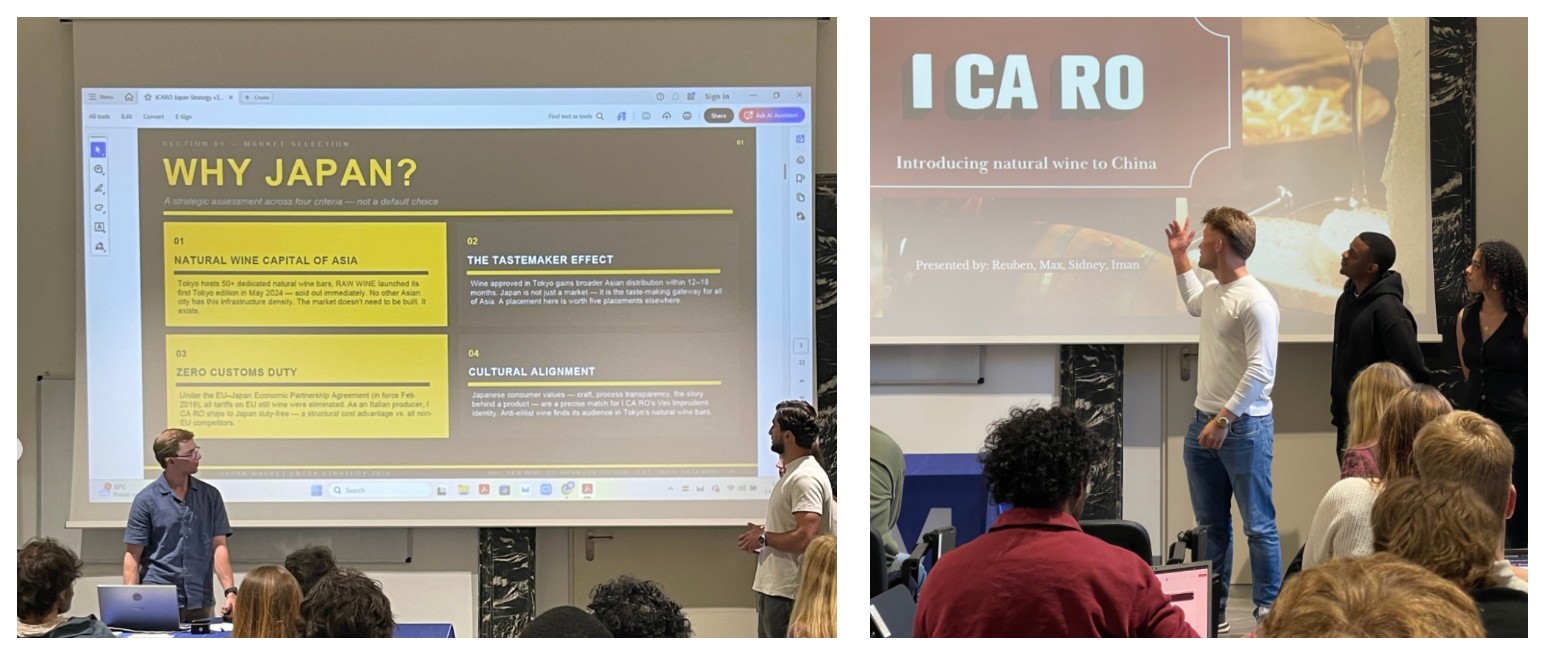
On a classroom screen in Rome, a question appears in large yellow letters: “WHY JAPAN?” On another, a team pitches natural wine to China. The assignment belongs to ICARO, a startup working with wines from Italy’s Castelli Romani. The students belong to Swiss School of Management. Their job is to figure out how a local product might travel.
It is May 2026, during the school’s International Student Week. Teams have been developing an Asian market-entry strategy, then defending their choices in presentations. Wine makes a useful teaching device. It has a place, a story, a price and a customer who might understand none of them. Moving it requires more than translating the label.
- Business degrees from bachelor’s study to applied doctoral research.
- Online teaching, with local in-residence learning options.
- A Dallas headquarters coordinating an international network.
- Accreditation that must be checked against the exact awarding institution.
The same problem of translation runs through SSM itself. Here is a school with Swiss in its name, an established teaching presence in Rome and, since March 2026, global headquarters in Dallas. Understanding it means setting aside the familiar picture of a business school gathered around one expensive patch of real estate.
A school becomes a network
SSM’s current institutional history dates its founding in Switzerland to 1991 and its expansion to Rome to 2002. Its president, Massimiliano Bracalé, is identified by the school as its founding president. The institution now describes Dallas as the administrative and academic center for its worldwide online operations, including degree issuance and regulatory coordination.
Why spread out? The World Higher Education Database’s account offers a practical explanation: international students wanted access, but Swiss living costs and tuition were an obstacle. Learning centers brought the school closer to them. The important innovation, in that account, was a change in where education could happen.
The present network combines digital instruction with in-residence locations. SSM describes those sites as examination centers, networking hubs and community spaces. That last function matters. A recorded lecture can move across a border effortlessly. Finding people to argue through a business problem with still benefits from a room.
Teaching expands
Institutional accreditation
Global coordination
The lecture has three doors
Consider the Bachelor of Business Administration. SSM describes a three-year, 180 ECTS program with three attendance options: in person, live online and through recorded lectures. Classes are streamed and recorded. Students can revisit material rather than having their access determined entirely by where they were at a particular hour.
The curriculum moves from business foundations toward application and specialization, ending in a thesis project. SSM also describes case studies, company visits and internships within the learning experience. These are familiar ingredients in management education. Their usefulness depends on the quality of the assignment, supervision and feedback, rather than on the number of countries printed in a brochure.
This creates a useful distinction for applicants comparing schools. Course access, teaching format and qualification level are separate decisions. A recording may solve a scheduling problem; it does not choose a specialization or make a research question manageable. Students still have to decide what they want to learn and how much structure they need. SSM’s menu makes those choices visible, but the work of matching them to an individual career remains with the applicant.
The customer changes as the qualifications advance. A bachelor’s student needs a foundation. An MBA applicant wants broader management tools. The one-year MBA includes finance, strategy, negotiation and leadership; listed specialization modules extend to luxury branding and distribution. The 12-month Executive MBA targets professionals and emerging leaders. The DBA moves into research methods, a dissertation and an oral defense.
A recorded lecture can cross a border effortlessly. A useful conversation still needs somewhere to happen.
THE NETWORK’S PRACTICAL BET
The price includes a calendar
SSM operates as a private, tuition-funded institution. Its Dallas fee page lists $15,300 for the MBA/Executive MBA payment schedule, including a $60 application charge. The executive program page gives the same total, with installments spread through the year. The separate DBA schedule lists $30,000.
Those figures are published prices, rather than a universal quotation for every location. SSM says total costs can vary with transfer credits, repeated courses, books and other fees. Applicants should ask for the full schedule attached to their particular enrollment agreement.
Listed tuition and fees, paid in installments.
Program and location details matter.
There is another cost that rarely fits neatly into the tuition table: the disruption of studying. Moving country, interrupting a job or missing a class all carry consequences. SSM’s mixture of online access and local sites addresses that friction. For a working manager, the ability to keep showing up at work may be as relevant as the classroom address.
Read the name on the degree
Accreditation is where this geography becomes consequential. The Distance Education Accrediting Commission granted SSM institutional accreditation in June 2024. CHEA’s directory currently lists the institution in Dallas. Separately, IACBE lists SSM as a member with accredited business programs. Institutional and program accreditation answer different questions.
Then comes a distinction that deserves attention before anyone pays a deposit. SSM Malta explicitly identifies itself as a separately incorporated institution under Malta’s regulatory framework. Its notice says its programs and degrees are outside DEAC accreditation’s scope. A shared school name does not make every credential interchangeable.
For applicants, the sensible sequence is specific: identify the awarding institution, identify the program and delivery location, then check recognition for the intended purpose and destination. Further study, employer requirements and professional rules can ask different things of the same qualification. A network’s reach cannot settle those questions by itself.
The useful lesson comes in a bottle
SSM occupies the private international business-school market, where flexibility, practical teaching and access compete alongside credentials. Its cultural pitch emphasizes mentorship, inclusion and ethical leadership. The wine project offers a more concrete test of that promise: can students combine different perspectives into a strategy another person can interrogate?
Other educators can copy the assignment’s architecture: a real outside organization, a defined market question, mixed teams and a presentation deadline. They can also copy the attempt to put human contact around digital delivery. Neither works automatically. Students need time, reliable access and useful feedback; a local meeting place needs people worth meeting.
Back in Rome, the question on the screen remains refreshingly direct. Why Japan? It asks for a reason, a comparison and evidence. For a school selling an international business education, that is a useful question to keep asking.