College has a lavish supply of portals. There is a portal to apply, a portal to enroll, a portal to pay, a portal to learn and, eventually, a portal to request a piece of paper proving that all the other portals were successfully endured. Yet the question most likely to keep a student awake at 1 a.m. is rarely a portal question. It is smaller, more embarrassing and more urgent: whom do I ask?
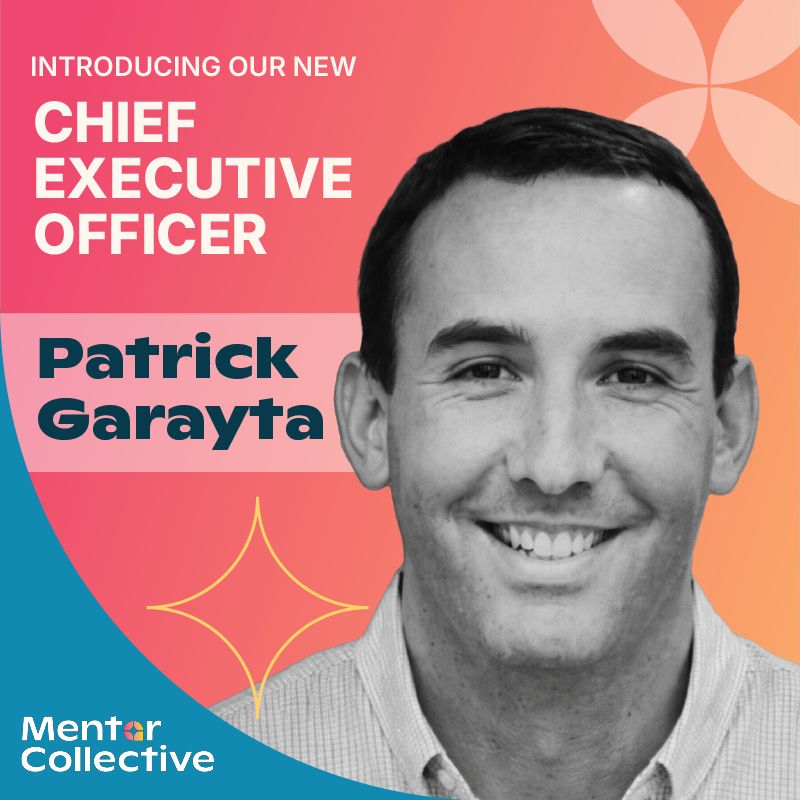
Patrick Garayta has spent his professional life around the systems that promise an answer. Since 2003, his résumé has passed through student services, digital learning, educational publishing, community education, volunteer software and workforce learning. In April 2026, the Baltimore-area executive became chief executive of Mentor Collective. The title put him in charge of a technology company. The job put him in charge of a paradox.
Mentorship works because it is personal. Institutions want it because it might be repeatable. A conversation can steady one student; a college needs to know how to arrange thousands of conversations, train the people having them, notice when they stall and understand whether any of it made a difference. The moment a relationship acquires a dashboard, everyone sensible becomes a little suspicious.
“I see an opportunity to partner with institutions to drive increased academic and career outcomes via mentorship.”Patrick Garayta, on becoming CEO of Mentor Collective
The long apprenticeship in scale
Garayta did not arrive at that paradox from a faculty office or a campus counseling center. His public record is the record of an operator. He began at Presidium Learning, a student-services company that Blackboard acquired. He stayed in that orbit for more than a decade, working on technology and service arrangements with colleges. One project still attached to his professional profile is a 2010 enterprise help desk at Hillsborough Community College. The reported results were the kind an operator keeps: financial-aid turnaround cut by half, staff productivity up 56 percent, first-call resolution rising from 20 percent to 91 percent.
Numbers like those are neat. Student life is not. But they show the early version of a theme that has followed Garayta: support only counts when it arrives in time and can survive institutional scale. The glamorous part of education technology may be the product demo. The consequential part is often whether somebody gets a useful answer before frustration hardens into departure.
After Presidium came Flat World Education, then senior roles at Blackboard and EVERFI. In 2021, Garayta moved to SignUpGenius as chief revenue officer. The product was different, but its quiet concern was familiar: how do you persuade a large, loosely connected group of people to show up for a specific purpose? At Skillsoft, he later led global go-to-market strategy and execution for the Global Knowledge business. Across the moves, the language grew more corporate - revenue, transformation, execution - while the underlying work remained organized participation.
Former colleagues describe the person inside that vocabulary. One praised his ability to build personal relationships and reduce the damage caused by disagreement. Another noted his willingness to learn and the clarity of his view of higher education. Testimonials are not neutral documents, of course. Nobody requests a recommendation from a sworn enemy. Still, the themes are strikingly well suited to his new brief: maintain a relationship through friction, keep learning, understand the institution.
A relationship is not a software installation
Mentor Collective describes itself as a mentorship operating system. The phrase is efficient, fashionable and slightly cheeky. Operating systems are meant to be invisible, reliable and everywhere. Mentorship is visible, variable and occasionally awkward. An operating system does not worry that its opening question sounded foolish. A first-year student does.
The company’s work is to handle the conditions around the relationship: recruiting participants, matching them, training mentors, prompting useful exchanges and giving institutions information about engagement. Mentor Collective says it has supported more than one million participants across more than 200 partnerships. Its scope extends across first-year students, transfer students, graduate students, online learners and alumni, each group arriving with different reasons to reach out and different reasons not to.
The attraction for colleges is not mysterious. A student who feels known is more likely to ask for help. A student who asks may learn where the tutoring center is, how transfer credits work, which professor is approachable or whether everyone else also found week three bewildering. None of these exchanges requires an algorithm. Getting the right people into the exchange, at the right moment and in enough numbers, can.
This is where Garayta’s sales background becomes relevant. A campus contract is only the prologue. A program must fit existing workflows, earn the confidence of administrators, attract mentors, persuade students to participate and produce evidence clear enough to defend the budget next year. The customer is an institution; the experience belongs to two people. Serving both without confusing them is the trick.
The software can arrange the meeting. It cannot make either person care.
The ambition inside “done the right way”
Garayta’s language on taking the role was revealingly qualified. Mentorship, he said, can unlock student success “if done the right way.” That small clause carries most of the burden. A poor match wastes time. An untrained mentor may offer confidence when a referral is needed, or advice when listening would do. An institution can celebrate participation while missing the people who never joined. Scale can spread a good practice, and it can spread an empty one with remarkable efficiency.
His immediate context is a company with a decade of program history, a national roster of college partners and a business that has appeared on the Inc. 5000 for seven consecutive years through 2026. It also sits inside a difficult market. Colleges face pressure to prove value, retain students and connect education with work. Budget committees prefer measurable interventions. Students prefer not to feel like interventions.
There is also a question of timing. Support offered after a student has decided to leave is a condolence disguised as a program. Support offered before any difficulty appears can feel generic and easy to ignore. The useful window lies between those points, when a concern is real but still movable. Matching software, engagement signals and program prompts can help identify that window. A mentor still has to enter it with tact. Garayta has described the desired model as scalable, efficient and sustainable. The more revealing adjective may be timely.
His Baltimore base gives the assignment another modern wrinkle. Mentor Collective’s public identity spans Boston, where it has long maintained its headquarters, and Wilmington, Delaware, where the 2026 appointment was announced. Its partners are spread across the country. Garayta is therefore leading a network business as a networked executive, less defined by a corner office than by conversations among campuses, staff, investors and institutional buyers. It is an appropriately distributed arrangement for a company whose central claim is that distance need not prevent a consequential connection.
Garayta’s task joins growth with translation. He must translate belonging into an institutional priority without draining the word of warmth. He must translate conversations into useful data without turning confidences into commodities. He must translate software into support while remembering that no student ever felt reassured by a feature list.
There is a restrained pragmatism in this career turn. Garayta has not claimed to invent mentorship, nor could anyone with a straight face. He has chosen the less theatrical problem of distribution. Valuable relationships have always existed on campuses. They have also been unevenly available, often favoring the student already comfortable knocking on a door. Designing an invitation does not cheapen the connection that follows. Done thoughtfully, it gives more people permission to begin.
Someone to ask
The best way to understand Garayta’s new job may be to return to that 1 a.m. question. The portal may contain the answer. The handbook may contain it twice. A chatbot may produce it in four seconds. Yet people often need more than information. They need context, reassurance and a person willing to say what happens next.
Technology companies tend to advertise the elimination of friction. Mentorship keeps a little friction on purpose. Two strangers must decide to speak honestly. A mentor must resist the temptation to perform wisdom. A mentee must risk asking the question beneath the question. There will be pauses, mismatches and messages answered later than anyone would like. Human beings remain stubbornly human, a product characteristic no release note has yet corrected.
Garayta’s career has trained him to value the system: the help desk, the platform, the go-to-market plan, the measurable outcome. Mentor Collective asks him to value the moment the system is supposed to enable. Success will look less like software than like a student sending a message, receiving a thoughtful reply and taking the next step with a little more confidence.
Colleges have enough portals. Garayta is betting they need more doors - and, on the other side, somebody who answers.