Kevin Rockmael began his marketing career in 1999, when a browser was still a place you went to look at the web and an online exam sounded faintly experimental. His first stop was Kaplan. More than a quarter-century later, he is helping Proctorio explain what it means to take a credible test when software can write an answer, imitate the act of writing it and manufacture a tidy digital trail along the way. The technology has changed. The assignment has remained stubbornly human: persuade people that an institution deserves their trust.
That assignment has carried Rockmael through a remarkably neat cross-section of the modern learning economy. Test preparation gave way to international education at Intrax. Then came narrative analytics at Monitor 360, video-based learning at Practice, education strategy at Entangled Solutions, an employer-funded learning marketplace at Guild Education and leadership development at Sounding Board. Today he works as a fractional chief marketing officer at Proctorio while also serving as CMO of Untapped Learning, which coaches students on the practical machinery of school: planning, organization and follow-through.
A resume like that can look restless from a distance. Up close, it is unusually consistent. Every company sits between a person and a hoped-for change. Pass the test. Study abroad. Learn the skill. Become the leader. Prove the work is yours. Rockmael has made a career in the awkward middle, where a promise meets the person asked to believe it.
A sociologist walks into a marketing meeting
Rockmael studied political science at UC Santa Barbara, then earned both a master's degree in sociology and an MBA at the University of Chicago. The combination looks almost too apt in retrospect. Business school asks how organizations compete. Sociology asks why groups behave, how institutions hold power and which assumptions become normal through repetition. A good education marketer eventually has to answer both.
He spent four years directing marketing at Kaplan before joining Intrax, where he became senior vice president of marketing and product development. Nine years at one organization is the long chapter in his chronology. It also placed him inside education before the sector adopted the polished language of platforms, ecosystems and seamless journeys. Families still had questions that no funnel could solve. Students crossed borders, not merely landing pages.
At Monitor 360, later known as Protagonist, his subject became narrative itself: how people make meaning and how organizations understand the stories moving a market. Then came Practice, a video-learning company acquired by Instructure, and Entangled Solutions, an education innovation firm later acquired by Guild. These were different products, yet each rewarded the same habit. Listen for the vocabulary people already use. Find the belief under the objection. Do not confuse a slogan with an explanation.
The acquisitions matter because they changed the audience without ending the work. A startup marketer can address a compact room in which product, sales and leadership share the same lunch table. Inside a larger company, every sentence must travel farther. It passes through legal review, sales enablement, customer success, senior leadership and, eventually, the people using the product. Practice becoming part of Instructure and Entangled becoming part of Guild gave Rockmael two versions of that passage. His later Guild title, head of marketing for the Learning Marketplace, sounds tidy. The marketplace itself was anything but. Employers wanted evidence that education benefits served business goals. Learning providers wanted students who could persist. Workers wanted programs worth fitting around jobs and families. Marketing had to hold all three claims without pretending they were the same claim. That is less like writing an advertisement than editing a difficult conversation.
The work between the jobs
The quieter entries reveal as much as the executive titles. Rockmael has mentored and advised MBA candidates through UCLA's Riordan MBA Fellows Program since 2021. At Guild, while leading marketing for the learning marketplace, he helped establish the Disability Action Community employee group and served as its chair. A colleague later described him as an advocate, problem solver and connector who gave the new community a mission and visibility.
He also served as an advisor and board member to Integrate Autism Employment Advisors, an organization that helps employers recruit and retain professionals too often filtered out by conventional hiring. His public essays extend the same concern beyond any one company. One argued that employers should build durable education-to-work pathways instead of treating labor shortages with temporary incentives. That piece traveled farther than an ordinary corporate article: it was later cited in civil-rights testimony submitted to the federal employment commission.
“We have an opportunity and a moral responsibility to find sustainable solutions.”Kevin Rockmael, writing on education and employment
The line is useful because it captures his preference for systems over sentiment. Mentoring helps one candidate. A program changes the odds for a cohort. An employee group creates a place where colleagues can find one another. A hiring practice can keep a door open after the original advocate leaves. Marketing often gets caricatured as the manufacture of appetite. Rockmael's version is more architectural: make the institution intelligible, then ask whether it has built the doorway promised in the copy.
From leadership gaps to proof gaps
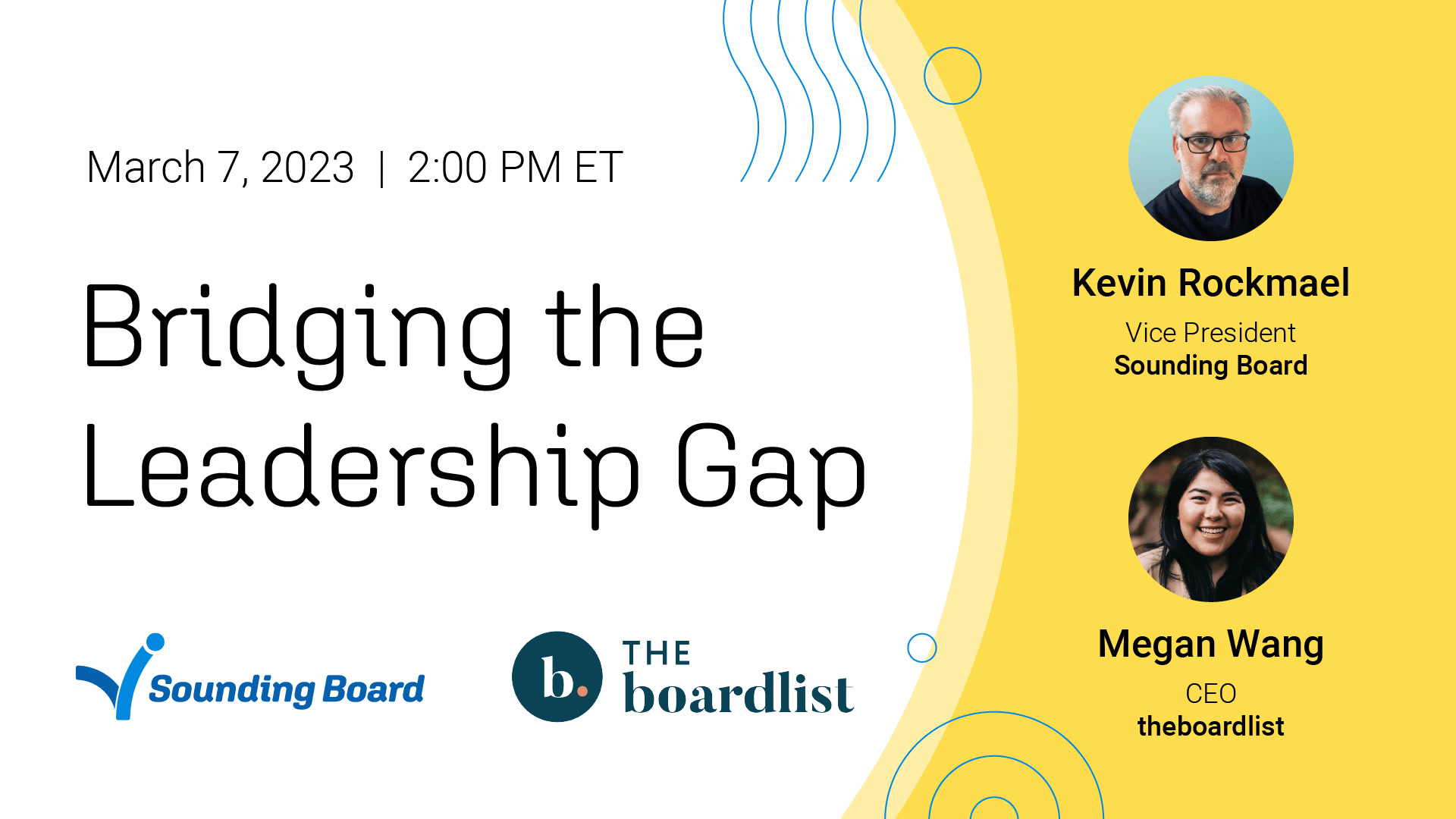
Sounding Board brought those interests together. As vice president of marketing, Rockmael worked on leadership development and argued publicly that coaching, mentoring, governance exposure and board service should be durable parts of how companies develop people. In a 2023 webinar with theBoardlist chief executive Megan Wang, the conversation ranged across retention, representation, succession and strategic thinking. The premise was pleasantly inconvenient: companies cannot complain about a leadership shortage while treating leadership development as a perk reserved for people who already look inevitable.
His next chapters were shorter and explicitly fractional: an interim marketing role at Blueprint, a year with Higher Ed Insight, then concurrent work with Untapped Learning and Proctorio. Fractional leadership suits a career built on translation. The executive enters with enough distance to notice the house language, but enough authority to change it.
Proctorio presents the sharpest version of the trust brief. Remote assessment is a practical answer to distance and scale, but it arrives inside a debate about privacy, fairness, human judgment and the limits of automated monitoring. Rockmael's writing states the company's case while acknowledging that implementation needs boundaries: clarity about what is monitored, institutional control of data and people making final decisions.
“Does this reflect genuine human effort?”
By 2026, his subject had moved beyond generated essays. He wrote about software that simulates the process of work: gradual typing, pauses, revisions and version histories designed to look convincingly human. The old question asked whether AI produced the answer. The emerging question asks whether the visible process proves anything at all. His proposed response is layered rather than theatrical, combining assessment design, identity verification, behavioral signals, faculty training and clear rules.
That position has critics, as any position in remote proctoring does. Proctorio itself has faced sustained scrutiny and litigation over its methods and conduct. Rockmael became a company spokesman in the 2025 settlement of a long-running case involving a librarian who had shared company videos. It is a reminder that trust cannot be treated as a mood created by messaging. The company asking students and institutions to accept scrutiny is scrutinized in return. Marketing does not resolve that tension. It has to speak inside it.
The same argument, in different rooms
At two conferences in 2026, Rockmael noticed that credentialing professionals and academic-integrity specialists discussed the same AI-era problem in different dialects. One room leaned toward security, fraud and verification. The other talked about pedagogy, learning and student conduct. Neither vocabulary was sufficient alone. His observation sounds like the sociologist in the marketing meeting again: before a group can agree on a solution, somebody has to notice that its words carry different assumptions.
This may be the durable skill across his career. Rockmael has worked in education long enough to distrust simple translations. A student is not a user with a backpack. A credential is not merely a conversion event. A learning marketplace contains workers, employers and schools whose incentives overlap without becoming identical. A trustworthy assessment must protect the meaning of a result without forgetting the person producing it.
The two current roles make a telling pair. Untapped Learning begins with the student who needs structure to do the work. Proctorio begins with the institution that needs confidence the work is authentic. One supports the process; the other protects the proof. Between them sits nearly three decades of Rockmael's professional life, spent asking institutions to say what they mean and mean what they sell.
Trust remains an inconvenient product. It cannot be downloaded, announced or installed through a browser extension. It accumulates when promises survive experience. That makes it slow, vulnerable and rather unfashionable. It also gives Kevin Rockmael the same difficult brief he started with, now under brighter lights: explain the institution, widen its doorway and leave the claim sturdy enough for people to test.