The most consequential check in Alex Pritchett's career was also one of the smallest. It was worth $600, the price Durham Public Schools agreed to pay in 2013 for a pilot that would help 60 freshmen at Southern High School schedule tutoring. For a pair of aspiring founders, it was not runway. It was barely taxi fare. But it did something capital alone cannot do: it turned a private conviction into a public transaction.
“Six hundred dollars! That felt like real validation!” Pritchett would later recall. The exclamation points earned their keep. Until then, the company that became Upswing had existed largely as conversation, after-hours labor and stubbornness. Pritchett worked days at a software company, then spent nights and weekends developing the first product with Melvin Hines. The founders knew the problem before they knew the product. College students had support available to them, but availability and access were not the same thing.
Their working headquarters had begun as an empty room in a shared house. They called it the brainstorming room, a charmingly literal name for a place in which two friends tried to redesign a corner of American education. There was no creation myth involving a mahogany table or a prophetic whiteboard. There was simply unused domestic square footage and a question: could technology make it easier for students to reach the people already trying to help them?
A social entrepreneur before the software
Pritchett had already learned that a useful resource can remain useless if people cannot comfortably reach it. At the University of North Carolina at Chapel Hill, where he studied business administration at Kenan-Flagler, he started a mentoring organization for Latino youth. He was also among the students who helped launch the Community Empowerment Fund in 2009.
CEF began by pairing interest-free microloans with practical education and personal support for people facing homelessness and poverty. Pritchett coordinated its small-business incubation work, designing weekly lessons on subjects such as business plans and bookkeeping while organizing student volunteer consultants. The mechanics mattered, but so did the company around the mechanics. A loan without guidance could be another form to complete; guidance without capital could be a sympathetic conversation with nowhere to go.
That logic followed him into higher education. Tutoring hours, advisors and other campus resources might technically exist, yet a commuter leaving a late shift or a first-generation student unsure whom to ask could still experience the institution as a maze. Pritchett's operator instinct was to work on the corridors: scheduling, communication, timely prompts and the unglamorous connective tissue between need and help.
The bargain-basement launch
The first Upswing product was assembled with the thrift of people who had more resolve than cash. Its web-hosting package, bought on eBay for about nine dollars, went down within a week of the school program's start. The timing had a certain comic purity. The founders could not access the system they were meant to demonstrate. Then, on the morning before launch, the host returned. They walked into the school and behaved as though nothing alarming had happened, which is one definition of early-stage customer service.
The pilot gave them enough confidence to leave their jobs. They took personal loans, accepted small contributions from friends and family, and emptied savings into the company. Groundwork Labs offered shared space in Durham and a place to refine the model. Four months there led to a downtown office, but an office is excellent at making a young company look official while also reminding its founders that rent is due.
They sought an accelerator that could provide money, advice and introductions. A local program rejected Upswing three times. Repetition can turn disappointment into weather: unpleasant, familiar and no longer sufficient reason to stay indoors. Hines sent a video to Tech Wildcatters in Dallas. The accelerator accepted them, but sent the acceptance letter to the wrong company. Five days after the deadline, the error surfaced. Suddenly, the founders had four days to decide whether to move across the country for three months.
A company measured first in rooms, then in miles
Four days and 1,100 miles
There was a reasonable alternative. A local entrepreneur offered comparable backing without requiring them to leave North Carolina. Pritchett and Hines talked through the night, declined the nearby offer, packed and drove roughly 1,100 miles to Dallas. It was a journey with all the cinematic ingredients except a sensible production budget.
The road mattered because it changed the founders' reference group. In Dallas, companies that had seemed intimidating from a distance turned out to be built by ordinary people managing ordinary uncertainty. During the program, Upswing merged with YourSigma, led by Chris Webb and Morgan Intrator, adding technical depth to Pritchett and Hines's education and business knowledge. When the accelerator ended, the team moved to Austin and continued building.
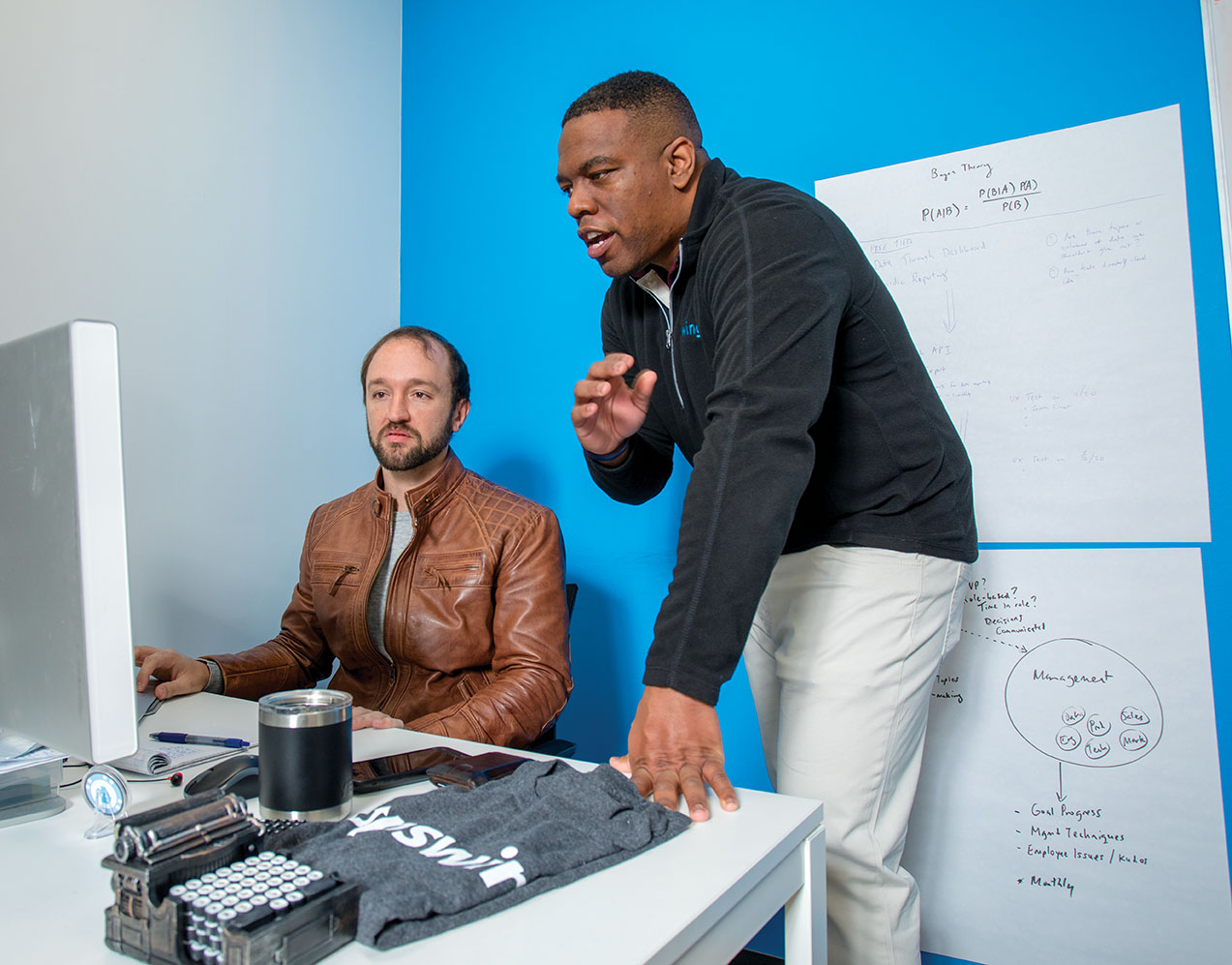
The product widened with the problem. The early tutoring scheduler became part of a broader platform through which colleges could coordinate tutoring, assignment review, advising and proactive student communication. By 2019, Upswing worked with more than 80 institutions and its services were available to about 700,000 students. In 2024, the company said it had extended support to more than 800,000 students nationwide.
Numbers of that size can become decor. The sharper point is who sits inside them. Upswing has concentrated on institutions serving adult learners, first-generation students, commuters and others whose college lives do not resemble the residential ideal pictured in admissions brochures. A student with work, children or a long bus ride does not necessarily need another portal. That student needs the right door to open before there is time to give up knocking.
The operating thesis
Support is not merely a service a college owns. It is a service a student can find, enter and use at the moment it matters. Upswing's work has been to shorten the distance between those two definitions.
What happens after the first hire
Pritchett's most revealing observation about company-building concerns neither code nor capital. The arrival of employees, he has said, changes the mental bargain. An idea that founders want to make work becomes an institution they need to make sustainable for the people who have chosen to believe in it. The romance drains away just as the responsibility arrives.
That is the COO's part of the story. Hines has often been the public storyteller of Upswing's mission; Pritchett has occupied the operational hinge between promise and delivery. His early essays reveal a mind fond of analogies, borrowing lessons for education from automobiles, trains and even the tortoise and the hare. The comparisons are playful, but the habit beneath them is serious: look elsewhere for systems that move people reliably, then ask what education can steal.
The company accumulated the conventional markers of progress. It graduated from Groundwork Labs and Tech Wildcatters, won an NC IDEA grant, joined the United Way GroundFloor fellowship and raised institutional capital. A 2024 investment of $2.6 million from Social Finance gave it more room to serve colleges whose students often sit outside the traditional 18-to-22-year-old model.
Yet the $600 contract remains the better symbol. Large rounds validate a company that already exists. The tiny check validated a possibility. It arrived when the software was fragile, the founders were dividing their lives into day jobs and night work, and no one could honestly promise that the next customer would appear.
The useful distance between idealism and operations
Pritchett's career has held one tension in productive balance. He is a social entrepreneur, animated by access and fairness, and an operator, preoccupied with the systems that survive good intentions. Either identity alone would be easier. Idealism can remain spotless when it never meets a service-level agreement. Operations can remain efficient when nobody asks whom the efficiency serves.
Upswing's history is the negotiation between them. Start with an unfair gap. Build a crude tool. Watch the host crash. Repair, measure, hire, raise money, widen the product and keep asking whether students actually reach the help. The sequence is less poetic than the mission statement. It is also how mission statements acquire consequences.
Today, Pritchett is again based in Durham, the city of that first school contract. The geography makes a neat circle, though the work does not. Higher education continues to wrestle with engagement, retention and the needs of students whose lives refuse to fit a traditional timetable. Software cannot settle those questions by itself. It can, at its best, make a useful human response easier to deliver.
The spare room is long gone. The nine-dollar host has presumably been granted an honorable retirement. But the founding discipline survives: begin with the person who cannot reach what already exists, then build the bridge carefully enough that people can trust its weight.