The trouble at Florida A&M’s pharmacy school was hiding in a small administrative detail: the tags attached to exam questions. A tag says what a question measures. Without it, a school can know that a student answered incorrectly yet struggle to see which competency needs attention. The examination has produced a score. The curriculum has acquired a blind spot.
- Enflux joins assessment, course and clinical data in one place.
- Its customers are academic programs, particularly health professions schools.
- Dashboards reveal patterns; ActionPlans document what people do about them.
The missing tag, not the missing lesson
In Enflux’s published Florida A&M case study, 73% of faculty had not tagged all their exam questions. The college adopted the platform in 2019, and its dashboards made the omissions visible. Administrators set a deadline, issued weekly ActionPlans and arranged targeted training. The school ultimately reported complete tagging compliance across four categories.
That sequence deserves attention. Software revealed a problem; people changed a practice. A curriculum can look deficient because its evidence is deficient. Before commissioning another committee to rewrite the teaching, it might be sensible to check whether anyone has labelled the questions.
“I liked the product immediately because it can display on dashboards all the information we need to track.”
Florida A&M Executive Director of IT
Fake followers, real students
Enflux arrived at this problem by a peculiar route. Founded in 2015 by Cameron Powell and Avery Booker, it originally analysed social-media audiences for luxury retailers, including detecting fake followers. Alejandra Zertuche joined in 2017 with experience in academic assessment at the University of the Incarnate Word’s pharmacy school. She recognised a familiar burden: institutions collecting evidence from disconnected systems for accreditation.
UIW pharmacy and Texas A&M medicine became early customers in 2017. By January 2018, the company had shifted to university accreditation with Zertuche as CEO. The useful lesson in that turn is about proximity. A person who knew the work could identify where analytics belonged. The opportunity was lodged in an administrator’s routine.

The place between the systems
A professional school already has software. Canvas holds course information. ExamSoft holds assessment results. Clinical education systems hold another portion of a student’s progress. Surveys and licensing-exam reports add further evidence. Each may serve its purpose perfectly well. The difficulty begins when an advisor wants to understand the student across all of them.
Enflux sells a cloud-based subscription that connects these records and presents program, course and student views. Its listed partners include ExamSoft, Canvas, CORE Higher Education Group, Blackboard and PeopleAdmin. This places it between the systems generating evidence and the academic leaders expected to interpret it. Institutions buy integration, configured reporting and support, alongside the dashboards.
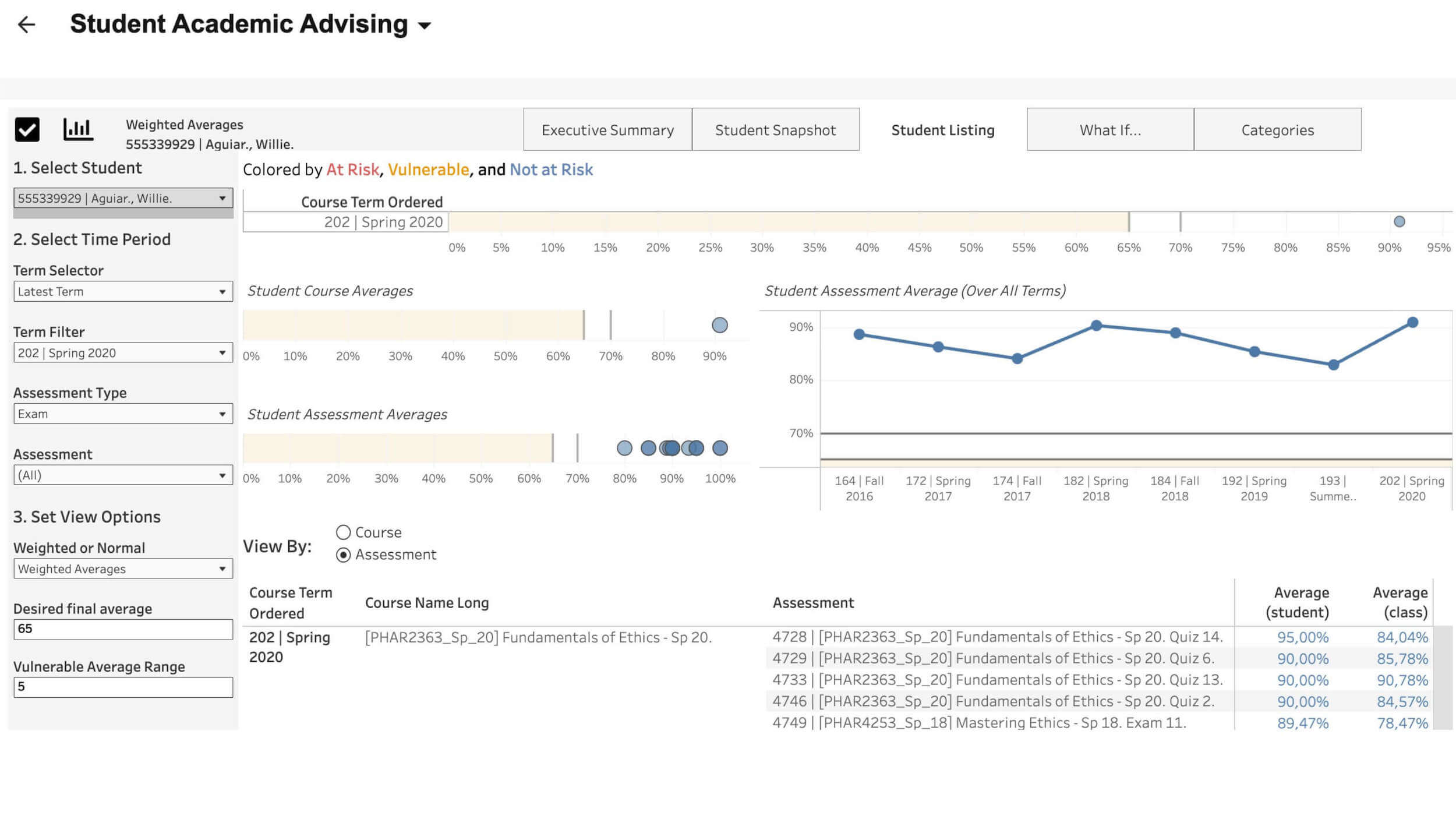
The company reports serving more than 100 academic programs across over 15 health sciences disciplines, reaching more than 132,000 students. Those are company-reported reach figures. Pharmacy, nursing, medicine, physician assistant and physical therapy programs are among its target users. Assessment directors and deans are buying a clearer view of the work already happening.
CompetencyGenie tackles an earlier stage in that chain. Announced with ExamSoft by Turnitin in August 2024, its Chrome extension assists exam-item classification against cognitive and discipline-specific frameworks. Enflux also offers bulk tagging inside its platform. This is AI assigned a fairly modest, useful occupation: helping classify the evidence that later feeds curriculum analysis.
A dashboard needs somebody to answer
At Palm Beach Atlantic’s pharmacy school, Yolanda Hardy had been pulling, cleaning and merging spreadsheets before she could contact students. The school began working with Enflux in 2021. Its case study describes consolidated data, daily refreshes and outreach in the week after an exam. The benefit is partly a change in timing: less preparation before the conversation begins.
ActionPlans adds a record of the response. Staff can assign work, attach evidence and track progress. At the University of Louisiana Monroe, the same mechanism supports strategic initiatives. A task can move to a new assignee when someone changes roles, carrying its documents along. Institutional memory gets a little less dependent on a particular inbox.
- 01Connect
the records - 02Review
the pattern - 03Assign
the response - 04Reassess
the outcome
Charleston’s pharmacy school offers another example. With one assessment administrator, it adopted Enflux in 2021 to support advising and accreditation work. Its published case reports 100% student retention and a 6% reduction in course failures in 2024, alongside eight-year reaccreditation. These outcomes belong to a school’s combined effort. They do not establish how much improvement the software alone caused.
Buy the workflow, then the software
The financial commitment has two sides. Enflux raised more than $3 million from 21 investors in 2019, according to contemporary reporting. For a school evaluating the product, the practical cost also includes organising integrations, agreeing definitions and training users. Enflux says most customers finish onboarding within 30 days; internal alignment affects that schedule.
A useful evaluation would choose a recurring decision, such as advising after the first examination, and follow it through a demonstration. Can staff find the right records? Do they understand the categories? Who owns the next action? Would the process continue if the assessment director left? These questions are more revealing than counting dashboard tiles.
There are limits. Incorrect tags still need correction. A risk signal requires interpretation and somebody available to help. Enflux’s current physician assistant material explicitly presents PANCE readiness predictions as support for faculty judgment. Its curriculum-mapping guidance stresses refreshing the evidence as courses and outcomes change. Buying software does not settle those responsibilities.
Readers can copy the underlying habit without buying anything: connect the relevant evidence, name the person responsible, document the response and check what happened next. Enflux’s appeal is that it gives this habit a place to live. The student was already in the records. The challenge was arranging the records so someone could notice.