Company Profile • Edtech & Student Success
The Startup That Texts College Dropouts Before They Drop Out
Melvin Hines was one of 68 kids in his high school class to graduate. He built Upswing so the other students - the adult learners, the first-gen, the ones nobody texts back - get a fair shot at the finish line.
Most college software is built for a student who does not need much help: the eighteen-year-old who moved into a dorm, has a meal plan, and shows up to office hours. Upswing built for everyone else. The Durham, North Carolina company sells colleges a single online front door for student support - tutoring, advising, mental health, writing help, early alerts - and wires a text-message assistant named Ana on top of it, aimed squarely at the students most likely to disappear from the roster before graduation.
The pitch is almost boring in its logic. Students rarely skip help because they are lazy. They skip it because help is scattered across ten different campus offices, each with its own hours, its own login, its own line. A working adult taking two night classes does not have the time or the map to find it. Upswing's answer is to consolidate the whole thing and then, crucially, to reach out first - by text, before the student has decided they are done.
01 / The founderA kid who was one of 68
Melvin Hines grew up in south Georgia and was one of only 68 students in a class of roughly 250 to graduate high school. He went on to the University of Georgia and then to Duke, where he collected both a law degree and an MBA and, for a while, taught law. The origin story is not decoration - it is the company's operating thesis. Hines has said plainly that he started Upswing "to help students from communities like mine get a fair opportunity at upward mobility."
He built it with Alex Pritchett, his roommate at Duke's Fuqua School of Business. The two worked nearly a year without pay before a startup boot camp finally accepted them. That unglamorous beginning is a detail the company still tells on itself, and it tracks with how the product is designed: for people who do not start with a cushion.
02 / The productOne login, and a text from Ana
The platform stitches together the services a struggling student would otherwise have to chase separately. There is 24/7 online tutoring, staffed either by the college's own tutors or Upswing's. There is written assignment review, with feedback typically returned within about 48 hours. There is advising with online scheduling, an early-alert system so staff can flag at-risk students, a citation and writing toolkit, and - added around the 2021 fundraise - one-on-one mental health support delivered confidentially.
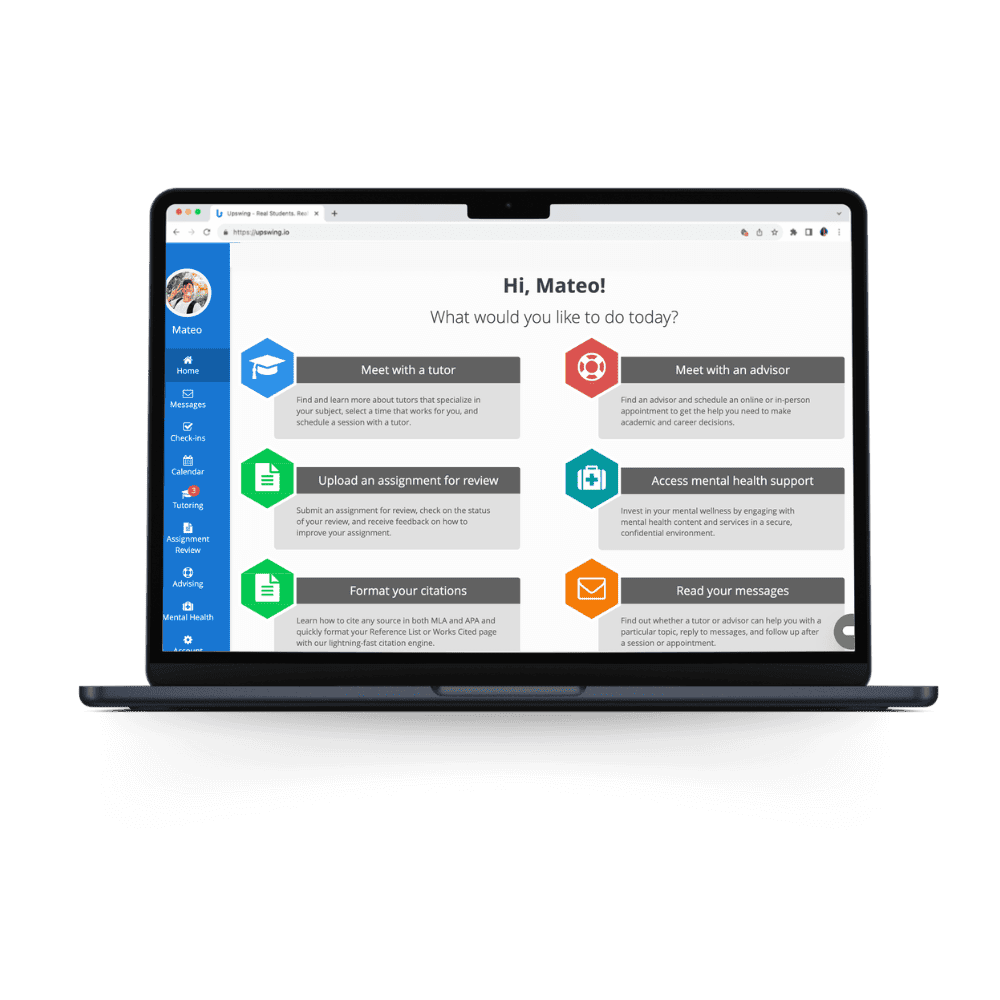
The part that makes people lean in is Ana, the SMS virtual assistant. Instead of waiting for a student to remember a portal exists, Ana texts them - reminders, encouragement, a nudge toward a resource, an offer to book a tutoring slot. No app to download, no new password. For the non-traditional students Upswing serves, that single design choice is close to the whole game. Ana even has her own Instagram handle, @anabyupswing.
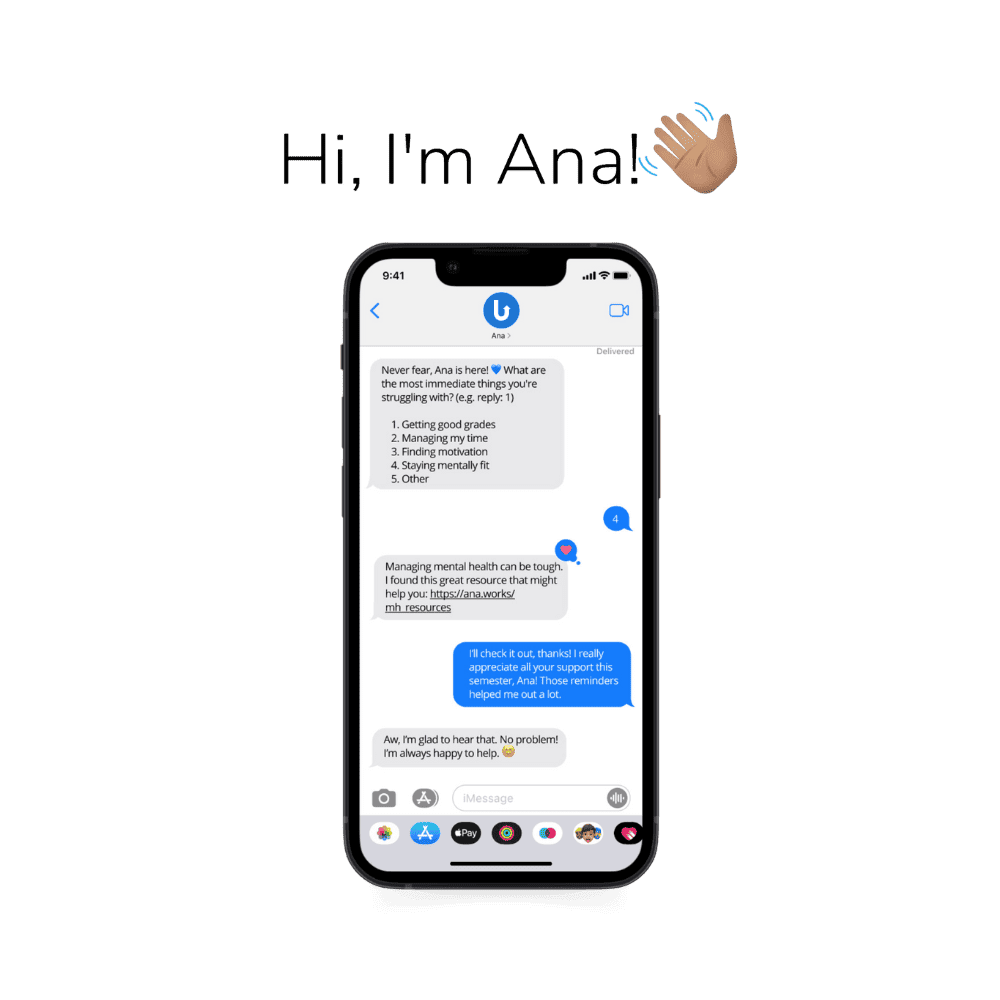
Ana (SMS assistant)
Proactive text outreach that nudges, encourages and books tutoring or advising - no app required.
Tutoring & review
24/7 online tutoring plus written assignment feedback, usually back within about 48 hours.
Advising & early alerts
Online scheduling and at-risk flags so staff can step in before a student disengages.
Mental health
Confidential one-on-one support and wellness content, added around the Series A.
03 / The customersBuilt for the students most software forgets
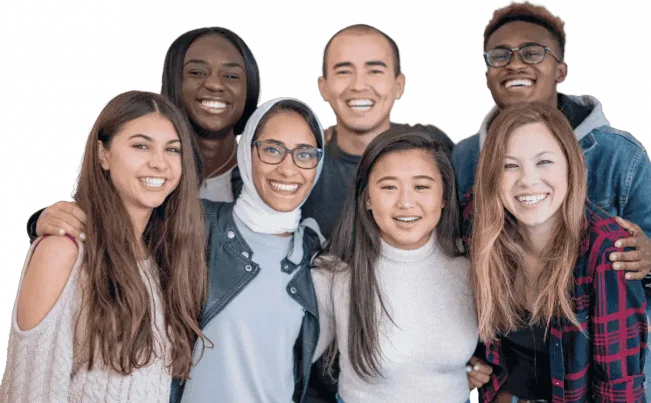
Upswing sells to community colleges, four-year universities, trade schools and nonprofits, but its center of gravity is the minority-serving institution. By the company's own accounting, roughly half of its customers are Historically Black Colleges and Universities or Hispanic-Serving Institutions. That is not a coincidence of sales luck; it is the strategy. The students it is designed for are first-generation, adult, veteran, low-income, and student-parents - the ones for whom one missed deadline or one unanswered question can end an enrollment.
Accessibility runs deeper than a compliance checkbox. The platform is designed against WCAG guidelines, sessions carry built-in alt text, audio and chat, and the company has made a point of hiring coaches who themselves have disabilities. As Hines has put it, "we can never have equity in education or technology if those crafting the technology don't have the requisite backgrounds and experiences."
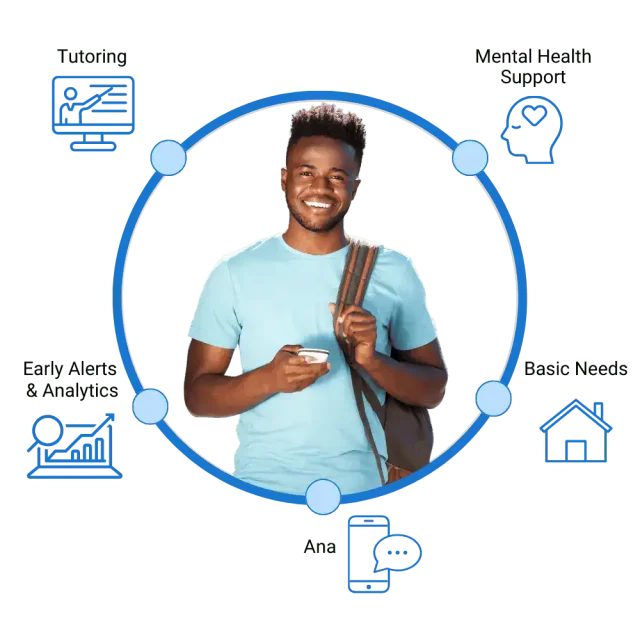
The whole thing in one diagram
Upswing's word for its approach is "holistic" or "wraparound" - academic help and non-academic help in the same place. Tutoring, mental health, basic-needs resources, early alerts and Ana all orbit a single student.
04 / The differenceDashboards for deans, or a lifeline for students
The student-success software market is crowded. EAB's Navigate and Starfish, Civitas Learning, ConexED and a wave of tutoring vendors all compete for the same college budgets. Most of them sell up: analytics and dashboards designed for administrators to watch cohorts and predict risk. Useful, but the student never touches them.
Upswing points the telescope the other way. Its surface is the thing the student actually uses, and its outreach - the text from Ana - is the product doing the work an overstretched advising office cannot. Same market, opposite end. That framing is also why the company reads as an impact business as much as an edtech one.
05 / The modelFree for students, paid by the college
Upswing is a B2B2C business: the college or university buys an institutional subscription, and the platform is free to every student on campus. The quietly clever part is how colleges pay. Institutions frequently fund Upswing through federal and philanthropic grants - Title III and Title V, pandemic-era HEERF dollars, minority-serving-institution programs. In effect, the company turned the compliance and student-success budget into a buying channel, which is part of why its customer base skews toward the institutions those grants are meant to help.
06 / The backersWhen JPMorgan and impact funds share a cap table
Upswing has raised roughly $13 million over a decade, and the investor list is a tell. Early money came from the Charlotte Angel Fund and, in 2017, Rethink Capital Partners and the Lumina Foundation. A Series A of more than $5 million in 2021 was co-led by Imaginable Futures and JPMorgan Chase, with Bonsal Capital, Sustain VC, Impact America Fund and Lumina joining. In September 2024, Social Finance's UP Fund added a $2.6 million catalytic investment plus a working-capital loan. Blue-chip banks and mission-first impact funds do not usually crowd onto the same line unless a company sits credibly in both worlds.
07 / The market fitWhat a reader can actually take from this
Strip Upswing down and there are a few moves worth copying. First: meet users where they already are. Betting the outreach layer on plain SMS rather than an app is the difference between a tool that exists and a tool that gets used. Second: pick the customer everyone else deprioritizes. Serving HBCUs and HSIs first was both a mission and a wedge into a market the enterprise incumbents treat as an afterthought. Third: fund the buyer. If your customer has grant money earmarked for exactly the outcome you produce, help them spend it.
The honest caveats matter too. Retention software is notoriously hard to prove - vendor numbers deserve a skeptical read, and Upswing's exact figures on students retained and dropouts prevented should be treated as company claims rather than audited results. The approach works best where an institution genuinely serves non-traditional students and can route grant dollars to it; a selective, well-resourced campus has less to gain. But as a study in building for the overlooked, Upswing is a clean one.
Ten years in, that is the shape of the company: not a dashboard for deans, but a text to a student who was about to give up - sent, ideally, before they do.