Boston, Massachusetts · EdTech · Artificial Intelligence
The logo of a company that started by introducing nervous teenagers to slightly-less-nervous undergraduates, and now sells artificial intelligence to the people who decide who gets in.
CollegeVine
The free chancing calculator for a sixteen-year-old. The AI workforce for the admissions office. Same company, both sides of the desk.
The Dispatch · 2026
A bot picks up the phone in the admissions office
Somewhere in an enrollment office this week, a prospective student types a question at eleven at night - about financial aid, about a major, about whether anyone there speaks Portuguese. An answer comes back in seconds. It is personal, patient, and on-brand. It is also not a person. It is one of CollegeVine's AI agents, and at last count it had carried on more than half a million of these conversations across 95-plus campuses.
That is CollegeVine in 2026: a Boston company that quietly turned the most paperwork-heavy corner of education into something a fleet of AI agents can run. The students still get free tools. The colleges now get software that does the recruiting. The company sits in the middle, which is a comfortable place to sit if you can survive getting there.
"The free chancing calculator for a teenager and the enterprise AI for a university are the same product, viewed from two ends of the same anxiety."
- The throughline of CollegeVine's business
The Problem They Saw
Admissions runs on scarcity
College admissions has always been a market in advice. The families who can afford a private counselor buy clarity - which schools, which essays, which odds. Everyone else navigates by rumor. The students who most need a guide are the ones least likely to have one, and the system has been comfortable with that arrangement for a long time.
Meanwhile, the institutions on the other side were quietly drowning too. Tuition at public four-year colleges has climbed roughly 141% over two decades. Enrollment is falling. By some counts a college closes about once a week. Admissions teams are asked to recruit more students, faster, with smaller staffs - the textbook setup for either burnout or automation.
So there were two problems wearing the same coat: students without guidance, and institutions without enough hands. CollegeVine decided they were the same problem.
Two crises, one hallway. The student can't find help; the office can't afford to give it. Charming, in a bleak sort of way.
"Tuition is up 141% in twenty years and colleges close at a rate of one per week. CollegeVine treats that as a product spec, not a tragedy."
- On the cost crisis the company targets
The Founders' Bet
Three friends from one New Jersey high school
Zack Perkins, Johan Zhang and Vinay Bhaskara went to the same public high school in New Jersey. Two of them ended up at Harvard, one at the University of Chicago, and in 2013 they started pairing high schoolers with college mentors out of their dorm rooms. They called it Admissions Hero. It was, by the standards of the genre, a perfectly reasonable tutoring business.
The bet was that this did not have to stay a tutoring business. Perkins dropped out of Harvard as a sophomore in 2015 to work on it full time. The team moved into the Harvard Innovation Lab, where they met edtech veteran Jon Carson. In 2016 they rebranded to CollegeVine - a name about fit, not just getting in - and started building the thing that would actually scale: software.
The insight was unglamorous and correct. Mentorship doesn't scale; mentors are human and there are only so many of them. But the judgment mentors offer - your odds, your reach schools, your next move - is a data problem. Turn it into a model and you can hand it to millions of students for free. That model became the Chancing Engine.
The founders' yearbook would tell you they peaked early. The cap table would disagree.
"Mentorship doesn't scale. Judgment does - if you can turn it into math."
- The idea under the Chancing Engine
The Product
One platform, two front doors
Walk in the student door and everything is free. The Chancing Engine reads your grades, scores, background and activities and tells you your real odds at a given school - and, more usefully, how to move them. A school-list generator builds a balanced set of reaches and safeties. A scholarship finder surfaces money. A Q&A community lets you ask strangers who recently sat where you're sitting. None of it costs anything, which is either generous or a very large top of funnel, depending on your level of cynicism.
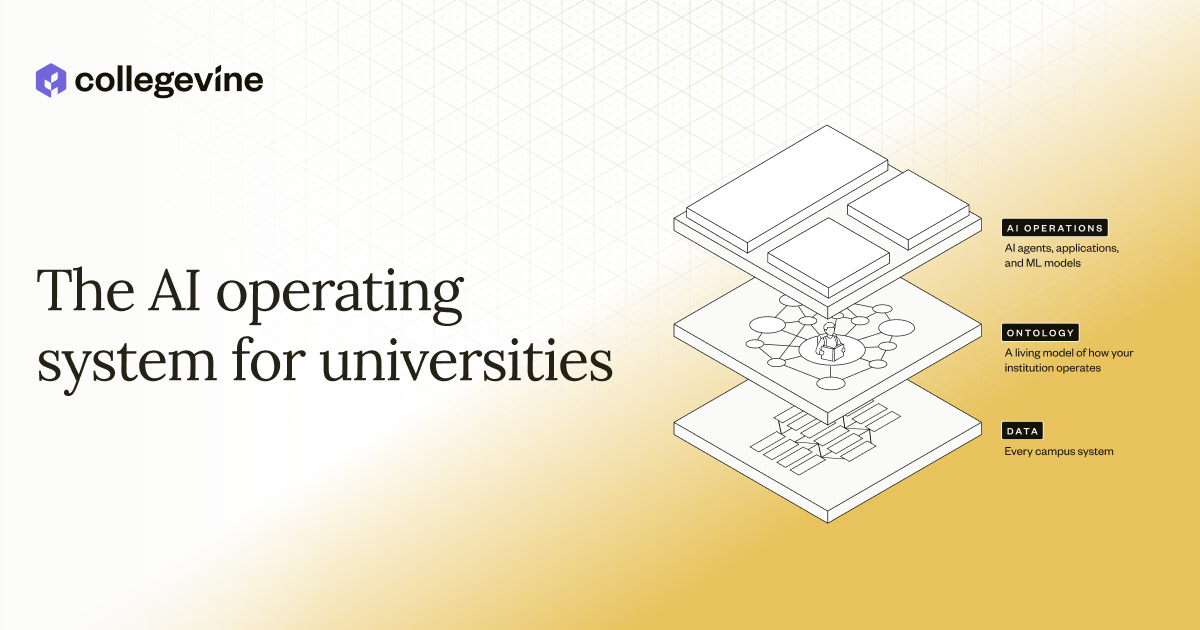
Walk in the college door and you meet the agents. The AI Recruiter runs hyper-personalized outreach to prospective students. The AI Advisor supports the ones already enrolled. The AI Ambassador keeps alumni in the loop. Three agents, one per stage of a student's life with an institution - and each one is the labor a stretched admissions office can no longer staff by hand.
Chancing Engine
ML-based admission odds, plus the moves that improve them. Free.
AI Recruiter
Personalized recruitment journeys for prospective students.
AI Advisor
Support and advising for currently enrolled students.
AI Ambassador
Alumni and community engagement, automated.
Free tools for the kid, paid agents for the college. The teenager is the product and the customer is the school - a business model with admirable nerve.
"Three agents, one for each stage of a student's life with a college. The org chart of an admissions office, rendered in software."
- On the AI agent platform
The Mission
Level the field, then lower the price
The founding line was simple: level the playing field of college admissions, regardless of socioeconomic status. That is why the consumer tools are free and always have been. A kid without a counselor gets the same odds, the same list, the same essay feedback channel as a kid whose family hired one.
The mission has since grown a second half. If the first crisis is that students can't get guidance, the second is that colleges can't afford to give it - and the bill lands on tuition. By making recruiting and advising cheaper for institutions, CollegeVine argues it is also fighting the cost that pushes higher education out of reach. Whether that argument holds depends on whether the savings reach students or just the budget. That's the open question, and the company knows it.
Backers have taken the bet seriously. Roughly $31M has come in from University Ventures, Morningside Ventures, Fidelity Investments and SVB Capital, among others. The company runs lean - around 90 employees - for the reach it claims.
"Free for the student who can't afford a counselor. Cheaper for the college that can't afford to lose one. The mission has two halves now."
- On leveling access and cutting cost
Why It Matters Tomorrow
Back to the office at eleven at night
Return to that admissions office. The student typing a question at eleven at night used to get silence until morning, if they got anything at all. Now they get an answer - personal, instant, in their language. The office that couldn't have stayed open that late didn't have to. The kid who would have given up didn't.
That is the change CollegeVine is selling, and the reason to watch it closely. If AI agents really do make recruiting cheaper and guidance universal, a thirteen-year pivot from dorm-room tutoring to enterprise software will have been worth it. If the savings just pad budgets while the agents quietly replace the humans who once did the caring, that's a different story. CollegeVine has put itself in a position to write either one.
The bot picks up the phone. What it says next is the whole company.