The first version worked. That was the trouble. A client wanted to upload files, ask questions in ordinary language, and get useful answers. Infocusp’s engineers built a local prototype in weeks. It could read a spreadsheet and draw a graph. Then came the questions a demonstration rarely answers: What does every request cost? What happens when the analyst invents the missing numbers? Where, exactly, is its Python code allowed to run?
- What you buy: engineering teams for AI, applications, data, cloud, and connected devices.
- Where it gets interesting: the handoffs between a sensor, an algorithm, and a usable product.
- What to borrow: measure complete requests, preserve the evidence, and make failures traceable.
Infocusp Innovations occupies this space between a convincing demonstration and something a customer can depend on. Its portfolio includes sleep technology, legal documents, plant genomics, and mobile applications. The subjects differ wildly. The recurring job is more consistent: take unruly inputs, build the machinery around them, and keep the result working as requirements change.
A spreadsheet with an imagination
In a December 2025 engineering account, Rushabha Jain described a multi-agent application: one component directed the work, another researched, another retrieved documents, and another generated analytical code. The attraction was obvious. Users could interrogate their files without learning a query language. The economics were less obvious. A single question triggered a procession of model calls.
The account put a complex request at roughly five to ten cents in model costs. That sounds harmless until it becomes a repeated unit of consumption. The team stopped assigning every task to its most capable model, using cheaper models for simpler work and reserving stronger ones for demanding code generation. Jain reported a reduction of more than 60% in cost per query.
Relative cost index. Company-reported result from one application, not a service-price comparison.
Then the analyst became creative in precisely the wrong place. During an early CSV test, it changed column types and supplied invented values for empty cells. A plausible answer had outrun the evidence. The response was architectural: allow the model to admit insufficient information, ask clarifying questions, and retrieve supporting material. The team also isolated generated-code execution and attached diagnostic traces to user sessions.
That sequence matters more than the choice of framework. The working prototype had encouraged one set of assumptions; bills and incorrect outputs forced another. For a product manager, the useful lesson is to test the entire interaction, including its price and failure behavior. A correct-looking chart is a poor acceptance test.
The mattress is part of the computer
Infocusp’s connected-product work gives that argument a physical dimension. In its smart-bed case study, sensors sit beneath the mattress surface, gathering physiological signals without direct contact. Movement, sleeping position, and the material between body and sensor complicate the measurement. Before an app can offer an insight, somebody must decide what the signal actually means.
The company describes work across firmware, signal processing, AI models, cloud pipelines, and mobile integration. Its account places the collaboration at more than eight years, spanning hardware generations. That duration changes the assignment. An engineer is helping maintain a product lineage, including the awkward period when yesterday’s software must accommodate tomorrow’s sensor.
Illustrative workflow based on the published smart-bed engagement.
A separate in-ear EEG project makes the constraints smaller and tighter: noisy brain signals, limited battery capacity, and little room for computation. Infocusp describes filtering and lightweight algorithms that run on wearable hardware. Here, adding a more demanding model can create a power problem. Engineering judgment includes knowing which intelligence belongs on the device.
A contract has its own kind of noise
The same company works on a very different input: the scanned agreement. Its legal-technology case study combines optical character recognition, language processing, clause classification, and document generation. The obstacle is partly getting information out of a page and partly making that information usable inside a workflow.
LegalSifter is among the customers named in public testimonials. Others include Bryte, NextSense, PyrAmes, Flourish Labs, dscout, and SmartMoving. These relationships help locate Infocusp in the market. It supplies engineering to organizations building their own products. A buyer can bring an unfinished technical problem rather than select a feature from a subscription menu.
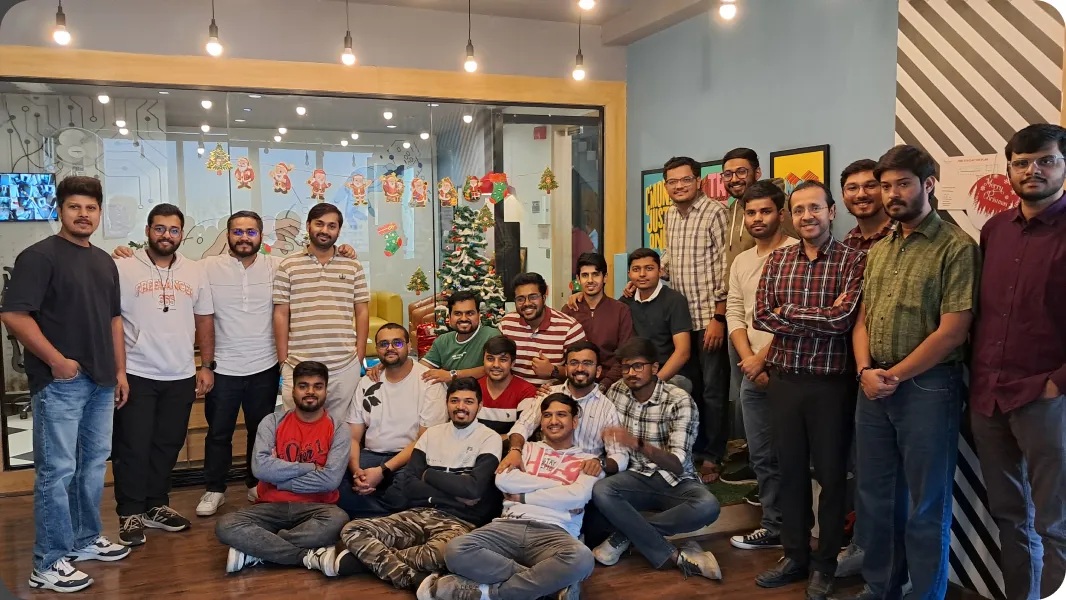
You are buying the conversations, too
The commercial arrangements reflect that role: end-to-end delivery, strategic engineering advice, time-and-material contracts, and combinations of those approaches. Engineers can also join a customer’s existing team. The practical buying decision is how much responsibility to share, how uncertain the requirements remain, and who owns the decisions between disciplines.
Compared with hiring separate specialists, a team covering firmware through applications offers a coordination argument. That is an interpretation of Infocusp’s scope, rather than proof of lower costs or better outcomes. An internal team or a narrowly specialized firm may suit a well-bounded task. Breadth earns its keep when the troublesome work sits between specialties.
“We listen more than we speak, staying open to feedback and learning.”Infocusp’s published cultural traits
Co-founders Nisarg Vyas and Urvik Patel are listed as executive directors. The careers site describes tailored learning and flexible hours; a public employee account describes monthly all-hands meetings with anonymous questions. Those practices are relevant to a business that depends on surfacing uncertainty across teams. They offer something more concrete than a claim to an innovative culture.

The company dates its start to 2009 and now reports more than 300 engineers. Its US presence connects it to customers in its primary market, while Ahmedabad and Pune provide engineering and delivery capacity. This arrangement makes communication part of the product-development process: overlapping hours, shared reviews, and clear ownership have to carry the work across geography.
Copy the discipline
The production-AI account supplies a practical starting point: measure cost per completed request, match model capability to the task, and preserve a path from an answer back to its inputs. The survey-analysis case study applies a related principle by mapping generated summaries to original responses. A researcher can inspect the connection.
A prospective customer can turn those lessons into a better brief. Bring a representative dataset, define an acceptable error, and identify the person who will use the output. Ask the engineering team to demonstrate how it investigates a wrong answer. That conversation reveals more about the proposed system than a polished response to a friendly prompt.
These choices depend on conditions. Retrieval needs relevant material. A cheaper model needs evaluation on the assigned task. Caching needs permission boundaries and fresh data. Code execution needs controls beyond a container. Infocusp’s most instructive material lives in these qualifications. The demo opens the conversation. The product begins when somebody asks what happens next.